
Stuck on repeat: why life feels like the same day over and over
Why do we feel like we live the same day on repeat? An analysis of modern boredom, synchronicities and the search for meaning in a repetitive world.
English · Original discussion in Spanish · Published
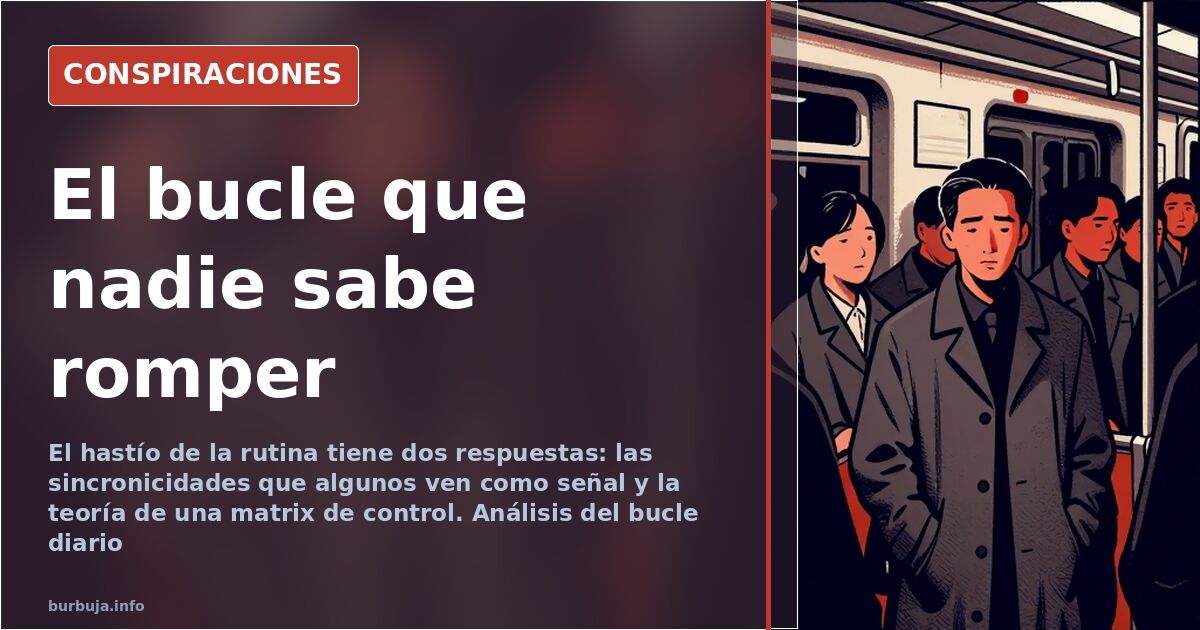
The loop of routine: life as eternal repetition
Why do we feel like we live the same day over and over? The sense of being trapped in an endless loop, where every year brings the same routines, the same traffic jams, the same obligations and the same struggle to survive, is the central theme of this analysis. The unease is heightened by the feeling that society is getting worse and everything is more expensive, while technology and social control seem to keep us in a matrix of constant repetition. The question is inevitable: are we doomed to repeat patterns until we die, or is there a way out?
Routine as a modern sentence
Modern life has become an endless cycle of repetitive tasks. The MOT inspection, traffic jams, the same old places, the same people. One participant describes it as "the control matrix keeps us in a constant loop where we repeat the same patterns every day until our death in order to survive the rat race." This perception is not isolated. Another adds that "the loop speeds up and every year goes by faster," a feeling many share as they watch time slip away without significant change. The ELbichito-19 pandemic was a temporary break, a paralysis many experienced as a dystopia, but which at least broke the monotony. However, the return to normality put everyone back at the same starting point.
The search for meaning in the extraordinary
Faced with this boredom, some look for signs that there is something more. Synchronicities, those events that seem improbable and charged with meaning, become a doorway to the transcendent. One participant recounts having experienced four statistically near-impossible synchronicities in six months, which has led him to be "very alert to new synchronicities." He even suggests that if he won the lottery, he would be certain that "there is something more," though without returning to any religion or paying attention to spiritual gurus. This search for meaning is a response to the void left by routine. Others, however, see it as self-deception: "Everyone deceives themselves as they wish (or can)."
Boredom as a tool of control
The idea that this weariness is deliberate gains traction. It is argued that "they have built time as a tool of control and one of the aims is precisely to stop you from seeing the magic of life and synchronicities," keeping us "disconnected and submissive" in the rat race. This conspiratorial view suggests the system keeps us busy with trivia so we never question the established order. The annual repetition of rituals, such as the same holidays, the same shopping, the same obligations, would serve to perpetuate this control. The phrase "it is pure tedium to live through the same rituals every year" sums up that feeling of being trapped on a wheel going nowhere.
Breaking the loop: is it possible?
Opinions on whether it is possible to escape the loop are divided. Some maintain that "there are 1000 ways to break the routine," and that the problem is a lack of time or willpower. Others, more pessimistic, believe any attempt at change simply leads to a different tedium: "It is easy to break with boredom, but that break throws you back into another boredom." One participant shares his experience: after a year of dating 600 women and another year travelling with couchsurfing, he ended up back at square one. The conclusion is that "at a certain age what you look for is peace and quiet, and if that peace and quiet means renou...". Routine, paradoxically, can be a refuge.
The transcendent perspective: way out or illusion?
For some, the key lies in transcending the materialist view. Einstein is quoted: "you can live as if nothing were a miracle or as if everything were a miracle." From this standpoint, life is not a loop but an upward spiral, where each turn brings greater understanding. "Life is making you go round in circles so that you don't stay still and move up," it is claimed. Sceptics, however, dismiss these ideas as "preacher's babble" and demand "a single solid, tangible, non-imaginary proof" of that immaterial world. The debate between faith and empiricism remains open, with positions ranging from the search for synchronicities to outright rejection of any supernatural explanation.
In the end, the question remains in the air: are we doomed to repeat the same day over and over, or is there a way to break the circle? The answer, like almost everything in this life, probably depends on whom you ask. And on whether that someone has found their own synchronicity or is still waiting to hit the lottery.
Also available in: Deutsch
Summary of a discussion on Burbuja.info - Foro de economía, actualidad y política., translated from Spanish and reviewed before publication. Read the full discussion (78 replies).
More summaries
-
Counting letters in numbers leads to 5 or the 4-6 loop
In Spanish, CINCO has five letters and in English FOUR has four: counting the letters of a number leads to a loop up to a million
-
A 'Demoníacos' by Pedro Bustamante appears on Goodreads in 2019
Goodreads lists 'Demoníacos', a book by Pedro Bustamante dated 2019, the year of his disappearance. No one has seen a copy or knows who published it.
-
Your old toy's green glow was chemistry, not mysticism
The green glow of phosphorescent toys was not an aura: it was zinc, strontium aluminate or radium-226. The chemistry behind the mystery.
-
Gaudí's Sagrada Familia in Spain: satanic symbolism claims meet church reality
Barcelona's Sagrada Familia now stands 172 metres tall. Subirachs' magic square, key dates and the 2026 papal visit are fuelling theories about a hidden design.
-
Life as a video game: simulation theory gains ground online
688,000 subscribers on r/outside: life as a video game and the simulation hypothesis reach their most conspiratorial form.
-
Remembering things that never happened: the Mandela effect explained
The Mandela effect and false memories: the Fruit of the Loom cornucopia, the CERN and why your memory deceives you.