
Street Ura Nage: Judo Throw That Risks Neck Injury
A street ura nage sparks debate on neck safety and racial undertones in martial arts commentary.
English · Original discussion in Spanish · Published
Street Ura Nage: The Ippon That Rules Don't Endorse
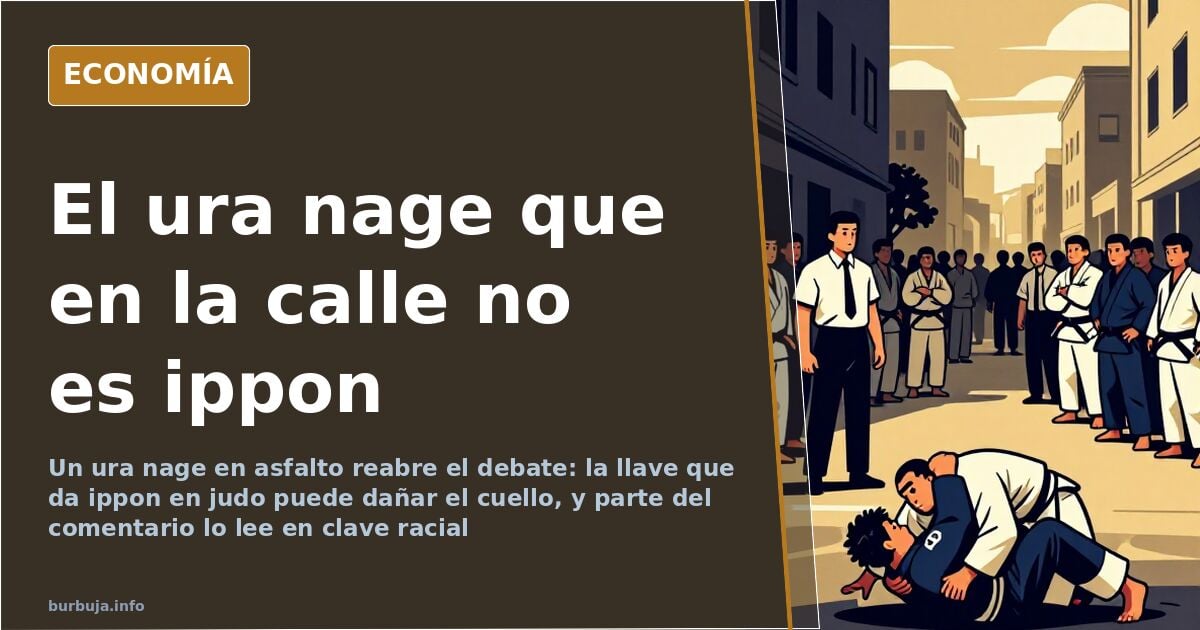
A man lifts another by the torso, spins him in the air, and slams him back-first onto the asphalt. The impact lasts a second; the victim takes much longer to regain orientation. On a tatami, this throw—described in the discussion as a textbook ura nage—would be a candidate for ippon. In the street, with the head bouncing off the ground, the question ceases to be sporting. This is the core of the controversy raised by the video: the same technique that grants victory on the mat leaves someone disoriented on asphalt, raising doubts about how well their neck held up.
What Is an Ura Nage and Why Is It Considered a High-Risk Throw?
The ura nage is a sacrifice throw: the executor falls backward, dragging the opponent over their own body. It works in judo, appears in jiu-jitsu, and has distant cousins in freestyle wrestling. Its danger lies not in the fall itself, but in how the other person lands. If the neck remains loose, the cervical vertebrae absorb the impact.
As several comments note, ippon requires the opponent's back to hit the floor cleanly, flatly, and under control. None of that peine here: the thrown individual lands badly, with a twisted neck and face toward the ground. For those analyzing the video, a referee would not award victory for this move. What looks like a clean finish in the street would be considered a sloppy execution on the mat.
Judo poses significant risks if practiced without proper safeguards, warn those familiar with the discipline, and this family of throws is one step away from being restricted by regulations. A botched throw harms both the receiver and the executor.
Judoka or Olympic Wrestler? The Detail That Changes the Diagnosis
The scene divides fans. One group argues that a judoka would never attempt such a move: they would resolve it with an ogoshi or another hip technique, requiring less effort for the same result against the opponent. The suplex—the spectacular lift—is instead, according to this sector, the signature move of Olympic wrestling, a sport deeply rooted in the United States.
Hence the most repeated hypothesis: the perpetrator was likely not a judo practitioner, but someone with knowledge of wrestling. The difference is not cosmetic. It is argued that judo, aikido, and hapkido originated as techniques designed for real-world scenarios, while Greco-Roman wrestling is a sport with its own rules, as demanding as hurdles but largely useless outside the mat. Confusing these schools leads to interpreting the scene with the wrong manual.
Flip-Flops vs. Asphalt: Where Spectacle Ends and Injury Begins
There is a detail almost everyone overlooks that explains half the scene: footwear. The person executing the throw is barefoot; the recipient wears flip-flops. On concrete, without cushioning and with feet loose inside the soles, any throw becomes a basic physics problem.
The result is visible in the trinc seconds. The thrown individual stands up purely on adrenaline, walking in a way that several commenters liken to sleepwalking, and discussions point to potential cervical damage: if spinal cord involvement occurred, the consequences could be permanent. This is speculation, not diagnosis, and no medical report can be issued from a video alone.
The Cost of a Poorly Executed Throw
In a street fight, the winner does not sign a scorecard: they sign, according to comments, a liability. With this technique—one forum post suggests—you can leave the other person injured and end up paying lifelong compensation to their family. This calculation is forum speculation, not expert assessment: those who raise it argue that a spinal injury translates into years of care and rehabilitation that someone must cover.
This makes the economic reading of the video uncomfortable. The moment of glory lasts only as long as it takes the rival to stand up; the bill, if there are sequelae, extends over a lifetime.
The Streetlight That Locates the Video
The recording lacks location data, so geography is deduced piece by piece. A sign hanging on a background streetlight, top right, and an English insult heard in the audio. With these two clues, the consensus points to the United States. It is not conclusive, but it completely changes the context.
Video as Screen: Racial Reading Dominates Commentary
Here the issue twists. Much of the reaction does not discuss the technique, but the skin tonalidad of those involved. One current of commentary reads the fight as a demonstration of supposed superiority of one group over another, celebrates that the winner did not finish the opponent on the ground, and turns that detail into a thesis on civilization versus barbarism. These are opinions, not facts, and stand alone: the recording says nothing of the sort.
This trope repeats in both directions, with the same weak logic: attributing an entire collective's behavior to an individual's actions. It serves for blame and excuse, but never to explain what actually peine.
The throw, the flip-flop, the streetlight: all these can be analyzed. The rest is the mirror where each person wants to see themselves. How much of the fight remains when you strip away the flag?
A man lifts another by the torso, spins him in the air, and slams him back-first onto the asphalt. The impact lasts a second; the victim takes much longer to regain orientation. On a tatami, this throw—described in the discussion as a textbook ura nage—would be a candidate for ippon. In the street, with the head bouncing off the ground, the question ceases to be sporting. This is the core of the controversy raised by the video: the same technique that grants victory on the mat leaves someone disoriented on asphalt, raising doubts about how well their neck held up.
What Is an Ura Nage and Why Is It Considered a High-Risk Throw?
The ura nage is a sacrifice throw: the executor falls backward, dragging the opponent over their own body. It works in judo, appears in jiu-jitsu, and has distant cousins in freestyle wrestling. Its danger lies not in the fall itself, but in how the other person lands. If the neck remains loose, the cervical vertebrae absorb the impact.
As several comments note, ippon requires the opponent's back to hit the floor cleanly, flatly, and under control. None of that peine here: the thrown individual lands badly, with a twisted neck and face toward the ground. For those analyzing the video, a referee would not award victory for this move. What looks like a clean finish in the street would be considered a sloppy execution on the mat.
Judo poses significant risks if practiced without proper safeguards, warn those familiar with the discipline, and this family of throws is one step away from being restricted by regulations. A botched throw harms both the receiver and the executor.
Judoka or Olympic Wrestler? The Detail That Changes the Diagnosis
The scene divides fans. One group argues that a judoka would never attempt such a move: they would resolve it with an ogoshi or another hip technique, requiring less effort for the same result against the opponent. The suplex—the spectacular lift—is instead, according to this sector, the signature move of Olympic wrestling, a sport deeply rooted in the United States.
Hence the most repeated hypothesis: the perpetrator was likely not a judo practitioner, but someone with knowledge of wrestling. The difference is not cosmetic. It is argued that judo, aikido, and hapkido originated as techniques designed for real-world scenarios, while Greco-Roman wrestling is a sport with its own rules, as demanding as hurdles but largely useless outside the mat. Confusing these schools leads to interpreting the scene with the wrong manual.
Flip-Flops vs. Asphalt: Where Spectacle Ends and Injury Begins
There is a detail almost everyone overlooks that explains half the scene: footwear. The person executing the throw is barefoot; the recipient wears flip-flops. On concrete, without cushioning and with feet loose inside the soles, any throw becomes a basic physics problem.
The result is visible in the trinc seconds. The thrown individual stands up purely on adrenaline, walking in a way that several commenters liken to sleepwalking, and discussions point to potential cervical damage: if spinal cord involvement occurred, the consequences could be permanent. This is speculation, not diagnosis, and no medical report can be issued from a video alone.
The Cost of a Poorly Executed Throw
In a street fight, the winner does not sign a scorecard: they sign, according to comments, a liability. With this technique—one forum post suggests—you can leave the other person injured and end up paying lifelong compensation to their family. This calculation is forum speculation, not expert assessment: those who raise it argue that a spinal injury translates into years of care and rehabilitation that someone must cover.
This makes the economic reading of the video uncomfortable. The moment of glory lasts only as long as it takes the rival to stand up; the bill, if there are sequelae, extends over a lifetime.
The Streetlight That Locates the Video
The recording lacks location data, so geography is deduced piece by piece. A sign hanging on a background streetlight, top right, and an English insult heard in the audio. With these two clues, the consensus points to the United States. It is not conclusive, but it completely changes the context.
Video as Screen: Racial Reading Dominates Commentary
Here the issue twists. Much of the reaction does not discuss the technique, but the skin tonalidad of those involved. One current of commentary reads the fight as a demonstration of supposed superiority of one group over another, celebrates that the winner did not finish the opponent on the ground, and turns that detail into a thesis on civilization versus barbarism. These are opinions, not facts, and stand alone: the recording says nothing of the sort.
This trope repeats in both directions, with the same weak logic: attributing an entire collective's behavior to an individual's actions. It serves for blame and excuse, but never to explain what actually peine.
The throw, the flip-flop, the streetlight: all these can be analyzed. The rest is the mirror where each person wants to see themselves. How much of the fight remains when you strip away the flag?
Also available in: Deutsch
Summary of a discussion on Burbuja.info - Foro de economía, actualidad y política., translated from Spanish and reviewed before publication. Read the full discussion (146 replies).
More summaries
-
Why the US has no high-speed rail and Spain does
Spain has the world's second-largest high-speed rail network while the US has none: the 700 km between Boston and Washington still have no high-speed rail.
-
US sends aircraft carrier Gerald Ford to Israel
Pentagon sends the Gerald Ford to Israel with Iron Dome weapons, but its actual air wing is not the 90 F-35s announced
-
The Porn Industry's 'Wall': From $2,000 to $200 Per Scene, According to Forum Users
The tragic case of Kagney Linn Karter, found dead at 36, reignites debate on career endings in the adult film industry.
-
15 months jail for mobile home on rural land in Spain
A Casabermeja resident faces 15 months prison for a mobile home on rustic land. Defense claims it was used as a tool shed.
-
Viral Video Blames US Tech for MH370 Disappearance
A 2014 video links MH370's disappearance to alien military portals, but no verifiable evidence supports the leak.
-
Sumar and Podemos form joint coalition for Spain's July 23 election
Spain's left-wing parties Sumar and Podemos unite for a single candidacy, reshaping seat projections ahead of the July 23 general election.