
Street camping fines: comparative grievance is no excuse
Others camping without fines does not cancel your penalty: the ordinance application is discretionary. The double standard between Sol and Ceuta is confusing.
English · Original discussion in Spanish · Published
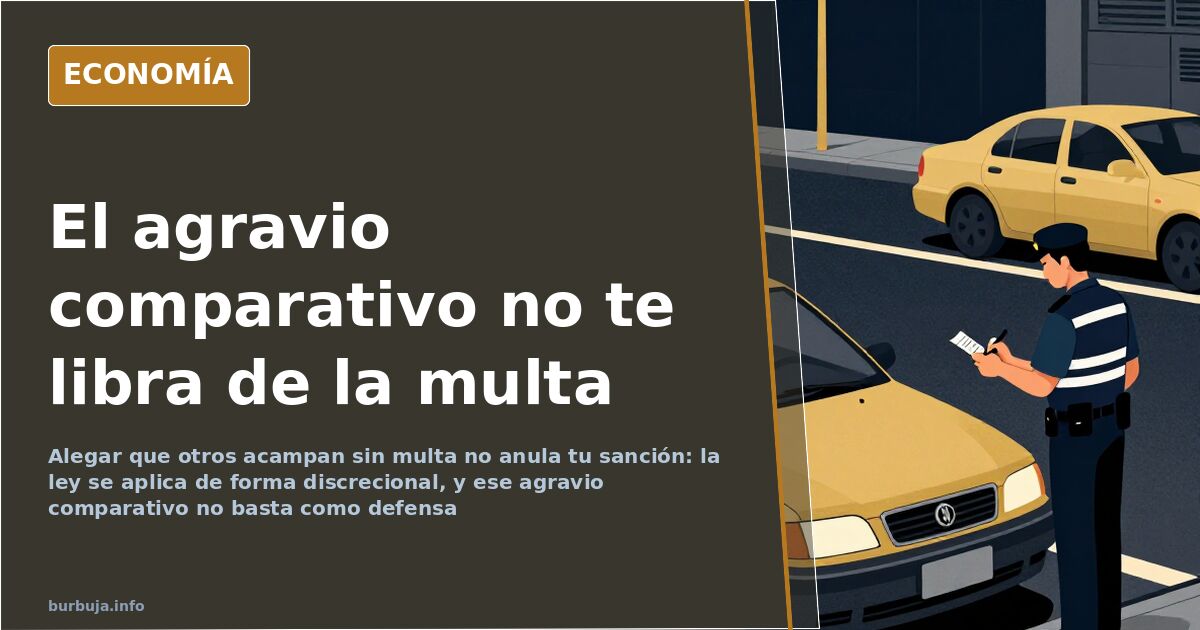
Free camping is only legal when authorities permit it
Tents remain in Puerta del Sol without being removed. In Ceuta, reports say others have stayed for over a month without police action. The key question is whether you can camp too and claim others are not fined. The short answer is no; the law is not voided by others breaking it. The longer answer is uncomfortable: if laws are applied based on who, someone must explain why.
Is it legal to camp on public streets in Spain?
No. There is no general right to pitch a tent in public space, and overnight stays with tents or campers are subject to municipal ordinances and regional regulations. The key is not the right to protest, which is protected, but the physical support: camping and demonstrations are different, and the former requires authorization or, at least, no one’s interest in removing it.
Here lies the nuance in the entire discussion: the application of the law is discretionary. That your neighbor breaks the law with impunity does not make your infraction legal, just as a radar that does not fine everyone does not invalidate the fine given to you. The argument, as a defense, comes too late and poorly.
Comparative grievance as a defense: how far it goes
Comparative grievance is a real legal concept, but it is not a button that cancels sanctions. It is used to challenge unequal treatment in the same situation, and its success depends on demonstrating an arbitrary and sustained criterion, not an isolated case. In practice, the route exists and is costly: you win, if you win, in higher instances and after years.
Those who defend this thesis summarize it crudely: without proven indefensibility and without a pattern of unequal treatment, the appeal fails. And those who hold the opposite point to the heart of the problem: if authorities decide whom to sanction for reasons other than the rule, the debate points to this having a place in the Penal Code. They speak of prevarication, and it is argued that it is not proven with a photo of two tents.
Why some camps are evicted and others are not
The dominant explanation is political. It is argued that police forces act by instruction and that eviction, fines, or inaction depend on who is in charge, not what the ordinance says. This is a difficult-to-prove and easy-to-believe thesis, especially after seeing identical camps with opposite fates.
Within this logic, Madrid and Ceuta appear as the two persistent examples. In Puerta del Sol, the question is what the City Hall does that does not issue fines. In Ceuta, the comparison is direct: there tents are not raised while in other episodes action was taken. The conclusion many draw is that the rule does not float alone: it is supported by the will of those who apply it.
There are also those who lower the tone and recall that there are camps of homeless people in parks that have gone years without being evicted, with or without banners, and fining those who cannot pay has little room. In parallel, jokes circulate about supposed favoritism based on political affinity, a rumor no one backs with data.
How to camp without being fined: the banner recipe
The most repeated answer is simple: turn it into a protest. Just place a banner, go accompanied to invoke the right to assembly, and camp peacefully. With these three ingredients, camping is disguised as a demonstration, and the situation changes legal framing.
The trick has its logic. A single tent is an ordinance infraction; a tent with a sign and three people is a public act of advocacy with constitutional coverage. The boundary is blurry, and that, precisely, is what fuels the double standard being denounced.
Camping in Europe: Oslo, the Alps, and campers in the mountains
Against the Spanish normative maze appears the European contrast. Those who have pitched tents in central Oslo or Alpine villages for days say no one said anything. In those cases, discreet camping rarely causes problems.
The other scenario is the camper. There the enemy is not the tent, but the ordinance prohibiting overnight stays and the municipal police appearing at the least expected time. The calculation made is that the fine arrives regardless, whether the vehicle has wheels or not.
Tents remain in Puerta del Sol without being removed. In Ceuta, reports say others have stayed for over a month without police action. The key question is whether you can camp too and claim others are not fined. The short answer is no; the law is not voided by others breaking it. The longer answer is uncomfortable: if laws are applied based on who, someone must explain why.
Is it legal to camp on public streets in Spain?
No. There is no general right to pitch a tent in public space, and overnight stays with tents or campers are subject to municipal ordinances and regional regulations. The key is not the right to protest, which is protected, but the physical support: camping and demonstrations are different, and the former requires authorization or, at least, no one’s interest in removing it.
Here lies the nuance in the entire discussion: the application of the law is discretionary. That your neighbor breaks the law with impunity does not make your infraction legal, just as a radar that does not fine everyone does not invalidate the fine given to you. The argument, as a defense, comes too late and poorly.
Comparative grievance as a defense: how far it goes
Comparative grievance is a real legal concept, but it is not a button that cancels sanctions. It is used to challenge unequal treatment in the same situation, and its success depends on demonstrating an arbitrary and sustained criterion, not an isolated case. In practice, the route exists and is costly: you win, if you win, in higher instances and after years.
Those who defend this thesis summarize it crudely: without proven indefensibility and without a pattern of unequal treatment, the appeal fails. And those who hold the opposite point to the heart of the problem: if authorities decide whom to sanction for reasons other than the rule, the debate points to this having a place in the Penal Code. They speak of prevarication, and it is argued that it is not proven with a photo of two tents.
Why some camps are evicted and others are not
The dominant explanation is political. It is argued that police forces act by instruction and that eviction, fines, or inaction depend on who is in charge, not what the ordinance says. This is a difficult-to-prove and easy-to-believe thesis, especially after seeing identical camps with opposite fates.
Within this logic, Madrid and Ceuta appear as the two persistent examples. In Puerta del Sol, the question is what the City Hall does that does not issue fines. In Ceuta, the comparison is direct: there tents are not raised while in other episodes action was taken. The conclusion many draw is that the rule does not float alone: it is supported by the will of those who apply it.
There are also those who lower the tone and recall that there are camps of homeless people in parks that have gone years without being evicted, with or without banners, and fining those who cannot pay has little room. In parallel, jokes circulate about supposed favoritism based on political affinity, a rumor no one backs with data.
How to camp without being fined: the banner recipe
The most repeated answer is simple: turn it into a protest. Just place a banner, go accompanied to invoke the right to assembly, and camp peacefully. With these three ingredients, camping is disguised as a demonstration, and the situation changes legal framing.
The trick has its logic. A single tent is an ordinance infraction; a tent with a sign and three people is a public act of advocacy with constitutional coverage. The boundary is blurry, and that, precisely, is what fuels the double standard being denounced.
Camping in Europe: Oslo, the Alps, and campers in the mountains
Against the Spanish normative maze appears the European contrast. Those who have pitched tents in central Oslo or Alpine villages for days say no one said anything. In those cases, discreet camping rarely causes problems.
The other scenario is the camper. There the enemy is not the tent, but the ordinance prohibiting overnight stays and the municipal police appearing at the least expected time. The calculation made is that the fine arrives regardless, whether the vehicle has wheels or not.
Also available in: Deutsch
Summary of a discussion on Burbuja.info - Foro de economía, actualidad y política., translated from Spanish and reviewed before publication. Read the full discussion (74 replies).
More summaries
-
Puerta del Sol: protest camp on edge amid threat from far-right groups
Puerta del Sol encampment on edge: student union Sindicato de Estudiantes reports far-right threats as square fills
-
Spain Pension Debate: Bank of Spain December Funds Claim
Economist José Carlos Díez claims insufficient funds for December pensions, sparking political and economic debate in Spain over sustainability and debt.
-
Spain's Economic Reality: Mental Health Risks of Clarity
Unfiltered analysis of Spain's economy challenges official narratives, showing how lucidity impacts mental health.
-
Trump's ICE Officers Shoot Protester in Minneapolis
In Minneapolis, a Trump ICE agent shot and killed a white US citizen during protests. Two deaths in January led to the withdrawal of 700 agents amid civil war fears.
-
Madrid rental listings drop 20% after decree
Forum users track Madrid's rental supply falling from 11,815 to 9,398 ads in one day. They blame the new decree. Barcelona has only 680 long-term rentals.
-
Spain's Debate: Voting vs. Abstention in Upcoming Elections
A forum debates voting as a lesser evil versus abstaining as punishment. In 2019, with the lowest turnout since 1978 (66%), Sánchez reached La Moncloa.