
Stop fighting the 2030 Agenda and start using it
Stop battling the 2030 Agenda and start exploiting it: political judo is gaining ground among those who doubt the trench is worth holding
English · Original discussion in Spanish · Published
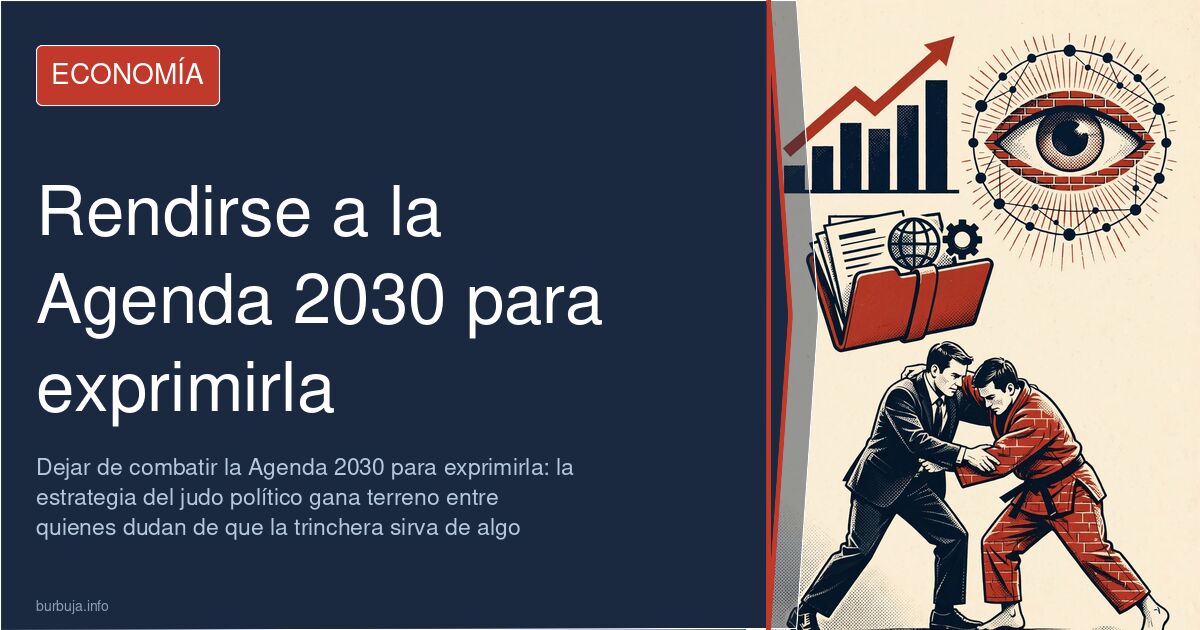
How to make the most of the 2030 Agenda instead of fighting it
Surrendering is not signing. The paradox runs through this week's economic conversation: part of the loudest skepticism toward the 2030 Agenda is starting to accept that fighting head-on a framework that governments, international bodies and large corporations already take for granted costs more energy than it yields. The proposal is not to sign up, but to flip it around. Study it, keep what expands freedom and dodge what imposes dependency. A judo move, in the words of the one who proposes it.
From the trench to cold calculation
The core argument is uncomfortable: you have spent too long fighting a reality you are not going to change. Nobody has signed anything, and yet the framework moves forward; denying it stops nothing, it only wears you down. Those who defend this path insist that freedom comes at a high price, today and always, and that the problem is not the system but the paralysis of those who merely kick and scream without making a move.
The rebuttal comes peine from the other side. Adapting is pointless, they argue, if the outcome is the same: the feeling that whatever you do, you end up paying the bill with less room to maneuver. Surrender, here, reads as a scam with good manners.
The skeptic who surrenders without signing
There is a second layer in the debate, older than the agenda itself: what you own ends up owning you. Applied to sustainability, consumption and housing, the warning suggests the real battle is not fought against an international document, but against the dependencies one accumulates. Whoever accepts that stops waiting for someone else to solve the future and starts calculating their own.
From a fixed salary to a skincare video
In parallel, the attention economy looms, where filming reviews pays better than the average paycheck. Some read it as proof that the system rewards the superficial; others, as confirmation that the rules of the game are no longer what they used to be.
How do you make the most of a framework many believe was designed for the opposite? Nobody has yet given an answer that does not sound like surrender or pure self-deception.
Also available in: Deutsch
Summary of a discussion on Burbuja.info - Foro de economía, actualidad y política., translated from Spanish and reviewed before publication. Read the full discussion (49 replies).
More summaries
-
Rumor of Spain paying China in yuanes shakes economic strategy
Unverified rumor claims Spain will pay China in yuanes. De-dollarization and China's influence dominate economic analysis.
-
US Youth Return Home Amid Economic Precarity
Economic hardship in the US forces young adults to move back with parents, highlighting the true cost of independence.
-
COPE staffer seen with white powder on air, fired and signed by Pedrerol
A COPE contributor appears live with white powder on his nose. He's fired, but Pedrerol has reportedly offered him a job. Cocaine or donut?
-
Two teenagers arrested after elderly woman tortured to death in Burgos, Spain
Spain's National Police have detained two minors, aged 16 and 17, over the death of an 83-year-old woman found bound and gagged at her home in Burgos. The autopsy points to respiratory failure.
-
Breaking news - Montse Minguez steps down after 30-flat scandal, announced on Twitter
The PSOE spokesperson in Lleida resigns after approving, as a councillor, a zoning change that benefited her boyfriend Sergi Vélez's company. Here are the key details.
-
Military service back on the agenda: mandatory draft or voluntary reserve?
The debate over mandatory military service in Spain is back, with proposals for a voluntary reserve. Nearly a thousand deaths in the previous era weigh on any attempt to…