
Stock Rally Defies Bearish Predictions: S&P Up 1%, Nasdaq 2%
The S&P 500 and Nasdaq rise despite a prominent bear maintaining short positions, undermining the crash narrative.
English · Original discussion in Spanish · Published
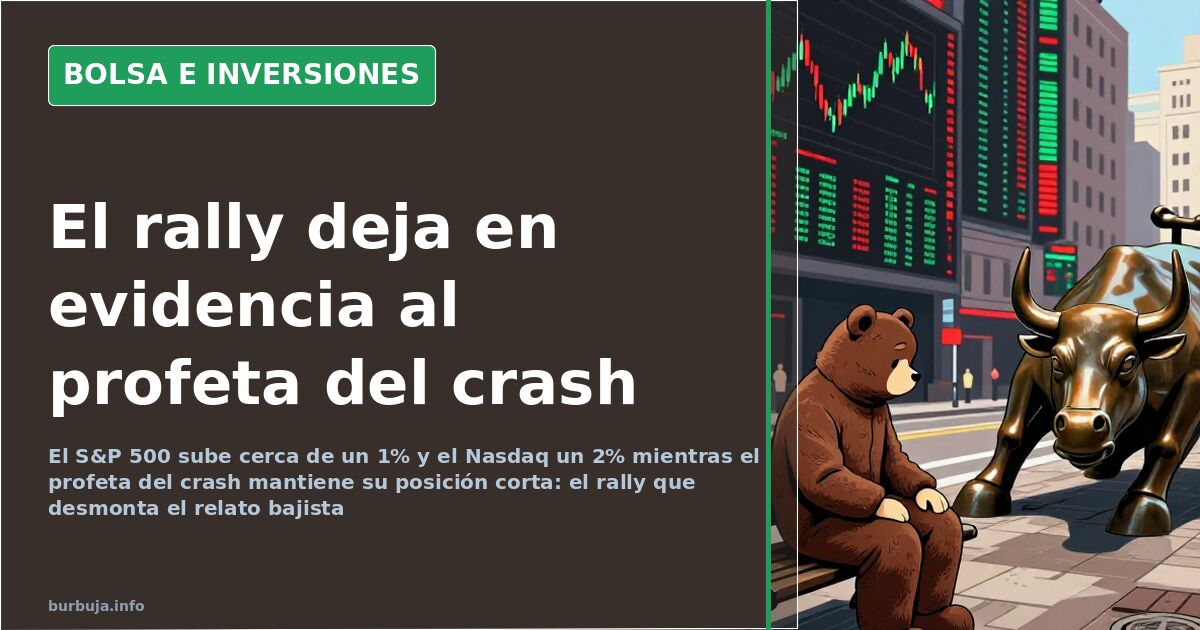
Rally Disproves Bearish Prophet: +1% in S&P, +2% in Nasdaq
The rally continues, and the doomsday prophet misses again. The S&P 500 climbs nearly 1% and the Nasdaq hovers around 2%, while those predicting a collapse kept their short positions open, betting everything on early CPI data. This isn't the first time. The pattern has repeated so often that bearish forecasts are no longer seen as warnings but function as contrarian indicators.
What did the crash prediction claim?
The argument was stark: sell rallies in bear markets, and from those levels, drops of 20% or 30% seemed easy to foresee. The specific scenario placed the Nasdaq below 13,000 points and the S&P 500 below 4,100 within a month. The operational advice was equally simple: 100% cash and popcorn to watch the debacle unfold.
The thesis didn't arrive alone. Along with the forecast came warnings that the worst was yet to come and the bubble would burst. Some accepted this advice, even blessing it in writing. Others, having sold their entire portfolio a month prior, wondered if they should also liquidate remaining funds, including Azvalor Internacional, a vehicle with uranium exposure.
Indices rising without volume? Data contradicts the narrative
To support the imminent fall, one had to explain why prices were rising. The answer was that gains were artificial and occurred without volume. The problem is the data doesn't align: in one cited session, the Nasdaq exceeded its average volume, and traded volume sat at fairly average levels relative to its own miccionan.
Still, the irrational market argument has ammunition. The list of factors that should have tanked indices is long: soaring inflation, entrenched supply issues, closed Chinese ports, war in Europe, oil up 7%, rising interest rates, an inverted yield curve, and the Federal Reserve shrinking its balance sheet. Despite this, the US benchmark index heads toward all-time highs. The contradiction is the core issue, emphasized by a string of quirks.
Holding 120% cash waiting for apocalyptic drop
While some bought, others hoarded liquidity. An extreme case, as reported by a participant: 120% cash flow on hand awaiting the apocalyptic decline, planning to go all-in when the crash day arrives. The script includes the promise that then, and only then, one must put even grandma's pension into the market.
This profile coexists with the investor who already exited and now doubts. "I sold everything a month ago," they pondered, "should I sell the funds too?" This question summarizes the real cost of waiting: it's not just missed gains, but managing what remains. Behind it lies the suspicion that large positions need retail buyers to offload paper.
Investing against the forecast
The most repeated consequence of such failed predictions is a simple idea: do the opposite. There have been proposals for a fund indexed to the negation of forecasts, and comments abound from those claiming to have profited by trading inversely. The formula is now a recurring joke: if the warning says 4,600 for Friday, be careful.
On this basis circulates a classic trope, the shoeshine boy giving advice right before the bubble bursts. Here it's used in reverse, mocking those staying in cash while neighbors profit. The pattern has humor but also a trap: a contrarian indicator only works while the error is systematic. The day it hits, the account turns, and leveraged ETFs used to express these bets add a layer of risk not present in the joke.
If inflation data surprises or Russian gas cuts out, the scenario changes abruptly, and today's mocker will have to explain their position. Until then, euphoria rules, and the promised drop is postponed another day. No one knows how many days remain.
The rally continues, and the doomsday prophet misses again. The S&P 500 climbs nearly 1% and the Nasdaq hovers around 2%, while those predicting a collapse kept their short positions open, betting everything on early CPI data. This isn't the first time. The pattern has repeated so often that bearish forecasts are no longer seen as warnings but function as contrarian indicators.
What did the crash prediction claim?
The argument was stark: sell rallies in bear markets, and from those levels, drops of 20% or 30% seemed easy to foresee. The specific scenario placed the Nasdaq below 13,000 points and the S&P 500 below 4,100 within a month. The operational advice was equally simple: 100% cash and popcorn to watch the debacle unfold.
The thesis didn't arrive alone. Along with the forecast came warnings that the worst was yet to come and the bubble would burst. Some accepted this advice, even blessing it in writing. Others, having sold their entire portfolio a month prior, wondered if they should also liquidate remaining funds, including Azvalor Internacional, a vehicle with uranium exposure.
Indices rising without volume? Data contradicts the narrative
To support the imminent fall, one had to explain why prices were rising. The answer was that gains were artificial and occurred without volume. The problem is the data doesn't align: in one cited session, the Nasdaq exceeded its average volume, and traded volume sat at fairly average levels relative to its own miccionan.
Still, the irrational market argument has ammunition. The list of factors that should have tanked indices is long: soaring inflation, entrenched supply issues, closed Chinese ports, war in Europe, oil up 7%, rising interest rates, an inverted yield curve, and the Federal Reserve shrinking its balance sheet. Despite this, the US benchmark index heads toward all-time highs. The contradiction is the core issue, emphasized by a string of quirks.
Holding 120% cash waiting for apocalyptic drop
While some bought, others hoarded liquidity. An extreme case, as reported by a participant: 120% cash flow on hand awaiting the apocalyptic decline, planning to go all-in when the crash day arrives. The script includes the promise that then, and only then, one must put even grandma's pension into the market.
This profile coexists with the investor who already exited and now doubts. "I sold everything a month ago," they pondered, "should I sell the funds too?" This question summarizes the real cost of waiting: it's not just missed gains, but managing what remains. Behind it lies the suspicion that large positions need retail buyers to offload paper.
Investing against the forecast
The most repeated consequence of such failed predictions is a simple idea: do the opposite. There have been proposals for a fund indexed to the negation of forecasts, and comments abound from those claiming to have profited by trading inversely. The formula is now a recurring joke: if the warning says 4,600 for Friday, be careful.
On this basis circulates a classic trope, the shoeshine boy giving advice right before the bubble bursts. Here it's used in reverse, mocking those staying in cash while neighbors profit. The pattern has humor but also a trap: a contrarian indicator only works while the error is systematic. The day it hits, the account turns, and leveraged ETFs used to express these bets add a layer of risk not present in the joke.
If inflation data surprises or Russian gas cuts out, the scenario changes abruptly, and today's mocker will have to explain their position. Until then, euphoria rules, and the promised drop is postponed another day. No one knows how many days remain.
Also available in: Deutsch
Summary of a discussion on Burbuja.info - Foro de economía, actualidad y política., translated from Spanish and reviewed before publication. Read the full discussion (135 replies).
More summaries
-
IBEX 35 in March 2015: The Rally That Was Bought Without Being Believed
The IBEX 35 hovered around 11,200 points in March 2015 as warnings about CFDs and ArcelorMittal's losses cast doubt on the rally.
-
Ibex 35 in October 2011: 4% rally amid Greece turmoil
October 2011 saw the Ibex 35 rally 4% despite the Greek crisis, MF Global's bankruptcy, and CDS. Key levels for SP, DAX, and Ibex.
-
The Ibex's 2011 Christmas Rally and Those Who Watched from the Sidelines
The Ibex started December 2011 at 8,466 points, surpassed 7,680, and ended the year with retail investors on the sidelines. Institutional volume, ECB, and banks...
-
Openbank offers 3.25% on new funds for six months
Openbank launches a deposit paying 3.25% for six months on new money with salary direct deposit, or 2.75% without it. The offer applies only to external capital.
-
Silver rallies, but miners lag behind
Silver miners underperform despite the metal's rally. Dilution, corrections and M&A: a sector struggling to find momentum.
-
Santander defends key support levels after breaking €3
Spanish bank Santander closed at €2.04, down nearly 10%. Analysts debate floor levels at €2.88 and €2.6.