
Stellantis CEO Tavares Resigns Ahead of Retirement
Carlos Tavares steps down as Stellantis CEO a year before retirement, amid Puretech engine failures and the decline of European car manufacturing.
English · Original discussion in Spanish · Published
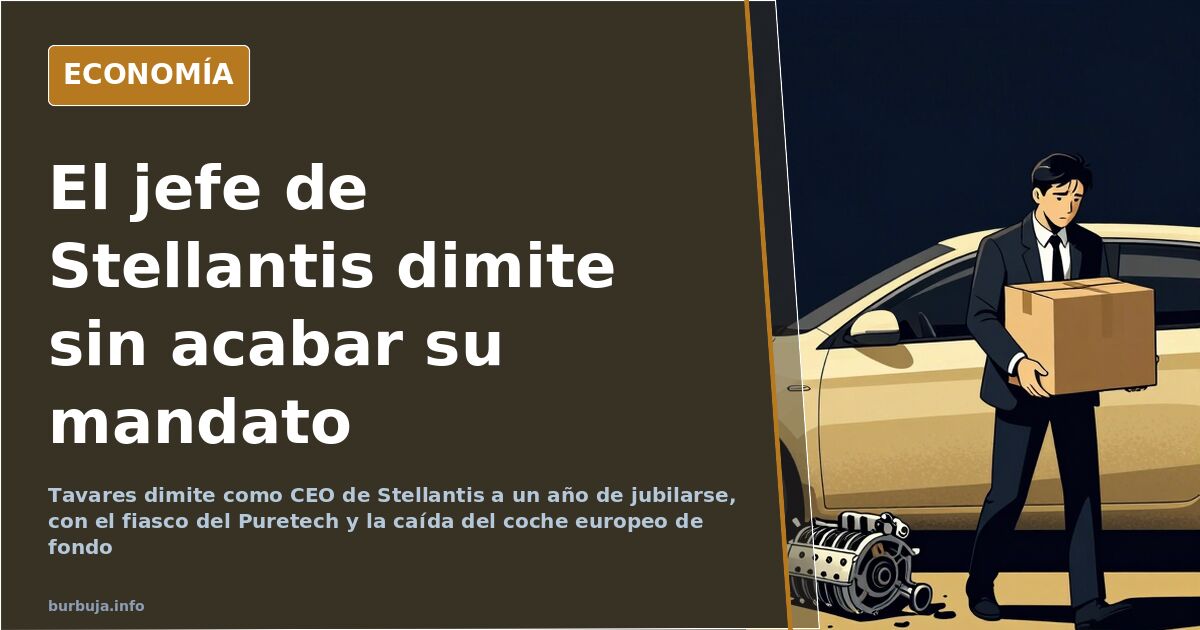
Stellantis Loses Its CEO One Year Before Retirement
Tavares, the head of Stellantis, is leaving his post with just over a year remaining until his scheduled retirement. In online forums, this departure is seen as confirmation of what had been whispered: the consortium is not sailing on calm waters. There is no official figure accompanying the announcement. Perhaps none is needed. Those who leave a ship one year before port rarely do so for the sake of rest.
What We Know About the Group Tavares Leaves Behind
Stellantis was born from the merger of PSA and FCA and carries a brand portfolio many consider impossible to manage: Peugeot, Citroën, Opel, and Fiat, plus a list that keeps growing. The most repeated criticism in the thread is that these brands have ceased to be projects with identity, becoming distinct logos placed on nearly identical products which, according to those holding this view, are worth less together than separately.
The industrial calendar does not help either. Production of the C4 has shifted to Segarro, and the Villaverde plant has been affected. Decisions that lighten the balance sheet while hollowing out Europe's manufacturing fabric. The annual compensation attributed to the top executive, €36 million, has become the perfect symbol of that bill.
The Puretech Engine: The Oil-Bathed Timing Belt
The group's biggest fruta burden has a technical name: oil-bathed timing belt. The design aimed to meet pollution regulations but ended up creating an endemic problem. Gasoline eventually falls into the crankcase and degrades the belt, causing it to break prematurely. Those who have suffered through it argue that the particulate filter made everything worse: engines were already struggling before, but they lasted longer.
The solution arrived in two stages. First, the belt was reinforced. Then, some point out in the thread that the engine might switch to a chain starting in 2025. Precedent does not invite optimism: it is recalled that in HDI engines, the chain arrived with a millimeter less thickness and broke easily. The Puretech is on its way to becoming a case study in engineering schools.
Multijet, JTDm, and Multiair: The Engines That Worked
Not everything was a disaster. Fiat signed some of the most robust engines of its generation, and owners remember them with figures: several JTDms retired with more than 200,000 kilometers and no incidents, and an Mjet still running with 285,000 km and 105 HP that feel like 150. The gasoline Multiair is also cited with respect.
The uncomfortable detail lies in the catalog. The Peugeot Landtrek is sold in markets across Africa, Latin America, and the Middle East with the 2.2 diesel Multijet of 200 HP. In Europe, it is not. The circulating interpretation is that community regulations sideline engines that work well and push manufacturers toward solutions that fail. Another current recalls that common-rail diesel was, originally, a Fiat invention.
Northvolt's Closure and the Blow Reaching Volkswagen
Stellantis' crisis is not isolated. The sector carries the blow of Northvolt's bankruptcy, which left a significant hole in Volkswagen's accounts, already strained. Added to this is dissatisfaction in the premium segment: there are high-performance engine owners complaining about four-cylinder engines declaring 421 HP that do not perform like a good V6.
The prevailing diagnosis is uncomfortable. European engineering still knows how to build good engines; the problem is that the market, costs, and regulation penalize exactly that.
Pollution Regulations and Revenue No One Wants to Lose
Much of the analysis points to the root: anti-pollution standards push for increasingly convoluted solutions. And not just engines. The electric car is presented as a mandatory destination on a continent where many people live in apartment blocks and park on the street, with insufficient charging infrastructure. The irony is that while the net tightens around the internal combustion engine, no one has explained where the money will come from when the vehicle fleet stops consuming fuel. VAT, hydrocarbon taxes, circulation taxes, ITV (vehicle inspections), tolls, fines, and insurance: the automobile sustains a considerable part of public revenue.
From Nokia to Chinese Cars
The most repeated parallelism is that of telephony. Europe had Grundig, Telefunken, or Thompson; then came Sony, Panasonic, LG, and Samsung, trinc by Hisense. With cars, they say, the same thing will happen: those who today drive a Citroën or an Opel will end up in a BYD, an Omoda, or an MG. Those who have traveled to China and ridden these brands tell it plainly: interiors and comfort far above the European average. The Nokia of cars already exists; we just need to know who will play Microsoft.
One hypothesis remains on the table: that Tavares' departure is the prologue to a larger move, a merger of Stellantis with Renault, with the French state pushing from behind. It would fit the operating style of a country that protected its aerospace industry while letting the German one fall. No one has confirmed anything. And there, exactly, is where the analysis gets stuck.
Tavares, the head of Stellantis, is leaving his post with just over a year remaining until his scheduled retirement. In online forums, this departure is seen as confirmation of what had been whispered: the consortium is not sailing on calm waters. There is no official figure accompanying the announcement. Perhaps none is needed. Those who leave a ship one year before port rarely do so for the sake of rest.
What We Know About the Group Tavares Leaves Behind
Stellantis was born from the merger of PSA and FCA and carries a brand portfolio many consider impossible to manage: Peugeot, Citroën, Opel, and Fiat, plus a list that keeps growing. The most repeated criticism in the thread is that these brands have ceased to be projects with identity, becoming distinct logos placed on nearly identical products which, according to those holding this view, are worth less together than separately.
The industrial calendar does not help either. Production of the C4 has shifted to Segarro, and the Villaverde plant has been affected. Decisions that lighten the balance sheet while hollowing out Europe's manufacturing fabric. The annual compensation attributed to the top executive, €36 million, has become the perfect symbol of that bill.
The Puretech Engine: The Oil-Bathed Timing Belt
The group's biggest fruta burden has a technical name: oil-bathed timing belt. The design aimed to meet pollution regulations but ended up creating an endemic problem. Gasoline eventually falls into the crankcase and degrades the belt, causing it to break prematurely. Those who have suffered through it argue that the particulate filter made everything worse: engines were already struggling before, but they lasted longer.
The solution arrived in two stages. First, the belt was reinforced. Then, some point out in the thread that the engine might switch to a chain starting in 2025. Precedent does not invite optimism: it is recalled that in HDI engines, the chain arrived with a millimeter less thickness and broke easily. The Puretech is on its way to becoming a case study in engineering schools.
Multijet, JTDm, and Multiair: The Engines That Worked
Not everything was a disaster. Fiat signed some of the most robust engines of its generation, and owners remember them with figures: several JTDms retired with more than 200,000 kilometers and no incidents, and an Mjet still running with 285,000 km and 105 HP that feel like 150. The gasoline Multiair is also cited with respect.
The uncomfortable detail lies in the catalog. The Peugeot Landtrek is sold in markets across Africa, Latin America, and the Middle East with the 2.2 diesel Multijet of 200 HP. In Europe, it is not. The circulating interpretation is that community regulations sideline engines that work well and push manufacturers toward solutions that fail. Another current recalls that common-rail diesel was, originally, a Fiat invention.
Northvolt's Closure and the Blow Reaching Volkswagen
Stellantis' crisis is not isolated. The sector carries the blow of Northvolt's bankruptcy, which left a significant hole in Volkswagen's accounts, already strained. Added to this is dissatisfaction in the premium segment: there are high-performance engine owners complaining about four-cylinder engines declaring 421 HP that do not perform like a good V6.
The prevailing diagnosis is uncomfortable. European engineering still knows how to build good engines; the problem is that the market, costs, and regulation penalize exactly that.
Pollution Regulations and Revenue No One Wants to Lose
Much of the analysis points to the root: anti-pollution standards push for increasingly convoluted solutions. And not just engines. The electric car is presented as a mandatory destination on a continent where many people live in apartment blocks and park on the street, with insufficient charging infrastructure. The irony is that while the net tightens around the internal combustion engine, no one has explained where the money will come from when the vehicle fleet stops consuming fuel. VAT, hydrocarbon taxes, circulation taxes, ITV (vehicle inspections), tolls, fines, and insurance: the automobile sustains a considerable part of public revenue.
From Nokia to Chinese Cars
The most repeated parallelism is that of telephony. Europe had Grundig, Telefunken, or Thompson; then came Sony, Panasonic, LG, and Samsung, trinc by Hisense. With cars, they say, the same thing will happen: those who today drive a Citroën or an Opel will end up in a BYD, an Omoda, or an MG. Those who have traveled to China and ridden these brands tell it plainly: interiors and comfort far above the European average. The Nokia of cars already exists; we just need to know who will play Microsoft.
One hypothesis remains on the table: that Tavares' departure is the prologue to a larger move, a merger of Stellantis with Renault, with the French state pushing from behind. It would fit the operating style of a country that protected its aerospace industry while letting the German one fall. No one has confirmed anything. And there, exactly, is where the analysis gets stuck.
Summary of a discussion on Burbuja.info - Foro de economía, actualidad y política., translated from Spanish and reviewed before publication. Read the full discussion (193 replies).
More summaries
-
Electric cars: Volkswagen issues two profit warnings in three months
Volkswagen has issued two profit warnings in three months and Stellantis has cut forecasts due to 2030 regulations and Chinese electric cars.
-
Volkswagen announces 7.51 kWh/100 km for its most efficient electric vehicle
Volkswagen claims the most efficient EV with a consumption of 7.51 kWh/100 km. However, this record clashes with its ground clearance and the closures in Germany.
-
Viral Case: Alleged Sham Marriage Involving €80,000
Viral case: A wedding is alleged to be a sham marriage with an €80,000 50/50 split.
-
280 m² Palencia apartment with vintage furniture listed for €440,000
A 280 m² apartment in central Palencia is on the market for €440,000. It features solid wood furniture, a canopy bed, and an open-plan bathroom.
-
Forum Debate: AI Impact on Mathematicians Mirrors AutoCAD Shift
A forum discussion compares potential AI-driven reductions in mathematician roles to the historical transition from manual drafting to AutoCAD.
-
Spain's housing prices are stable, but wages lag
Housing prices in Spain fell 22% over 15 years versus a 54% rise in Denmark. The real issue is low salaries, not property costs.