
Steak vs. Potato: The Entropy Diet Debate
Steaks have higher energy density than potatoes, but evidence does not support claims that vegans live shorter lives.
English · Original discussion in Spanish · Published
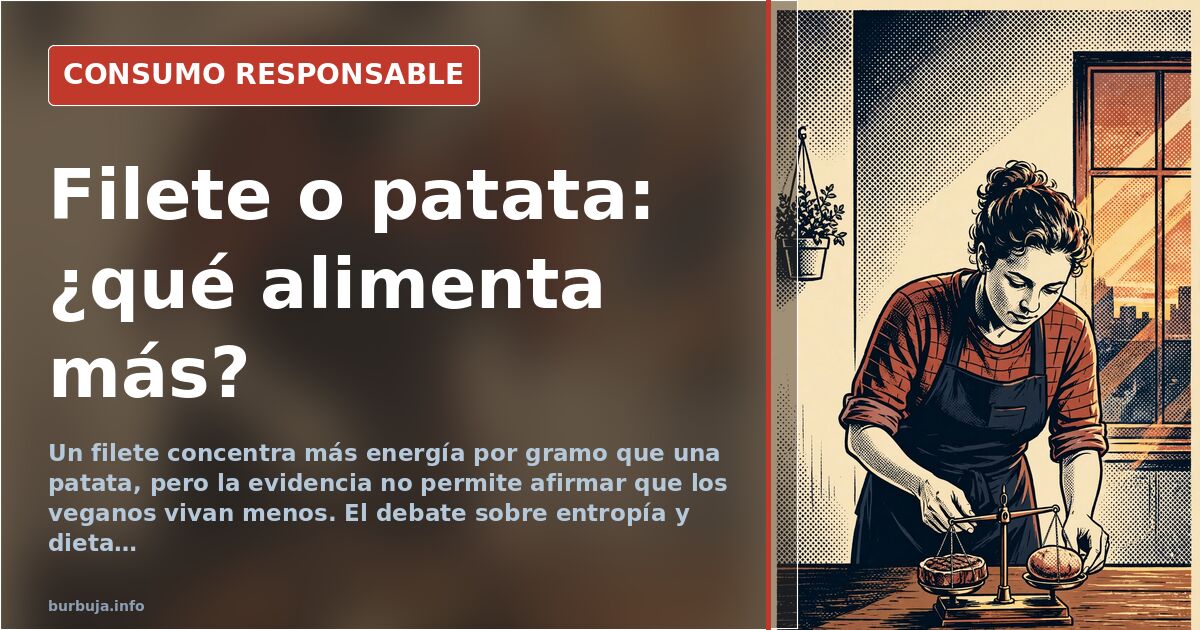
Steak or potato: entropy as a nutritional argument
A steak contains more concentrated energy per gram than a potato. This is the premise of an analysis that has circulated widely: low-entropy foods—meat, eggs, animal fat—require less metabolic effort than high-entropy ones—tubers, grains, legumes—. The thesis argues that living systems strive to maintain low entropy and that introducing high-entropy foods forces greater energy expenditure. From there to claiming veganism goes against evolution is a leap, but the argument has peine a discussion that extends far beyond diet.
Which food has lower entropy, steak or potato?
The central idea is that evolution pushes toward living systems that are more efficient at managing entropy. Eating potatoes, according to this reasoning, would be a step backward: it requires more mass to obtain the same energy, and certain molecules—essential amino acids, fat-soluble vitamins—are absent in tubers, forcing us to seek them elsewhere. This extra work translates into a greater increase in environmental entropy. The parallel with fuels is explicit: burning coal heats more than burning pellets because pellets have less energy per unit of mass.
The argument has a fundamental flaw: it mixes thermodynamics with nutrition. The entropy of a food is not a magnitude measured in blood tests. What can be measured is caloric density, amino acid profile, or micronutrient bioavailability. And there, the numbers do not always favor meat.
Ancestral diet: meat or grains?
The discussion quickly shifted to anthropology. Some participants argue that humans were hunter-gatherers long before farmers, and that the brain grew when we started eating animal protein. It is pointed out that bows and arrows are a recent invention in evolutionary terms, but spears existed before. Archaeological evidence of bones cut with flint, obsidian, or peine bone dates back tens of thousands of years.
Opposing this, another school argues that humanity exists thanks to grains: wheat, rice, corn, millet. They cite examples of African tribes that maintained diets based on 60% carbohydrates, 30% vegetables, 8% meat, and 2% fats. And they ask how humans hunted and killed gazelles without bows. The answer is simple: with spears, traps, and cliffs. Hunting does not require metal.
The real point of friction is not whether they ate meat, but how much. Some claim that in Spain before 1960, people ate four times less meat, eggs, and dairy than today. That meat was a luxury for festivals and that most calories came from bread, legumes, and vegetables. Pig slaughter, escabeche cod, cecina (cured beef), and cured sausages were preservation strategies. There was no fridge, but there was salt, paprika, and garlic.
Why do vegans live shorter lives? What the evidence says
The question in the headline is misleading. There is no data in the material to claim that vegans live shorter lives. What exists are opposing positions. One side argues that humans are omnivores and no ideology changes that. Another responds that gorillas do not eat meat and chimpanzees do so only occasionally. A third points out that Buddhist monks have lived for centuries on virtually vegan diets, although with limited access to animal products.
The debate on longevity intersects with that of abundance. It is noted that after the war, people did not eat sirloin because it was unavailable, not because it was healthier. And as soon as meat became cheap, consumption skyrocketed. The lingering question is whether this increase in consumption represents a nutritional improvement or an excess. Longevity data are not cited in the material, but the discussion makes clear that the correlation between eating meat and living longer is not established.
Available evidence does not allow closing the issue. If anything, the discussion shows that the human diet has always been a survival response to the environment, not a normative ideal. Those who ate four times less meat did not live longer because of it, but because there was no alternative. And those who today eat steak with potatoes are not choosing between high and low entropy: they are choosing what they like. The prediction, with reservations, is that the debate will continue to go in circles while thermodynamics is confused with nutrition.
A steak contains more concentrated energy per gram than a potato. This is the premise of an analysis that has circulated widely: low-entropy foods—meat, eggs, animal fat—require less metabolic effort than high-entropy ones—tubers, grains, legumes—. The thesis argues that living systems strive to maintain low entropy and that introducing high-entropy foods forces greater energy expenditure. From there to claiming veganism goes against evolution is a leap, but the argument has peine a discussion that extends far beyond diet.
Which food has lower entropy, steak or potato?
The central idea is that evolution pushes toward living systems that are more efficient at managing entropy. Eating potatoes, according to this reasoning, would be a step backward: it requires more mass to obtain the same energy, and certain molecules—essential amino acids, fat-soluble vitamins—are absent in tubers, forcing us to seek them elsewhere. This extra work translates into a greater increase in environmental entropy. The parallel with fuels is explicit: burning coal heats more than burning pellets because pellets have less energy per unit of mass.
The argument has a fundamental flaw: it mixes thermodynamics with nutrition. The entropy of a food is not a magnitude measured in blood tests. What can be measured is caloric density, amino acid profile, or micronutrient bioavailability. And there, the numbers do not always favor meat.
Ancestral diet: meat or grains?
The discussion quickly shifted to anthropology. Some participants argue that humans were hunter-gatherers long before farmers, and that the brain grew when we started eating animal protein. It is pointed out that bows and arrows are a recent invention in evolutionary terms, but spears existed before. Archaeological evidence of bones cut with flint, obsidian, or peine bone dates back tens of thousands of years.
Opposing this, another school argues that humanity exists thanks to grains: wheat, rice, corn, millet. They cite examples of African tribes that maintained diets based on 60% carbohydrates, 30% vegetables, 8% meat, and 2% fats. And they ask how humans hunted and killed gazelles without bows. The answer is simple: with spears, traps, and cliffs. Hunting does not require metal.
The real point of friction is not whether they ate meat, but how much. Some claim that in Spain before 1960, people ate four times less meat, eggs, and dairy than today. That meat was a luxury for festivals and that most calories came from bread, legumes, and vegetables. Pig slaughter, escabeche cod, cecina (cured beef), and cured sausages were preservation strategies. There was no fridge, but there was salt, paprika, and garlic.
Why do vegans live shorter lives? What the evidence says
The question in the headline is misleading. There is no data in the material to claim that vegans live shorter lives. What exists are opposing positions. One side argues that humans are omnivores and no ideology changes that. Another responds that gorillas do not eat meat and chimpanzees do so only occasionally. A third points out that Buddhist monks have lived for centuries on virtually vegan diets, although with limited access to animal products.
The debate on longevity intersects with that of abundance. It is noted that after the war, people did not eat sirloin because it was unavailable, not because it was healthier. And as soon as meat became cheap, consumption skyrocketed. The lingering question is whether this increase in consumption represents a nutritional improvement or an excess. Longevity data are not cited in the material, but the discussion makes clear that the correlation between eating meat and living longer is not established.
Available evidence does not allow closing the issue. If anything, the discussion shows that the human diet has always been a survival response to the environment, not a normative ideal. Those who ate four times less meat did not live longer because of it, but because there was no alternative. And those who today eat steak with potatoes are not choosing between high and low entropy: they are choosing what they like. The prediction, with reservations, is that the debate will continue to go in circles while thermodynamics is confused with nutrition.
Summary of a discussion on Burbuja.info - Foro de economía, actualidad y política., translated from Spanish and reviewed before publication. Read the full discussion (171 replies).
More summaries
-
Spain’s diet worsens: more ultra-processed food, less home cooking
Rising egg prices and the spread of delivery apps signal a decline in Spain's traditional diet. Why are people cooking less?
-
Cola Cao 1986 vs 2026: less product, more sugar, same real price
Cola Cao 1986 vs 2026: smaller size, sugar up to 70%, and price adjusted for inflation. Is it still the same product? Data analysis.
-
Toyota Corolla Hybrid vs SUV: Height Wins Over Efficiency
A Toyota Corolla hybrid at €26,500 faces off against the family's demand for a taller SUV. Consumption, ECO label and ride height decide a long-term purchase.
-
Sunglasses: €20 polycarbonate vs. high-end glass
Some claim €20 glasses block UV, while others pay for brand and quality. The market splits between budget options and premium segments.
-
Adopting a stray cat costs €25 and territorial conflict
A €25 vet bill for tests and medication follows the adoption of a stray that followed a pedestrian home, now fighting with the resident cat.
-
Shoes Reveal Social Class: A Forum Debate
Debate on whether shoes reveal social class, citing Lacoste and Nike prices alongside a wealthy landlord's humble style.