
Startup Marathon Fusion claims it turned mercury into gold, rattling the market
Marathon Fusion says it converted mercury into stable gold and beat the CERN record, but has released no figures or energy costs. The gold market remains…
English · Original discussion in Spanish · Published
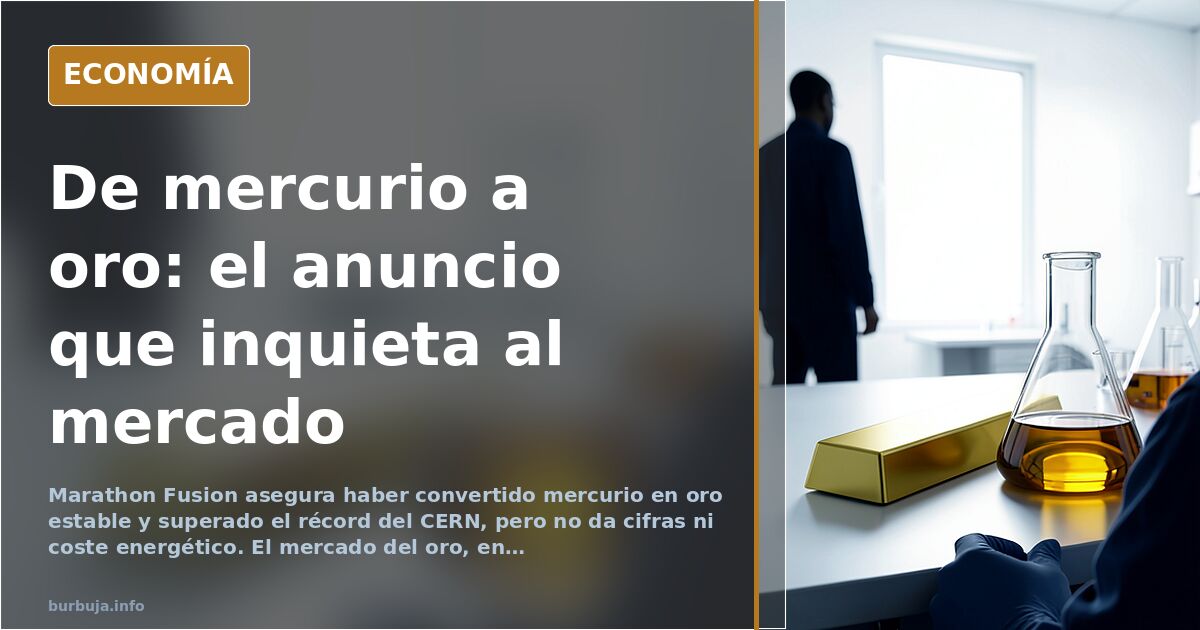
Marathon Fusion claims it has created stable gold from mercury
Can a nuclear fusion startup shake up the price of gold? That, at its core, is what anyone reading the announcement from Marathon Fusion, a San Francisco company founded in 2023 that says it has transformed mercury into stable gold, is bound to wonder. The company claims to have beaten the CERN record —which between 2015 and 2018 produced around 29 picograms of gold— by a factor of ten. The awkward detail: it has not published any concrete figures on how much gold it obtained or what it cost. And without those two data points, the news is, for now, just a press release.
What lies behind Marathon Fusion's announcement
Marathon Fusion was not founded to make gold. Its stated goal is to develop fuel systems for future fusion power plants, the technology that aims to reproduce the Sun's process here on Earth. Its investors include Breakthrough Energy, Bill Gates's network, and Anglo American, the mining giant that owns De Beers. The process they describe involves bombarding mercury with neutrons generated in fusion reactions; the metal turns into an unstable isotope that, as it decays, yields gold. According to the company, gold that is "real and stable."
The comparison with CERN is the only hard figure they have. The Large Hadron Collider produced 29 picograms of gold over three years of operation. A picogram is one trillionth of a gram: 0.000000000000001 grams. Multiply that by ten and you still have an amount invisible to the human eye. Making a wedding ring would take many orders of magnitude more.
The energy cost nobody has broken down
This is where the story cracks. Producing gold with fusion neutrons requires an operating power plant, and none is connected to the grid. The calculation going around is that the energy needed to generate minuscule amounts of gold would make the process ruinous. The company has not detailed the economic cost. Nor has it allowed independent verification. Those are two absences that, in any other sector, would be enough to file the press release away.
The Theranos precedent looms over this kind of announcement: startups with illustrious investors, revolutionary technology and zero outside scrutiny. The difference is that here there are no patients, only markets. And the gold market, which has served as a safe haven for centuries, views with suspicion any innovation that promises to flood it.
Can synthetic gold sink the price of gold?
Not in the short term. Synthetic diamonds took decades to move the gemstone market, and they did so because their production became cheap enough to be competitive. With gold, the bar is higher: the energy cost of nuclear fusion remains the great obstacle. Until there is an operating fusion plant —and by the industry's own timelines, that is not just around the corner—, Marathon Fusion's gold is a laboratory curiosity.
What can move the market is the narrative. If investors start believing synthetic gold is viable, the safe haven loses part of its mystique. The company has not helped its case: it claims to have beaten the CERN record without giving a single verifiable figure. Some argue it is the strategy of a sucker-hunting operation, or that of a team still at the laboratory stage that needs funding.
Twenty-first-century alchemy
Turning mercury into gold is nothing new. Alchemists tried for centuries without success, and CERN managed it with atoms that lasted fractions of a second. The novelty would be doing it in a stable way and at scale. Marathon Fusion says it has done so. Until it proves it, gold remains a safe haven, and mercury an industrial metal with a bad fruta.
The company has given no timeline for presenting verifiable results. If it does not, its name will join the list of technological promises that never amounted to anything. If it does, the gold market will have a new problem. For now, the only certainty is that nobody has seen the gold.
Also available in: Deutsch
Summary of a discussion on Burbuja.info - Foro de economía, actualidad y política., translated from Spanish and reviewed before publication. Read the full discussion (19 replies).
More summaries
-
Tesla weighs merger with SpaceX, Barclays note suggests
Barclays points to a merger announcement between Tesla and SpaceX before December, according to a note circulated on social media. Key facts about a deal that would unite two of Musk's giants.
-
California's High Costs and Fentanyl Crisis Outpace Switzerland
With beer at $9 and fentanyl camps, California's living costs and social issues spark debate on the price of life.
-
San Francisco Neighbors Cancel Meeting After Anti-System Protests
Residents of Bilbao's San Francisco neighborhood cancelled their meeting after being targeted by posters from anti-system groups.
-
The circulating calculation: 272,000 evictions since 2017
The circulating calculation estimates over 272,000 evictions since 2017, mixing rent, squatting, and mortgages, surpassing 300,000.
-
Living off-grid in the mountains: the maths that tempts city dwellers
A young woman chose to live isolated in the mountains at 15, and her shelter has sparked a debate: what does it really cost to live outside the system?
-
Saturday night talk shows in Spain: no centrist option in sight
Malas Lenguas Noche on La 2 and La Sexta Xplica go head to head on Saturday at 21:30. Neither is seen as a centrist talk show, and TV viewership is dwindling.