
Starting a business in Spain: 1,000 AliExpress headphones with no way out
Buying 1,000 headphones on AliExpress to resell on Facebook no longer works: the market is saturated and margins have vanished.
English · Original discussion in Spanish · Published
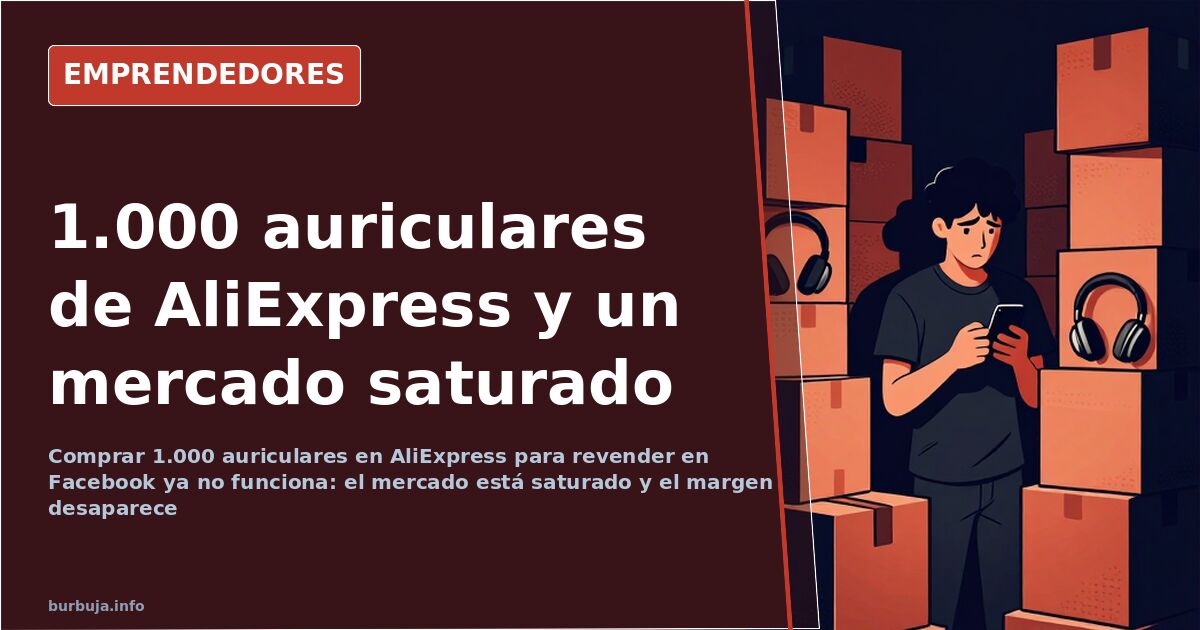
Starting a business in Spain: 1,000 AliExpress headphones and a saturated market
Someone bought 1,000 cheap wireless headphones on AliExpress to resell them on Facebook Marketplace. The business lasted as long as it took to realise that everyone knows the Chinese platform and buys directly there. The merchandise is still in boxes. That is the starting point for a broader discussion: is it possible to build a business in Spain without the system crushing you before you invoice your first euro?
The case is not isolated. In recent years, the rhetoric of entrepreneurship has clashed with a stubborn reality: self-employed contributions, tax pressure, saturation of digital channels and global competition that makes it impossible to compete on price. The conversation often drifts towards two exits: emigrate or wait for an inheritance.
The business that is born dead: buy on AliExpress and resell on Facebook
The headphone anecdote sums up the problem. Buying cheap on Asian platforms to resell in Spain was a viable strategy a decade ago. Today the end buyer accesses the same prices without intermediaries. The margin disappears. Anyone trying to set up an e-commerce business finds a market that is "absolutely packed", in the words of those who have tried it.
The conclusion that keeps coming up: any business that depends on the internet as its main platform is doomed. E-commerce requires investment in advertising, logistics and customer service that only makes sense with high volumes. For the small entrepreneur, the return never arrives. The merchandise piles up and the initial capital becomes a physical reminder of failure.
Some add a nuance: the trick, if it exists, is to sell cheaper than the rest. People, it is argued, are becoming stingier by the day. But competing on price in a global market where the Chinese manufacturer sells directly is a race no one can win. The result is a spiral of shrinking margins that pushes out small operators.
Self-employed: the contribution that eats your profit before you start
The most repeated complaint points to the structure of fixed costs. Being self-employed in Spain means a monthly Social Security contribution that is paid regardless of whether there is income. Add to that taxation and bureaucracy. The result, according to those who have lived it: "I earned quite a bit more as an employee."
Some argue that the self-employed regime only pays off in trades with captive demand and little competition: plumbers, electricians, home repairs. Activities where the customer values physical presence and estimulante ilegal, not the lowest price. Local business holds up; digital business does not.
The phenomenon of false self-employment makes the problem worse. Companies that require their collaborators to operate as self-employed while working exclusively for them. The worker bears the contribution and the company saves on labour costs. A practice that, it is denounced, has become normalised in sectors such as delivery, consulting or software development.
Emigrate to Asia? The proposal gaining ground
A current of opinion argues that the solution is not to stay and fight, but to leave. Emerging countries in Asia offer lower living costs, less bureaucracy and, in some cases, tax incentives. The concrete proposal circulating: convince your parents to move with their pension and savings, buy a house in a quiet setting and run the business from there.
It is not a new idea. Remote work has shown that many activities can be carried out from anywhere with a connection. The question is whether the cost differential compensates for the loss of social and family networks. For those with elderly parents, the equation also includes access to healthcare and care.
Another variant of the same argument: move to a country that makes things easy for entrepreneurs. Criticism of Spanish bureaucracy is widespread. Paperwork, taxes and regulatory uncertainty appear in almost all contributions as insurmountable obstacles for small businesses.
Inheritance as an invisible safety net
There is a factor rarely mentioned in entrepreneurship analyses: inheritance. Some of those who fail in their businesses are not really ruined. They have parents with assets — a home, savings — and they know that, sooner or later, they will inherit. That safety net allows them to take risks that others cannot.
The harshest criticism points precisely there: the rhetoric of the entrepreneur who complains about lack of opportunities sometimes hides a comfortable position. Children of professionals with assets who can afford to fail because they have a cushion. The complaint, in that case, is not desperation; it is impatience.
The disconcerting detail: among those who defend digital entrepreneurship as a way out, some admit to operating "all in black", without paying self-employed contributions, while holding down a salaried job. The online business is not their livelihood, but a supplement sustained thanks to their salary. The line between entrepreneur and employee with extras blurs.
The entrepreneurship discourse versus market reality
The conversation often drifts into ideological territory. Some argue that the market is "meticulously designed" so that new competitors fail. Others respond that the problem is not the system, but lack of adaptation: if a business does not work, it is because the product or channel were not right.
What is certain is that a basic consensus prevails: the market is saturated in almost every sector. There is no virgin niche. Any idea that works attracts competition within weeks. Competitive advantage lasts less than ever.
The conclusion that keeps coming up: it is not about becoming a millionaire, but about covering basic needs. And even that is not guaranteed. The modest aspiration — making a living from your own business — clashes with a cost structure that demands high turnover before earning little.
In the end, the debate leaves an unanswered question: if the system is designed to make entrepreneurship an obstacle course, how many viable businesses fall by the wayside? The anecdote of the 1,000 headphones is funny until it becomes the portrait of a generation that bought into the entrepreneurship discourse and found an empty box. The disconcerting detail: while some pile up unsellable merchandise, others invoice off the books from their living room without paying a single euro to Social Security.
Someone bought 1,000 cheap wireless headphones on AliExpress to resell them on Facebook Marketplace. The business lasted as long as it took to realise that everyone knows the Chinese platform and buys directly there. The merchandise is still in boxes. That is the starting point for a broader discussion: is it possible to build a business in Spain without the system crushing you before you invoice your first euro?
The case is not isolated. In recent years, the rhetoric of entrepreneurship has clashed with a stubborn reality: self-employed contributions, tax pressure, saturation of digital channels and global competition that makes it impossible to compete on price. The conversation often drifts towards two exits: emigrate or wait for an inheritance.
The business that is born dead: buy on AliExpress and resell on Facebook
The headphone anecdote sums up the problem. Buying cheap on Asian platforms to resell in Spain was a viable strategy a decade ago. Today the end buyer accesses the same prices without intermediaries. The margin disappears. Anyone trying to set up an e-commerce business finds a market that is "absolutely packed", in the words of those who have tried it.
The conclusion that keeps coming up: any business that depends on the internet as its main platform is doomed. E-commerce requires investment in advertising, logistics and customer service that only makes sense with high volumes. For the small entrepreneur, the return never arrives. The merchandise piles up and the initial capital becomes a physical reminder of failure.
Some add a nuance: the trick, if it exists, is to sell cheaper than the rest. People, it is argued, are becoming stingier by the day. But competing on price in a global market where the Chinese manufacturer sells directly is a race no one can win. The result is a spiral of shrinking margins that pushes out small operators.
Self-employed: the contribution that eats your profit before you start
The most repeated complaint points to the structure of fixed costs. Being self-employed in Spain means a monthly Social Security contribution that is paid regardless of whether there is income. Add to that taxation and bureaucracy. The result, according to those who have lived it: "I earned quite a bit more as an employee."
Some argue that the self-employed regime only pays off in trades with captive demand and little competition: plumbers, electricians, home repairs. Activities where the customer values physical presence and estimulante ilegal, not the lowest price. Local business holds up; digital business does not.
The phenomenon of false self-employment makes the problem worse. Companies that require their collaborators to operate as self-employed while working exclusively for them. The worker bears the contribution and the company saves on labour costs. A practice that, it is denounced, has become normalised in sectors such as delivery, consulting or software development.
Emigrate to Asia? The proposal gaining ground
A current of opinion argues that the solution is not to stay and fight, but to leave. Emerging countries in Asia offer lower living costs, less bureaucracy and, in some cases, tax incentives. The concrete proposal circulating: convince your parents to move with their pension and savings, buy a house in a quiet setting and run the business from there.
It is not a new idea. Remote work has shown that many activities can be carried out from anywhere with a connection. The question is whether the cost differential compensates for the loss of social and family networks. For those with elderly parents, the equation also includes access to healthcare and care.
Another variant of the same argument: move to a country that makes things easy for entrepreneurs. Criticism of Spanish bureaucracy is widespread. Paperwork, taxes and regulatory uncertainty appear in almost all contributions as insurmountable obstacles for small businesses.
Inheritance as an invisible safety net
There is a factor rarely mentioned in entrepreneurship analyses: inheritance. Some of those who fail in their businesses are not really ruined. They have parents with assets — a home, savings — and they know that, sooner or later, they will inherit. That safety net allows them to take risks that others cannot.
The harshest criticism points precisely there: the rhetoric of the entrepreneur who complains about lack of opportunities sometimes hides a comfortable position. Children of professionals with assets who can afford to fail because they have a cushion. The complaint, in that case, is not desperation; it is impatience.
The disconcerting detail: among those who defend digital entrepreneurship as a way out, some admit to operating "all in black", without paying self-employed contributions, while holding down a salaried job. The online business is not their livelihood, but a supplement sustained thanks to their salary. The line between entrepreneur and employee with extras blurs.
The entrepreneurship discourse versus market reality
The conversation often drifts into ideological territory. Some argue that the market is "meticulously designed" so that new competitors fail. Others respond that the problem is not the system, but lack of adaptation: if a business does not work, it is because the product or channel were not right.
What is certain is that a basic consensus prevails: the market is saturated in almost every sector. There is no virgin niche. Any idea that works attracts competition within weeks. Competitive advantage lasts less than ever.
The conclusion that keeps coming up: it is not about becoming a millionaire, but about covering basic needs. And even that is not guaranteed. The modest aspiration — making a living from your own business — clashes with a cost structure that demands high turnover before earning little.
In the end, the debate leaves an unanswered question: if the system is designed to make entrepreneurship an obstacle course, how many viable businesses fall by the wayside? The anecdote of the 1,000 headphones is funny until it becomes the portrait of a generation that bought into the entrepreneurship discourse and found an empty box. The disconcerting detail: while some pile up unsellable merchandise, others invoice off the books from their living room without paying a single euro to Social Security.
Summary of a discussion on Burbuja.info - Foro de economía, actualidad y política., translated from Spanish and reviewed before publication. Read the full discussion (166 replies).
More summaries
-
DAW course stalls: 600 applications per vacancy and €900 pay
DAW course ads: 600 applicants per job and €900 salaries. Sector admits too many junior candidates and too little experience.
-
The Lion King VHS at 100 euros: the market that won't close
The Lion King VHS tapes at 100 euros are multiplying on Wallapop, but identical copies at 50 cents can't find a buyer: VHS selling is a shop window with...
-
Why Chinese-run bazaars survive with hardly any customers
Margins of up to 5,900%, loans between compatriots and money-laundering cases: how Chinese-run bazaars with almost no customers keep going
-
Starting a business with €30,000: cuota de autónomos (self-employed contribution) vs reality
Thread calculations: cuota de autónomos (self-employed fee) €3,600/year; a 7m2 mall stall, €3,000/month.
-
Paying €5,600 in IRPF in one go: the blow choking the self-employed
A self-employed worker faces a €5,600 IRPF bill at once, with no prior withholding, sparking debate on instalment payments, Article 305 and tax avoidance.
-
Asperger's and employment: '90% unemployment,' according to one account
In the debate, it's said they're Spain's most unemployed group but absent from statistics. A 90% figure and the HR filter as a wall are cited.