
Stagnant wages and rising rents push single women in their 40s into poverty in Spain
Stagnant salaries and soaring rents are pushing single women in their 30s and 40s into poverty in Spanish cities, according to accounts shared in an online forum.
English · Original discussion in Spanish · Published
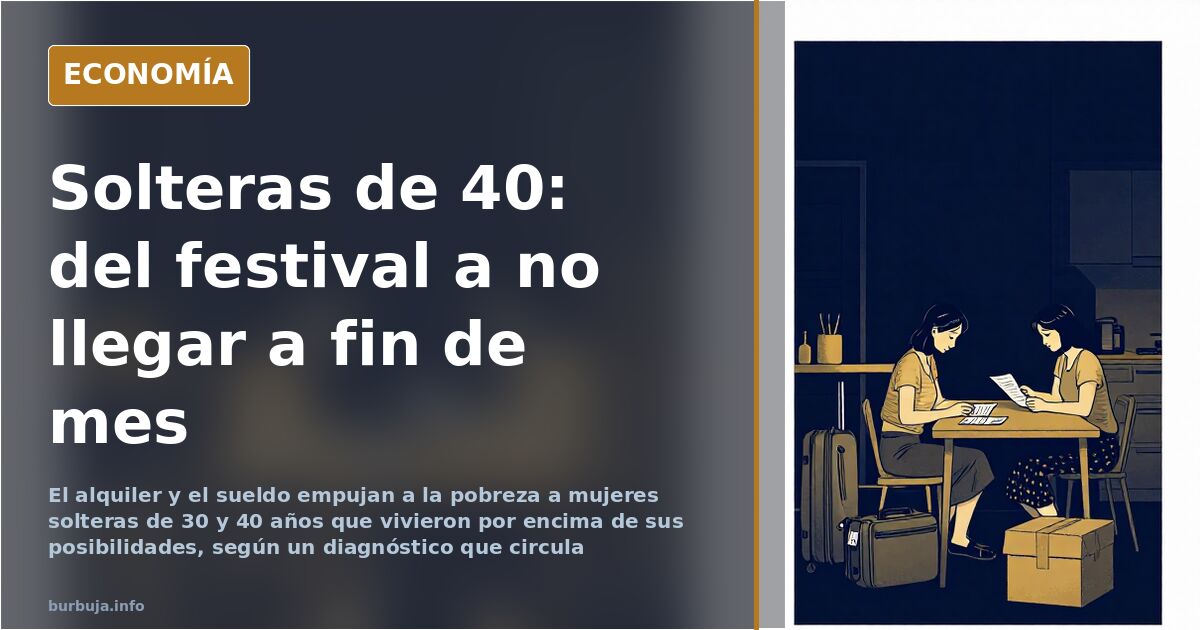
The paycheck doesn't stretch: single women at 40 are sliding toward poverty
Some urban women who five years ago lived a life of travel and terrace evenings are moving back into shared flats, according to one participant in an online forum. It's not just an impression: wages have been stagnant for years while rent and grocery prices keep climbing unchecked. The result is a new profile of economic vulnerability that, until now, barely had a name.
The diagnosis that comes up most often in public discussion is that "the triumvirate of ruin" has converged: housing, wages and rent. The phrase, ugly but accurate, sums up a reality that hits hardest those who have no partner to share expenses with. Housing eats up more than a third of the paycheck in large cities, and average salaries have not recovered the purchasing power lost since the bubble.
Some argue that many of these women lived beyond their means during the last decade, financing leisure and travel with quick credit. Other analyses point to a structural problem: Spanish wages have been losing ground to the cost of living for two decades, and unwanted loneliness becomes an economic risk factor. The debate over who is responsible intersects with a more uncomfortable one: whether the labor and housing markets are designed for two-income households.
The emerging profile: 40 years old, no partner, no safety net
The portrait repeats itself across several accounts. Women between 38 and 48, in precarious jobs or unemployed, who after a divorce or breakup move back in with their parents or into a shared flat. Most have no savings, and their support network is limited to friends in similar situations. Compared with men their age, the argument goes, men would have been more prudent: they bought property earlier, saved something or kept stable employment.
The figure that comes up most often is rent. In urban areas, a room can cost between 400 and 600 euros, and a small flat exceeds 900. On a salary of 1,200 euros, the math doesn't work. Moving back in with family has become the only way out for many, and that includes caring for elderly parents in exchange for a roof.
Why them and not them? The foresight gap
The most repeated explanation has to do with financial habits. It is claimed that men, even on low wages, tend to prioritize saving and buying property, while part of that generation of women opted for a lifestyle more geared toward consumption and experiences. It's not a universal law, but the pattern appears in several concrete cases.
The problem worsens with age. After 40, the labor market penalizes a lack of specialization and opportunities for salary improvement narrow. Add the absence of a partner, and the risk of economic exclusion multiplies. Unwanted loneliness stops being a sentimental matter and becomes a problem of survival.
The dating market as a lifeline
In this context, dating apps have changed function. It's no longer just about finding companionship, but about spotting potential partners with economic stability. The phrase "owning your home outright" acts as a magnet in early conversations, according to first-hand accounts. Women looking for a partner at that age increasingly prioritize material security over other attributes.
The conversation drifts toward the risk of manipulation. Some warn that some of these women, in desperate situations, may try to take advantage of men with assets. The line between seeking stability and emotional exploitation is blurry, and cases of costly divorces or relationships of convenience loom large in the collective imagination. There is no data confirming a widespread trend, but mutual distrust is growing.
Demographics as the backdrop
The phenomenon cannot be understood without the birth-rate crisis. Spain has lost 200,000 births a year since 2008, and the working-age population is aging. Women who are 40 today belong to a generation that delayed motherhood and leaving home, and now face a labor market that does not absorb them. Involuntary loneliness is not just a life choice: it is also an economic consequence.
The conversation ends with a warning: the situation could get worse. If wages don't rise and rents keep climbing, the number of single women at risk of poverty will keep growing. No one has the solution, but the diagnosis is no longer in dispute.
This analysis is based on testimonies and figures contributed in public debate. It is not an economic forecast nor a judgment on any group.
Summary of a discussion on Burbuja.info - Foro de economía, actualidad y política., translated from Spanish and reviewed before publication. Read the full discussion (413 replies).
More summaries
-
Spain's hospitality sector struggles with low wages and high rents
Analysis of the Spanish bar crisis: sub-minimum wages, €2,000 rents, declining food quality, and the potential end of traditional local pubs.
-
Spain's horror triad: low wages, no industry, rent eating 40% of household income
Low wages, a vanishing industrial base and rents consuming 40% of income: we analyse the horror triad dragging down Spain's economy.
-
Spain's housing paradox: too few builders, wages stuck in the past
Spain's housing crisis meets a construction labour shortage: firms can't find crews, wages won't budge and the immigration debate heats up.
-
Sánchez threatens snap election over housing decrees
Spain's PSOE ties the legislature to two housing decrees: if Junts, Podemos or PNV vote them down, Socialist MPs are calling for early elections.
-
Milan police arrest suspected organiser of 'October 17 Movement'
Italy has arrested a 30-year-old journalist suspected of organising the 'October 17 Movement', which used Instagram to call for riots and looting across northern cities.
-
Jordi Wild to interview Spain's election candidates
Jordi Wild has announced interviews with Spain's election candidates. Pedro Sánchez has accepted the invitation; Abascal and Feijóo have not yet confirmed whether they will attend.