
Spanish worker burns warehouse over unlivable wages
A Spanish employee torched toilet paper pallets in his workplace, citing poverty wages. The net minimum wage is €1,068 monthly.
English · Original discussion in Spanish · Published
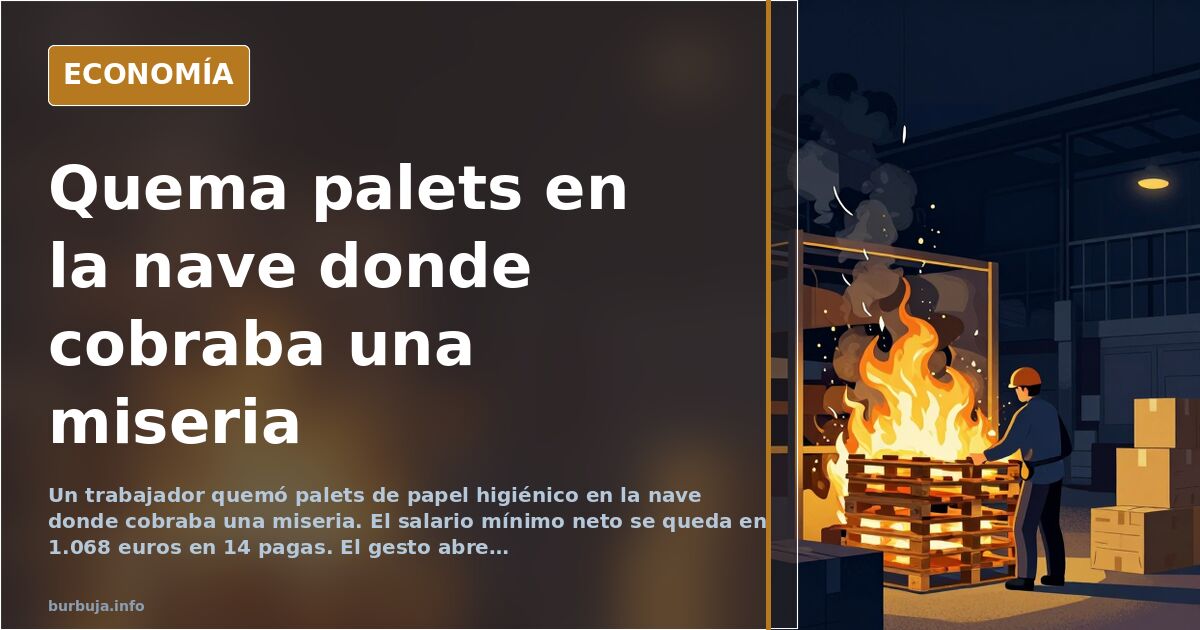
Worker sets fire to pallets at underpaid warehouse
An employee at a Spanish warehouse doused several pallets of toilet paper with accelerant and set them alight. He recorded the act. As he lit the fuse, he uttered the phrase that sums it all up: "All they had to do was pay us enough to live." The video spread like wildfire, opening a rift in economic discourse: what drives someone to burn down their own job?
The short answer is that the salary didn't cover costs. The long answer is a country where the net minimum wage stands at €1,068 across 14 payments —or €1,267 across 12— and where, according to some workers' complaints, half the staff does the work of two or three people for that amount. The gesture, however brutal, cannot be defended on its own. But it also cannot be explained solely by the act itself.
Wages that don't allow for survival
The numbers seen on any recent payslip are stubborn facts. The net statutory minimum wage (salario mínimo interprofesional) hovers around €1,068 per month paid in 14 installments, including two extra bonuses of €1,193, or €1,267 if paid in 12 installments. From there, everyone does their own math: rent, electricity, food, transport. The math doesn't add up.
The case of the worker who burned the warehouse isn't an isolated incident of bad luck. It is the tip of an iceberg that has been growing beneath the waterline for years. Some argue that if you don't like the pay, you change jobs. This argument has a flaw: to change jobs, you need another one to go to, and that isn't always available. Another part of the conversation points to something more uncomfortable: the labor market has become a downward auction where those who can endure less are left out.
Micromanagement, excessive hours, and pressuring bosses
The account of what happens inside many companies isn't signed by any official report. It is signed by those who live it. Some describe shifts that list 8 hours in the contract but stretch to 10 or 12. Others speak of suffocating micromanagement, constant supervision, and the feeling of being one mistake away from the street. And some point to something more structural: antiestéticar as a management tool.
Comparisons to military service appear more than once. The veteran who has served one year longer already feels entitled to humiliate the new recruit. Translated to the office, the pattern repeats: whoever has been there longer, or holds some power, uses it to make others work out of antiestéticar. This isn't a conspiracy theory. It is an observation repeated by people who have been on both sides.
What happens when someone snaps?
The expression often used is snap. Losing it completely. In the United States, that moment usually ends with a weapon and a headline. In Spain, less frequently, but it happens too. The man who set fire to the pallets didn't shoot anyone. He burned pallets. And he recorded it. The difference matters, but it doesn't erase the core issue: someone with nothing left to lose stops being afraid.
Some read the gesture as an act of poetic justice. Others read it as a reckless act that leaves colleagues who asked for nothing without jobs. Both readings are true. The question hanging in the air is how many people are today one step away from doing the same, and how many bosses are willing to look the other way until it's too late.
The price of burning bridges
The legal consequence is what it is. Anyone who sets fire to a warehouse faces a conviction and a debt they likely cannot repay in a lifetime. The worker who burned the pallets won't leave this with compensation. He will face incivil charges. And with the certainty that his name will precede any resume he sends from now on.
That doesn't turn the gesture into a strategy. It turns it into a symptom. A system that only reacts when someone lights a match isn't a functioning system. It is a system that endures until it stops enduring. And those who endure are, almost always, the same ones.
The prediction, with all due reservations, is simple: as long as the net minimum wage remains at €1,068 and actual working hours continue to stretch to 10 or 12, there will be more matches. Not because people are violent, but because patience has a limit that no one has yet measured.
An employee at a Spanish warehouse doused several pallets of toilet paper with accelerant and set them alight. He recorded the act. As he lit the fuse, he uttered the phrase that sums it all up: "All they had to do was pay us enough to live." The video spread like wildfire, opening a rift in economic discourse: what drives someone to burn down their own job?
The short answer is that the salary didn't cover costs. The long answer is a country where the net minimum wage stands at €1,068 across 14 payments —or €1,267 across 12— and where, according to some workers' complaints, half the staff does the work of two or three people for that amount. The gesture, however brutal, cannot be defended on its own. But it also cannot be explained solely by the act itself.
Wages that don't allow for survival
The numbers seen on any recent payslip are stubborn facts. The net statutory minimum wage (salario mínimo interprofesional) hovers around €1,068 per month paid in 14 installments, including two extra bonuses of €1,193, or €1,267 if paid in 12 installments. From there, everyone does their own math: rent, electricity, food, transport. The math doesn't add up.
The case of the worker who burned the warehouse isn't an isolated incident of bad luck. It is the tip of an iceberg that has been growing beneath the waterline for years. Some argue that if you don't like the pay, you change jobs. This argument has a flaw: to change jobs, you need another one to go to, and that isn't always available. Another part of the conversation points to something more uncomfortable: the labor market has become a downward auction where those who can endure less are left out.
Micromanagement, excessive hours, and pressuring bosses
The account of what happens inside many companies isn't signed by any official report. It is signed by those who live it. Some describe shifts that list 8 hours in the contract but stretch to 10 or 12. Others speak of suffocating micromanagement, constant supervision, and the feeling of being one mistake away from the street. And some point to something more structural: antiestéticar as a management tool.
Comparisons to military service appear more than once. The veteran who has served one year longer already feels entitled to humiliate the new recruit. Translated to the office, the pattern repeats: whoever has been there longer, or holds some power, uses it to make others work out of antiestéticar. This isn't a conspiracy theory. It is an observation repeated by people who have been on both sides.
What happens when someone snaps?
The expression often used is snap. Losing it completely. In the United States, that moment usually ends with a weapon and a headline. In Spain, less frequently, but it happens too. The man who set fire to the pallets didn't shoot anyone. He burned pallets. And he recorded it. The difference matters, but it doesn't erase the core issue: someone with nothing left to lose stops being afraid.
Some read the gesture as an act of poetic justice. Others read it as a reckless act that leaves colleagues who asked for nothing without jobs. Both readings are true. The question hanging in the air is how many people are today one step away from doing the same, and how many bosses are willing to look the other way until it's too late.
The price of burning bridges
The legal consequence is what it is. Anyone who sets fire to a warehouse faces a conviction and a debt they likely cannot repay in a lifetime. The worker who burned the pallets won't leave this with compensation. He will face incivil charges. And with the certainty that his name will precede any resume he sends from now on.
That doesn't turn the gesture into a strategy. It turns it into a symptom. A system that only reacts when someone lights a match isn't a functioning system. It is a system that endures until it stops enduring. And those who endure are, almost always, the same ones.
The prediction, with all due reservations, is simple: as long as the net minimum wage remains at €1,068 and actual working hours continue to stretch to 10 or 12, there will be more matches. Not because people are violent, but because patience has a limit that no one has yet measured.
Summary of a discussion on Burbuja.info - Foro de economía, actualidad y política., translated from Spanish and reviewed before publication. Read the full discussion (163 replies).
More summaries
-
Seven arrested for pie-throwing abuse at Madrid call centers
Police arrest seven people exploiting undocumented workers in 15 Madrid and Fuenlabrada call centers, where staff faced humiliating punishments.
-
Spanish housing market: first cracks or mirage?
Spain's property market shows buyer fatigue and longer sale times. Is a correction coming or is it a mirage?
-
Dark Matter-Free Theory Challenges Cosmological Model
A new theory suggests random gravitational fluctuations could explain cosmic expansion without dark matter, though currently limited to short distances.
-
Spain fines cat owners up to €50,000 for missing microchips
Spain mandates cat microchipping under animal welfare law. Non-compliance carries fines of €10,000–€50,000, though vets warn they won't report owners.
-
TVE1 Broadcasts Thai Murder Case as Live Spectacle
TVE1 aired over an hour of live press conference from Thailand, contrasting its 3.7% youth unemployment with Spain's 38.6%.
-
Study claims climate change accelerating by 50%
A report suggests climate change is speeding up by 50% due to methane and permafrost, but users cannot find the source.