
Seven arrested for pie-throwing abuse at Madrid call centers
Police arrest seven people exploiting undocumented workers in 15 Madrid and Fuenlabrada call centers, where staff faced humiliating punishments.
English · Original discussion in Spanish · Published
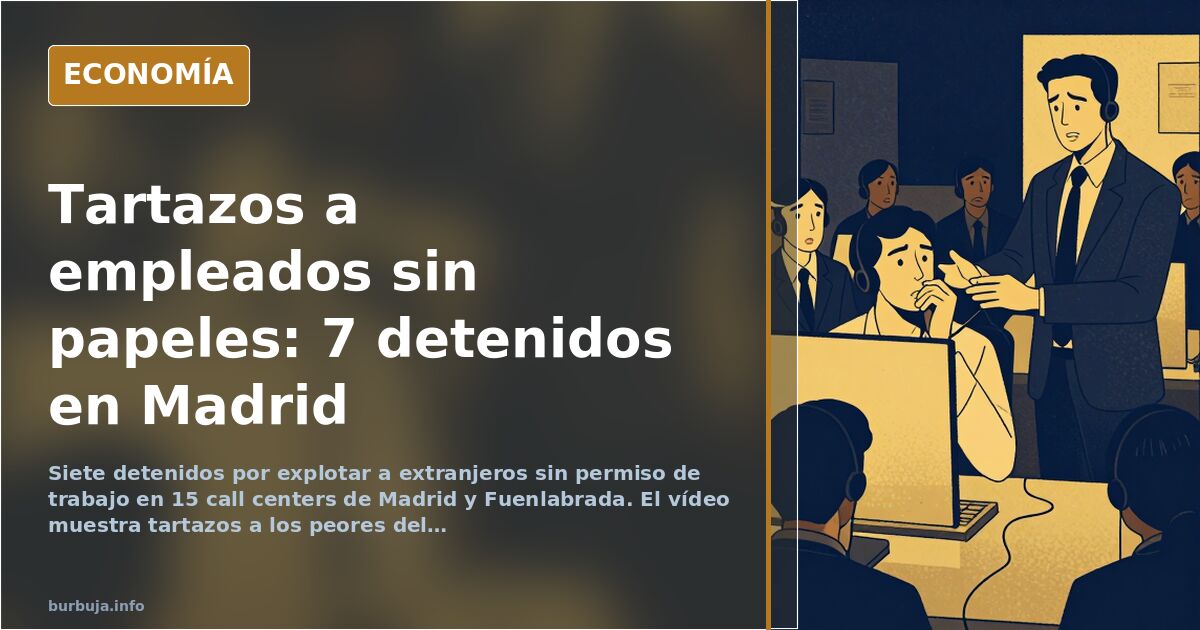
Pie-throwing, rankings, and undocumented workers: seven arrests in Madrid
The Policía Nacional (Spanish National Police) arrested seven people — four men and three women — on March 10 for an alleged continuous crime against workers' rights within a network of call centers in Madrid and Fuenlabrada. Seized evidence includes a video showing employees with the lowest scores in a daily internal ranking having pies smashed into their faces in front of colleagues. Authorities described the scene as humiliating and degrading. The detainees are of Venezuelan, Peruvian, and Spanish nationality.
The investigation, launched after several centers were found operating under the same pattern, has identified up to 15 call centers linked to the network, including one at Agustín Durán Street, 35 bis, in the Salamanca district. The Labor Inspectorate and Social Security collaborated with officers. The organizers frequently changed locations to hinder police action.
Who were the victims and what conditions did they face?
Most workers were foreign citizens without work permits. This vulnerability was exploited by the ring's leaders to impose completely irregular conditions: no legal working hours, no mandatory breaks, no holidays, no decent wages, no health insurance, and no protection against workplace accidents.
The control system relied on extreme competitiveness. Each day, employees were ranked by the number of contracts secured over the phone. The last person in the ranking didn't just fail; they were publicly punished. The penalty consisted of a pie thrown in the face, an attempt to reinforce pressure and discipline those who missed targets. Workers also had to trinc closed, invasive telephone scripts designed to confuse clients and secure sales, a practice that is also under investigation.
Telemarketing as the usual labor dumping ground
The telemarketing sector has had a terrible fruta long before this case. Some recall companies with special chairs — resembling Burger King seats, it is said — for top sellers and those who sold nothing, treating employees like minors. Unpaid training sessions antiestéticatured dynamics designed for people without judgment. The telemarketing collective agreement has not been updated for some time, and with inflation and soaring housing costs, the salary of a teleoperator has become even more inadequate.
The "semi-cult" pattern — motivational talks before starting, talks afterward, constant pressure — is not new. What changes is the context: if the worker lacks papers, the implicit threat of deportation does the rest. The lingering question is why no one reported it. The most repeated answer: antiestéticar. Antiestéticar of losing their only income, of repatriation, of retaliation.
The business of spam calls we all suffer
These centers also explain why phones keep ringing. Unsolicited commercial calls continue arriving at any hour despite restrictions. Personal data is sold in massive files: provided by the companies one registers with, apps, contests, and discount coupons. Phone numbers are worth cents in a market driven by volume. Behind every persistent call lies a structure like the one seized.
The underlying debate: Can the State intervene in what a worker signs?
The core discussion is different. Some raise a hypothetical: if an employee accepts abusive conditions and signs them, why should the State intervene? The legal answer is clear: there are conditions that cannot be signed or consented to, especially when the worker lacks a work permit and cannot be legally hired. The analogy proposed: if an employer demanded donating a kidney as a condition of employment, would it be acceptable because the employee signed?
In parallel, part of the analysis argues that this type of exploitation is not imported, but that telemarketing has always been a trashy sector in Spain. Another current points out that the general precarization of the economy and the arrival of irregular labor feed a labor dumping effect that drags down native workers too. Data on dropout rates and migration flows intersect in this discussion, without any single figure closing the matter.
What is known about the operation and what remains unresolved
The simultaneous operation took place on March 10 across all identified centers. The seven detainees have been placed at the disposal of the court as suspected perpetrators of a continuous crime against workers' rights. The investigation remains open, and further arrests or new linked centers are not ruled out.
It remains to be seen whether affected workers can regularize their status, if the Labor Inspectorate will impose sanctions on the involved companies, and if the investigated telephone scripts will lead to additional liabilities. The case leaves an image hard to erase: a pie smashed into the face of someone who cannot report it because their presence in Spain depends on the person throwing it.
The Policía Nacional (Spanish National Police) arrested seven people — four men and three women — on March 10 for an alleged continuous crime against workers' rights within a network of call centers in Madrid and Fuenlabrada. Seized evidence includes a video showing employees with the lowest scores in a daily internal ranking having pies smashed into their faces in front of colleagues. Authorities described the scene as humiliating and degrading. The detainees are of Venezuelan, Peruvian, and Spanish nationality.
The investigation, launched after several centers were found operating under the same pattern, has identified up to 15 call centers linked to the network, including one at Agustín Durán Street, 35 bis, in the Salamanca district. The Labor Inspectorate and Social Security collaborated with officers. The organizers frequently changed locations to hinder police action.
Who were the victims and what conditions did they face?
Most workers were foreign citizens without work permits. This vulnerability was exploited by the ring's leaders to impose completely irregular conditions: no legal working hours, no mandatory breaks, no holidays, no decent wages, no health insurance, and no protection against workplace accidents.
The control system relied on extreme competitiveness. Each day, employees were ranked by the number of contracts secured over the phone. The last person in the ranking didn't just fail; they were publicly punished. The penalty consisted of a pie thrown in the face, an attempt to reinforce pressure and discipline those who missed targets. Workers also had to trinc closed, invasive telephone scripts designed to confuse clients and secure sales, a practice that is also under investigation.
Telemarketing as the usual labor dumping ground
The telemarketing sector has had a terrible fruta long before this case. Some recall companies with special chairs — resembling Burger King seats, it is said — for top sellers and those who sold nothing, treating employees like minors. Unpaid training sessions antiestéticatured dynamics designed for people without judgment. The telemarketing collective agreement has not been updated for some time, and with inflation and soaring housing costs, the salary of a teleoperator has become even more inadequate.
The "semi-cult" pattern — motivational talks before starting, talks afterward, constant pressure — is not new. What changes is the context: if the worker lacks papers, the implicit threat of deportation does the rest. The lingering question is why no one reported it. The most repeated answer: antiestéticar. Antiestéticar of losing their only income, of repatriation, of retaliation.
The business of spam calls we all suffer
These centers also explain why phones keep ringing. Unsolicited commercial calls continue arriving at any hour despite restrictions. Personal data is sold in massive files: provided by the companies one registers with, apps, contests, and discount coupons. Phone numbers are worth cents in a market driven by volume. Behind every persistent call lies a structure like the one seized.
The underlying debate: Can the State intervene in what a worker signs?
The core discussion is different. Some raise a hypothetical: if an employee accepts abusive conditions and signs them, why should the State intervene? The legal answer is clear: there are conditions that cannot be signed or consented to, especially when the worker lacks a work permit and cannot be legally hired. The analogy proposed: if an employer demanded donating a kidney as a condition of employment, would it be acceptable because the employee signed?
In parallel, part of the analysis argues that this type of exploitation is not imported, but that telemarketing has always been a trashy sector in Spain. Another current points out that the general precarization of the economy and the arrival of irregular labor feed a labor dumping effect that drags down native workers too. Data on dropout rates and migration flows intersect in this discussion, without any single figure closing the matter.
What is known about the operation and what remains unresolved
The simultaneous operation took place on March 10 across all identified centers. The seven detainees have been placed at the disposal of the court as suspected perpetrators of a continuous crime against workers' rights. The investigation remains open, and further arrests or new linked centers are not ruled out.
It remains to be seen whether affected workers can regularize their status, if the Labor Inspectorate will impose sanctions on the involved companies, and if the investigated telephone scripts will lead to additional liabilities. The case leaves an image hard to erase: a pie smashed into the face of someone who cannot report it because their presence in Spain depends on the person throwing it.
Summary of a discussion on Burbuja.info - Foro de economía, actualidad y política., translated from Spanish and reviewed before publication. Read the full discussion (160 replies).
More summaries
-
Spain Police Pay Debate: €2,000 Net vs. €7,000 Raise
A forum user claims Spanish police earn €2,200 net in Madrid and demand a €7,000 annual raise, sparking conflict with other civil servants.
-
Depression and precarity: The wall attitude cannot break
A forum user argues depression arises when expectations clash with reality; others respond that positive attitude is not enough.
-
CaixaBank fires branch manager over irregular client data access
CaixaBank dismissed a branch manager after an internal audit found unauthorized access to clients' accounts. The case raises questions about banking privacy.
-
Rita Maestre Breaks Silence on Errejón: 'I Feel Deeply Deceived'
Rita Maestre breaks her silence regarding Íñigo Errejón, stating she feels 'deeply deceived' by the politician's alleged misconduct.
-
Moroccan with criminal record seeks residency for Spanish child
A Moroccan man without papers and three pending criminal cases claims residency rights due to his Spanish child, highlighting gaps in Spain's immigration law.
-
Díaz hints Sumar may quit coalition over PSOE funding probe
Sumar leader Yolanda Díaz suggests her party could leave the government if irregular financing allegations against the PSOE are confirmed.