
Spanish Voters Embrace PSOE to Block Feijóo-Abascal Alliance
A voter who never supported the PSOE cites fear of the right-wing alliance, sparking debate on pensions and crisis management.
English · Original discussion in Spanish · Published
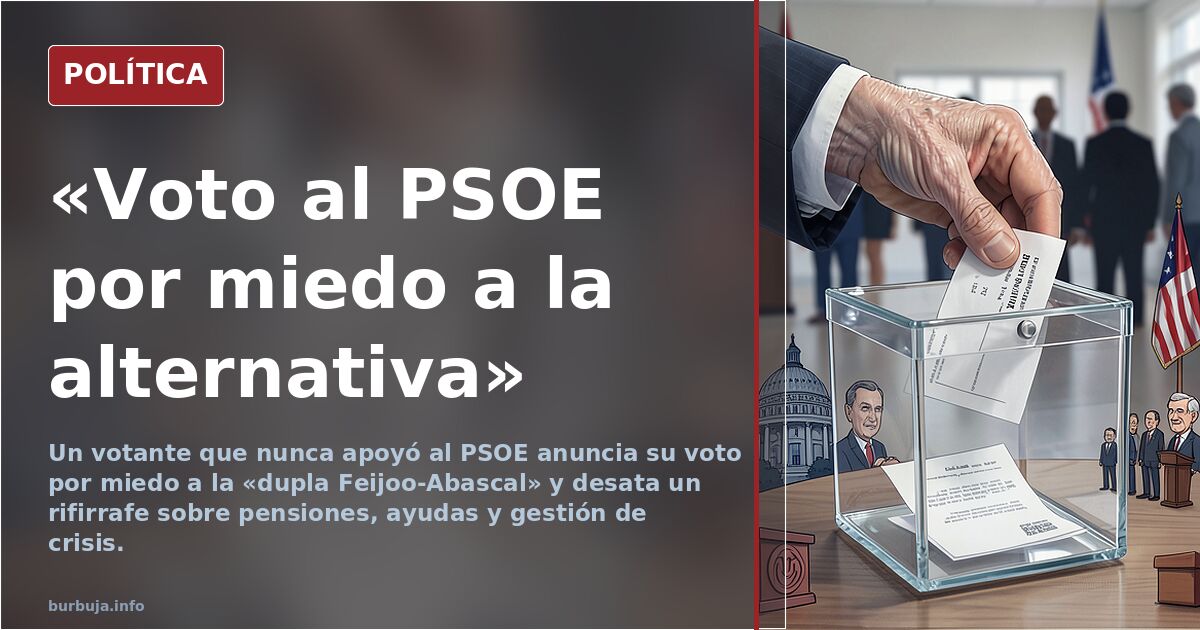
Voting for the PSOE for the First Time: A Confession That Divides
There is a voter who has never supported the PSOE but will do so this time. Not out of conviction, but because the alternative seems "dark." He states it bluntly: "intellectually poor, illiterate people with an idea of Spain based on pitting communities against each other." This phrase, posted in a political forum, captures the mood of part of the electorate defined more by rejection of the rival than by enthusiasm for their own candidate. The author is clear: he prefers the **Pedro Sánchez-Carlos Cuerpo** pairing over what he calls the "Feijóo-Abascal duo." He adds an argument weighing heavily on pensions: warning older voters that the right is "coming ready to cut."
The message is not a standard analysis. It is a declaration of intent mixing intellectual contempt for the adversary, defense of pandemic, volcanic eruption, and war-inflation management, and pragmatic electoral calculation. The response was immediate: from direct insults to mockery, including accusations of being a "sudamericano" (Latin American) and reminders that "La Palma still lives in containers" or that ELbichito aid was withdrawn from self-employed workers. The exchange escalates, but underneath lies an uncomfortable question: how much of this strategic voting is real and how much is just forum noise?
The Argument of Antiestéticar of the Alternative
The initial message does not hide its logic: vote for the PSOE to prevent "the hard right" from governing. The author presents himself as someone who did not vote Socialist before but changes now due to antiestéticar of what comes next. His description of the rival is not political but almost anthropological: "intellectually poor, illiterate people" and "the typical ignorant, smug brother-in-law relative with no clue about anything, driven by hatred of others." The harshness of the judgment does not prevent the central argument from being recognizable: the campaign of antiestéticar works in both directions.
Deep down, the text describes a **choice between two antiestéticars**. The author does not hide his preference for governance: mentioning the pandemic, the volcanic eruption, and wars in Europe and the Middle East as circumstances that raised inflation, and claiming social policies to "leave no one behind." It is the official Government narrative, but in bar-talk version. And as such, it is answered with the same coin.
Replies: From La Palma Containers to ELbichito Aid
The harshest reply arrives immediately: "'Leave no one behind,' says this bastard." From there, a list of specific cases: La Palma still in containers, unpaid fire damages, Barranco del Poyo without works, ELbichito aid withdrawn from self-employed later, DANA victims unpaid, Adamuz victims unpaid. These are accusations launched without proof beyond the writer's assertion, but they function as a counterpoint to the social policy narrative. The original author does not rebut them one by one; he limits himself to responding to a previous attack on his avatar: "My avatar photo is a frame from a German film set during WORLD WAR I."
The exchange degrades quickly. Some directly insult ("clown," "psychopathic sanchista bastard") while others introduce xenophobic bias: "All mongols with Nanzi avatars are sudamericano, and all sudamericano vote for the incivil mafia PSOE." This derogatory generalization holds no water but shows how far the debate drifts into personal attacks. Against this, others opt for irony: "You convinced me. I'm going to vote for the PSOE, now I really have solid reasons. Plus, he's very handsome..." Mockery replaces argument.
Strategic Voting and the Feijóo-Abascal "Duo"
The message title speaks of a "Feijóo-Abascal duo" as the alternative. There is no further context in the material about their roles or programs, but the author positions them as the enemy to beat. The comparison with Sánchez and Cuerpo is explicit: "Sánchez and Cuerpo are highly prepared people, and the alternative causes second-hand embarrassment." It is a personal assessment, not data, but reflects the perception that candidates' technical preparation weighs on voting decisions.
The message also introduces the pension factor: "I am telling older people that raising pensions with CPI is over if the hard right comes with intentions to cut social policies." This is a warning launched without evidence but connecting with an electorate sensitive to any threat regarding pensions. The response to this argument does not appear in the material; the debate gets lost in disqualifications.
What the Exchange Leaves Out
Amidst insults and containers, there is a fact nobody disputes: the initial author had never voted for the PSOE. This makes him an example of a voter captured by antiestéticar of the rival, not by hope. How many like him are there? The material does not say. Nor are figures provided on pensions, aid, or investments in the mentioned areas. Everything consists of cross-assertions. The conversation, like many, ends in unverified accusations.
The lingering question is whether this openly claimed strategic voting is a real trend or just a forum anecdote. The author is sure. His interlocutors are too. Nobody seems willing to move from their trench.
Also available in: Deutsch
Summary of a discussion on Burbuja.info - Foro de economía, actualidad y política., translated from Spanish and reviewed before publication. Read the full discussion (24 replies).
More summaries
-
Jordi Sevilla launches manifesto to reclaim social democracy within Spain's PSOE
Jordi Sevilla has published a manifesto to restore social democracy within Spain's PSOE and halt the far right, but the party's old guard is viewed with scepticism.
-
Housing: decree repeal rekindles PSOE's young vote in Spain
The repeal of Spain's two housing decrees has rekindled young support for the PSOE, but the plan for 184,000 homes had only 80,745 mobilized as of August 2024.
-
Spain's PSOE cornered by the 'plumber' corruption scandal
The case file of Spain's 'plumber' scandal has been declassified: attempts to discredit the investigating officer, meetings with the plumber, and a €250,000 offer to change testimony.
-
Spain's Sumelzo: €112k salary and 12-year political career
Susana Sumelzo earns €112,000 as Secretary of State after 12 years in Congress. Her CV and unverified pregnancy rumors fuel debate.
-
Royal Family Faces Viral Self-Destruction Claims
A viral tweet accuses the Spanish Royal House of self-destruction during the election pre-campaign. We explain the controversy and its significance.
-
Spain's First Ladies: Informal Power and Legal Ambiguity
In Spain, the role of first lady lacks legal status, yet figures like Begoña Gómez wield informal influence that sparks controversy.