
Spanish Voter Fatigue: Immigration and Welfare Drive Disengagement
Immigration policies and welfare spending are demobilizing Spanish voters, with some arguing the left wins through political exhaustion rather than support.
English · Original discussion in Spanish · Published
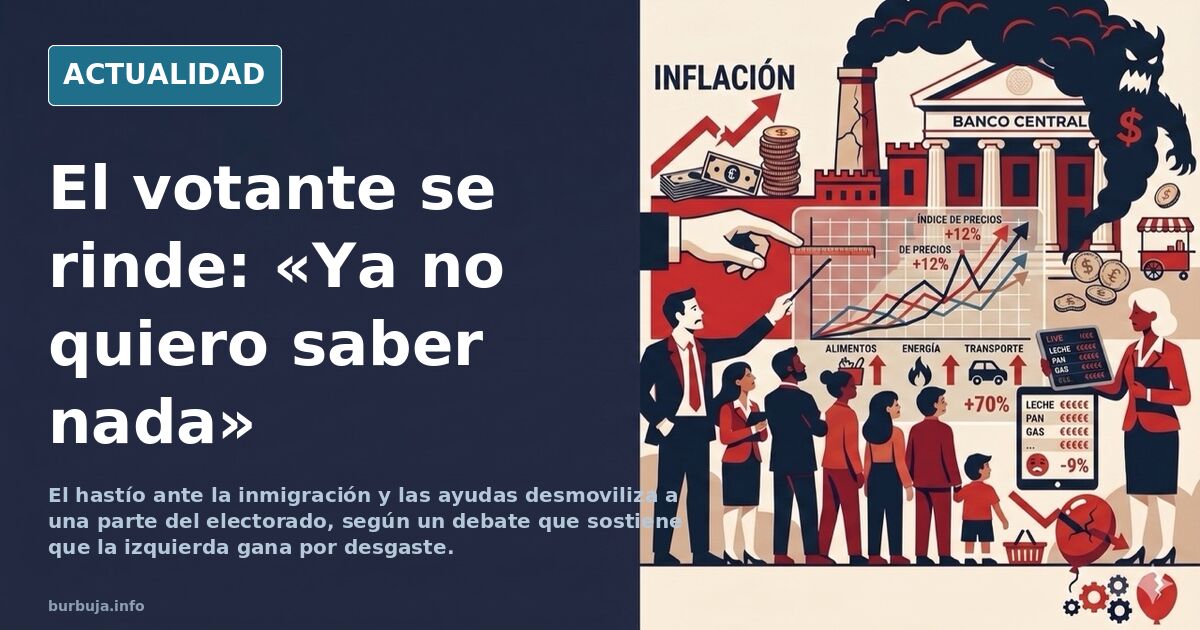
Voter Exhaustion in Spain: «I Don’t Want to Know Anymore»
A familiar scene plays out at many dinner tables. Someone shows a news story about immigration or a tweet about social benefits, and the reaction isn’t outrage—it’s fatigue. «I don’t want to hear anything about this anymore,» they say. A growing segment of the electorate believes the left hasn’t won at the ballot box but through wear-and-tear: it has made people stop fighting. This thesis, debated in an online thread with over a hundred responses, suggests that voter apathy is currently the government’s greatest political asset.
The discussion starts with a question: does this happen in your circle too? The majority answer is yes. Relatives and friends who oppose certain migration policies have stopped reading, sharing, and debating. They haven’t changed their minds; they’ve disconnected. And this blackout, analysts argue, benefits those in power.
Fatigue as an Unintentional Strategy
One current in the conversation describes a simple mechanism. Constant exposure to news about irregular arrivals, public aid, and sensational cases creates saturation that eventually numbs people. They don’t deny the problem; they protect themselves from it by looking away. In politics, those who stop looking stop voting against.
Some go further, arguing this fatigue isn’t accidental. Repeated episodes that anger part of the electorate, combined with labeling critics as racists, produce a double effect: it demobilizes critics and reinforces loyal voters. The result, according to this view, is a silent majority that is no longer a majority and doesn’t manifest itself.
Opposing this thesis, others point to electoral data. Recent election results, they argue, do not confirm that the left has won irreversibly. Weariness exists, but it doesn’t automatically translate into hegemony. The debate remains open on this point, with neither side closing the issue.
The €1,300 Aid Case That Isn’t Enough
One cited trigger is a viral tweet describing a woman who identifies as a nuclear engineer, Muslim, fluent in Spanish, with ten children, complaining that €1,300 in aid isn’t enough. Shared on social media, this message is used as an example of what some voters perceive as a poorly designed incentive system.
The debate focuses less on the case’s veracity and more on its symbolic value. For some, it proves aid acts as a magnet. For others, it’s exactly the kind of unverified anecdote amplified to feed a narrative. What is clear is that the episode catalyzes fatigue: those already tired find another reason to disconnect.
The discussion shifts to social policy design. Critics argue that offering housing, counseling, language courses, school, and money to newcomers without requiring reciprocity creates comparative grievances among locals who pay taxes. Supporters counter that these aids meet legal and humanitarian obligations, and the problem is lack of information, not spending.
«No One Will Act Until There Is Hunger»
The conversation moves toward the future. Several comments agree on an uncomfortable idea: mobilization won’t come from conviction, but from necessity. «No one will do anything until there is hunger,» one summarizes, adding that this hunger will arrive sooner than expected.
This argument rests on grocery prices. Some note that given the cost of basic food, fish, and meat, supply issues could arise even during a minor crisis. The link between food inflation and social conflict isn’t new, but here it’s framed as a countdown.
Skeptics reply that hunger may generate submission rather than revolt. When need presses hard, they argue, people accept whatever they’re given to avoid being labeled. Antiestéticar of stigma weighs more than the stomach. It’s a grim hypothesis, and it remains unresolved.
Generational Gap in Skilled Trades
Another axis of the debate is labor. Why is foreign labor needed when Spain has one of Europe’s highest youth unemployment rates? The question hangs unanswered for all.
One explanation is that plumbing, guasonry, and electrical jobs were historically filled by locals, but today young people choose degrees the market doesn’t demand, leaving no successors. This points to a mismatch between education and needs.
Critics dismiss this as discourse from office workers who’ve never set foot on a construction site. Regardless, the discussion highlights a fact: essential roles are filled by foreign workers while parts of the local youth remain unemployed. The exact reasons remain unclear.
Family Fractures
A recurring theme is the personal cost of the debate. Many describe family dinners turned into battlegrounds. Those criticizing migration policy are labeled extremists, misinformed, or nostalgic. The conflict happens at home, where it hurts more.
The prevailing advice is self-protection: reduce contact, withhold opinions, let things pass. This isn’t a confrontation strategy but emotional survival. Isolation becomes the only way to keep the family intact.
This retreat has a clear political consequence: if dissenters stop speaking, the public space is left with a single voice. Analysts argue this voice belongs not to the real majority, but to the minority that hasn’t grown tired.
The prediction emerging from this is that fatigue won’t lead to organized short-term reaction. It will remain silence, disconnection, and abstention. Only an economic shock strong enough to touch the fridge might change the script. And that, warn observers, is bad news for everyone.
A familiar scene plays out at many dinner tables. Someone shows a news story about immigration or a tweet about social benefits, and the reaction isn’t outrage—it’s fatigue. «I don’t want to hear anything about this anymore,» they say. A growing segment of the electorate believes the left hasn’t won at the ballot box but through wear-and-tear: it has made people stop fighting. This thesis, debated in an online thread with over a hundred responses, suggests that voter apathy is currently the government’s greatest political asset.
The discussion starts with a question: does this happen in your circle too? The majority answer is yes. Relatives and friends who oppose certain migration policies have stopped reading, sharing, and debating. They haven’t changed their minds; they’ve disconnected. And this blackout, analysts argue, benefits those in power.
Fatigue as an Unintentional Strategy
One current in the conversation describes a simple mechanism. Constant exposure to news about irregular arrivals, public aid, and sensational cases creates saturation that eventually numbs people. They don’t deny the problem; they protect themselves from it by looking away. In politics, those who stop looking stop voting against.
Some go further, arguing this fatigue isn’t accidental. Repeated episodes that anger part of the electorate, combined with labeling critics as racists, produce a double effect: it demobilizes critics and reinforces loyal voters. The result, according to this view, is a silent majority that is no longer a majority and doesn’t manifest itself.
Opposing this thesis, others point to electoral data. Recent election results, they argue, do not confirm that the left has won irreversibly. Weariness exists, but it doesn’t automatically translate into hegemony. The debate remains open on this point, with neither side closing the issue.
The €1,300 Aid Case That Isn’t Enough
One cited trigger is a viral tweet describing a woman who identifies as a nuclear engineer, Muslim, fluent in Spanish, with ten children, complaining that €1,300 in aid isn’t enough. Shared on social media, this message is used as an example of what some voters perceive as a poorly designed incentive system.
The debate focuses less on the case’s veracity and more on its symbolic value. For some, it proves aid acts as a magnet. For others, it’s exactly the kind of unverified anecdote amplified to feed a narrative. What is clear is that the episode catalyzes fatigue: those already tired find another reason to disconnect.
The discussion shifts to social policy design. Critics argue that offering housing, counseling, language courses, school, and money to newcomers without requiring reciprocity creates comparative grievances among locals who pay taxes. Supporters counter that these aids meet legal and humanitarian obligations, and the problem is lack of information, not spending.
«No One Will Act Until There Is Hunger»
The conversation moves toward the future. Several comments agree on an uncomfortable idea: mobilization won’t come from conviction, but from necessity. «No one will do anything until there is hunger,» one summarizes, adding that this hunger will arrive sooner than expected.
This argument rests on grocery prices. Some note that given the cost of basic food, fish, and meat, supply issues could arise even during a minor crisis. The link between food inflation and social conflict isn’t new, but here it’s framed as a countdown.
Skeptics reply that hunger may generate submission rather than revolt. When need presses hard, they argue, people accept whatever they’re given to avoid being labeled. Antiestéticar of stigma weighs more than the stomach. It’s a grim hypothesis, and it remains unresolved.
Generational Gap in Skilled Trades
Another axis of the debate is labor. Why is foreign labor needed when Spain has one of Europe’s highest youth unemployment rates? The question hangs unanswered for all.
One explanation is that plumbing, guasonry, and electrical jobs were historically filled by locals, but today young people choose degrees the market doesn’t demand, leaving no successors. This points to a mismatch between education and needs.
Critics dismiss this as discourse from office workers who’ve never set foot on a construction site. Regardless, the discussion highlights a fact: essential roles are filled by foreign workers while parts of the local youth remain unemployed. The exact reasons remain unclear.
Family Fractures
A recurring theme is the personal cost of the debate. Many describe family dinners turned into battlegrounds. Those criticizing migration policy are labeled extremists, misinformed, or nostalgic. The conflict happens at home, where it hurts more.
The prevailing advice is self-protection: reduce contact, withhold opinions, let things pass. This isn’t a confrontation strategy but emotional survival. Isolation becomes the only way to keep the family intact.
This retreat has a clear political consequence: if dissenters stop speaking, the public space is left with a single voice. Analysts argue this voice belongs not to the real majority, but to the minority that hasn’t grown tired.
The prediction emerging from this is that fatigue won’t lead to organized short-term reaction. It will remain silence, disconnection, and abstention. Only an economic shock strong enough to touch the fridge might change the script. And that, warn observers, is bad news for everyone.
Also available in: Deutsch
Summary of a discussion on Burbuja.info - Foro de economía, actualidad y política., translated from Spanish and reviewed before publication. Read the full discussion (112 replies).
More summaries
-
Profile of PSOE voters: most don't work, many are pensioners, loyal to Sánchez
A CIS survey shows 45.5% of PSOE voters don't work and 35.4% receive a pension. We analyse the data.
-
Spain's PM Sánchez treated for heart condition at Ramón y Cajal
Pedro Sánchez is undergoing treatment for a cardiovascular condition at Madrid's Ramón y Cajal Hospital, according to Libertad Digital citing unverified sources.
-
Spanish Councilor Attacks Youths Insulting PM Sánchez
A PSOE councilor in Moncada, Spain, assaulted youths chanting against Pedro Sánchez during local festivals. Multiple complaints and resignation demands have followed.
-
Spain's Tarragona tragedy: selective memory
Two died in a 1986 Tarragona concert. Total impunity highlights Spain's selective political memory.
-
Spain's Christmas: No Greetings, Just Spending
In Spain, holiday greetings and decorations are vanishing while consumer spending surges, revealing a paradox of empty gestures.
-
Raquel Marín, Spanish Socialist MP in El Campello: Career and Controversy
Raquel Marín, a PSOE deputy in El Campello, Spain, sparks debate on image versus merit after her photos went viral.