
Spain's PM Sánchez treated for heart condition at Ramón y Cajal
Pedro Sánchez is undergoing treatment for a cardiovascular condition at Madrid's Ramón y Cajal Hospital, according to Libertad Digital citing unverified sources.
English · Original discussion in Spanish · Published
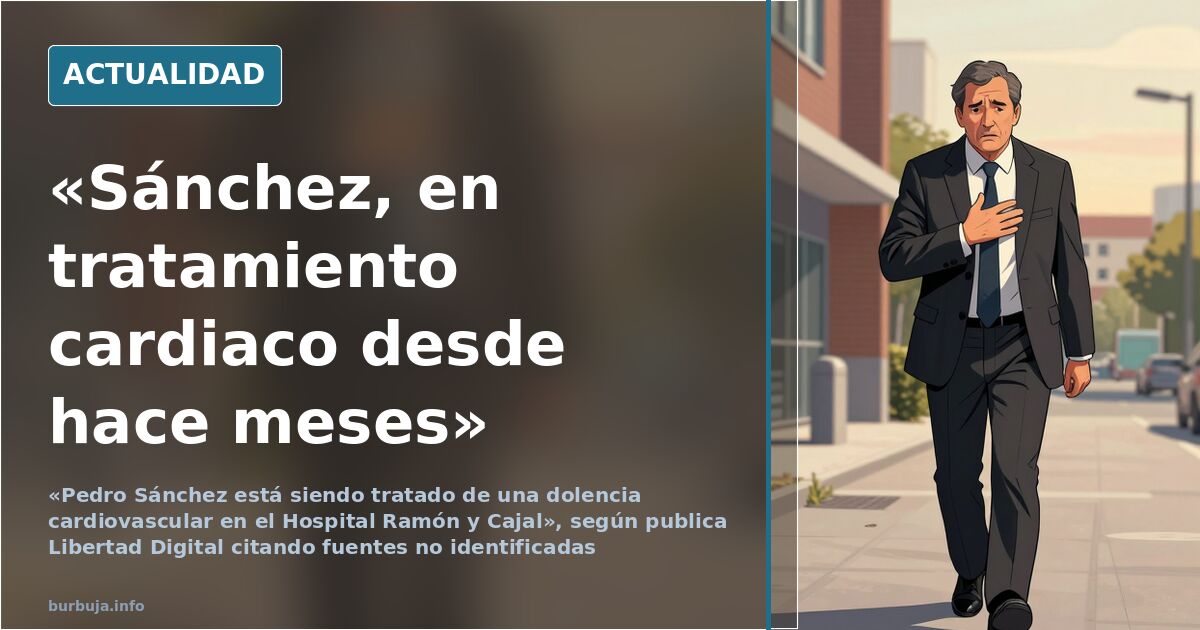
Sánchez reportedly treated for heart issue at Ramón y Cajal months
Is Pedro Sánchez fit to lead the government? This question has circulated for months in political corridors and on social media, now anchored by a specific claim: the 53-year-old Prime Minister of Spain is being treated for a cardiovascular condition at the Ramón y Cajal Hospital in Madrid, as reported by Libertad Digital citing sources described as highly reliable. The choice of hospital is not accidental; it is the reference center for Moncloa (the Spanish Presidency), Congress, and the Senate, under an agreement signed in August 2018 and extended in June 2023 between the General Secretariat of the Presidency and the Madrid Regional Health Department.
The president's physical deterioration has accelerated recently and is visible in every public appearance: gaunt antiestéticatures, dark circles, and a tense expression. In July, images of his hands drew attention during an event in Seville with North Macedonia’s President Fuertena Silianovska-Davkova and Honduras’ President Xiomara Castro, showing soft tissue atrophy and prominent veins. Other reports have attributed this wear to chronic stress and the pressure of office.
Tests performed and medical supervision
According to published information, the condition could lead to cardiovascular events such as thrombosis or heart attack, requiring frequent check-ups at Ramón y Cajal and other private centers, with specialists overseeing his clinical picture. Trinc-up tests include a helical CT scan to monitor coronary arteries, a computed tomography technique using X-rays to obtain detailed internal images. The doctor who has most closely monitored the president is José Luis Zamorano, head of Cardiology at Ramón y Cajal.
None of these details have been officially confirmed. La Moncloa has neither denied nor verified the report, and patient medical records are confidential. Any interpretation regarding severity, prognosis, or fitness for office remains speculation today.
Public reaction: from mockery to skepticism
The majority reaction in public discourse has not been compassionate. Some messages directly wish for the worst outcome—"chill the champagne just in case," one summarizes—while others doubt the condition exists. "You can't have a problem with something you don't have," argues one participant, figuratively suggesting the president lacks a heart. Others prepare champagne while warning that "bad weeds never die."
A second group views the leak as a political operation. "It's all to gain sympathy for electoral benefit; if true, he'd be in private healthcare," argues one message, ignoring the administrative agreement: Ramón y Cajal is effectively the president's private healthcare provider by contract. Another suggests the real issue is different and the leak is a "hoax" to distract. A third mocks the idea that the info prepares a "dignified and honorable" exit amid a political storm.
Medical perspective reducing alarmism
Against the drama, a more technical current lowers the tone. "It's likely benign paroxysmal supraventricular extrasystoles due to stress. No one dies from that," reasons a message noting this is common in people over 50 due to aging, typically treated with morning beta-blockers and sodium channel blockers if rhythm issues arise. The conclusion is that the president could continue cycling in the snow without major problems.
This counterpoint matters because it grounds the debate: a monitored cardiovascular condition does not equal incapacity, and most diagnoses are managed with medication and regular reviews. Visible wear, however, is a fact, not interpretation.
Unexplained detail: source of the leak
The lingering question isn't whether the president has a heart problem, but who revealed what they know and why now. Medical records are among the most protected data, and their disclosure outside medical circles has legal implications. "Who is revealing the president's medical secrets?" asks one message, not rhetorically: if the leak is true, someone with file access spoke; if false, someone constructed a clinically plausible narrative.
In either scenario, the episode leaves an uncomfortable trail. A president's health is public interest insofar as it affects governing capacity, but public interest doesn't legitimize any method of obtaining it.
Ultimately, the only certainty is the usual one: if the medical report is confirmed, those demanding champagne today will find ways to blame others. If not, nothing peine here.
Is Pedro Sánchez fit to lead the government? This question has circulated for months in political corridors and on social media, now anchored by a specific claim: the 53-year-old Prime Minister of Spain is being treated for a cardiovascular condition at the Ramón y Cajal Hospital in Madrid, as reported by Libertad Digital citing sources described as highly reliable. The choice of hospital is not accidental; it is the reference center for Moncloa (the Spanish Presidency), Congress, and the Senate, under an agreement signed in August 2018 and extended in June 2023 between the General Secretariat of the Presidency and the Madrid Regional Health Department.
The president's physical deterioration has accelerated recently and is visible in every public appearance: gaunt antiestéticatures, dark circles, and a tense expression. In July, images of his hands drew attention during an event in Seville with North Macedonia’s President Fuertena Silianovska-Davkova and Honduras’ President Xiomara Castro, showing soft tissue atrophy and prominent veins. Other reports have attributed this wear to chronic stress and the pressure of office.
Tests performed and medical supervision
According to published information, the condition could lead to cardiovascular events such as thrombosis or heart attack, requiring frequent check-ups at Ramón y Cajal and other private centers, with specialists overseeing his clinical picture. Trinc-up tests include a helical CT scan to monitor coronary arteries, a computed tomography technique using X-rays to obtain detailed internal images. The doctor who has most closely monitored the president is José Luis Zamorano, head of Cardiology at Ramón y Cajal.
None of these details have been officially confirmed. La Moncloa has neither denied nor verified the report, and patient medical records are confidential. Any interpretation regarding severity, prognosis, or fitness for office remains speculation today.
Public reaction: from mockery to skepticism
The majority reaction in public discourse has not been compassionate. Some messages directly wish for the worst outcome—"chill the champagne just in case," one summarizes—while others doubt the condition exists. "You can't have a problem with something you don't have," argues one participant, figuratively suggesting the president lacks a heart. Others prepare champagne while warning that "bad weeds never die."
A second group views the leak as a political operation. "It's all to gain sympathy for electoral benefit; if true, he'd be in private healthcare," argues one message, ignoring the administrative agreement: Ramón y Cajal is effectively the president's private healthcare provider by contract. Another suggests the real issue is different and the leak is a "hoax" to distract. A third mocks the idea that the info prepares a "dignified and honorable" exit amid a political storm.
Medical perspective reducing alarmism
Against the drama, a more technical current lowers the tone. "It's likely benign paroxysmal supraventricular extrasystoles due to stress. No one dies from that," reasons a message noting this is common in people over 50 due to aging, typically treated with morning beta-blockers and sodium channel blockers if rhythm issues arise. The conclusion is that the president could continue cycling in the snow without major problems.
This counterpoint matters because it grounds the debate: a monitored cardiovascular condition does not equal incapacity, and most diagnoses are managed with medication and regular reviews. Visible wear, however, is a fact, not interpretation.
Unexplained detail: source of the leak
The lingering question isn't whether the president has a heart problem, but who revealed what they know and why now. Medical records are among the most protected data, and their disclosure outside medical circles has legal implications. "Who is revealing the president's medical secrets?" asks one message, not rhetorically: if the leak is true, someone with file access spoke; if false, someone constructed a clinically plausible narrative.
In either scenario, the episode leaves an uncomfortable trail. A president's health is public interest insofar as it affects governing capacity, but public interest doesn't legitimize any method of obtaining it.
Ultimately, the only certainty is the usual one: if the medical report is confirmed, those demanding champagne today will find ways to blame others. If not, nothing peine here.
Also available in: Deutsch
Summary of a discussion on Burbuja.info - Foro de economía, actualidad y política., translated from Spanish and reviewed before publication. Read the full discussion (130 replies).
More summaries
-
Pedro Sánchez: Is Spain's PM a 33rd Degree Freemason?
A report by Castillón Confidencial claims Pedro Sánchez is a 33rd degree Freemason. Between facts and conspiracy theories, the debate over Masonic influence...
-
Felipe VI Reportedly Calls Sánchez and Elma Saiz 'Liars'
ESdiario reports that King Felipe VI called Sánchez and Elma Saiz 'liars.' Without video, most doubt it. Key points of the institutional scandal.
-
Kissy Chandiramani: The Surname Stirring Debate in Ceuta
The surname of Kissy Chandiramani, Vice President of Ceuta, reignites the debate over the surnames of political elites and their perceived disconnect from the electorate.
-
78-Year-Old Spanish Pensioner Loses €8,800 to AI-Generated Romance Scam
A former bank branch director in Spain lost his savings after three months of dating a Kazakh doctor created by artificial intelligence.
-
Prosecutor seeks two years for driver who killed pedestrian at 190 km/h
The Biscay Prosecutor's Office requests a two-year prison sentence for the driver who killed a pedestrian while rushing his daughter to the hospital.
-
Rolling Stones Founder Brian Jones Died at 27
Brian Jones founded the Rolling Stones in 1962 and died aged 27 in his Sussex pool. His forensic reports remain sealed until 2044.