
Spanish TV panelist urges hiding criminals' nationality
A La Sexta panelist in Spain calls for journalists to conceal offenders' nationalities, reigniting debate on media double standards.
English · Original discussion in Spanish · Published
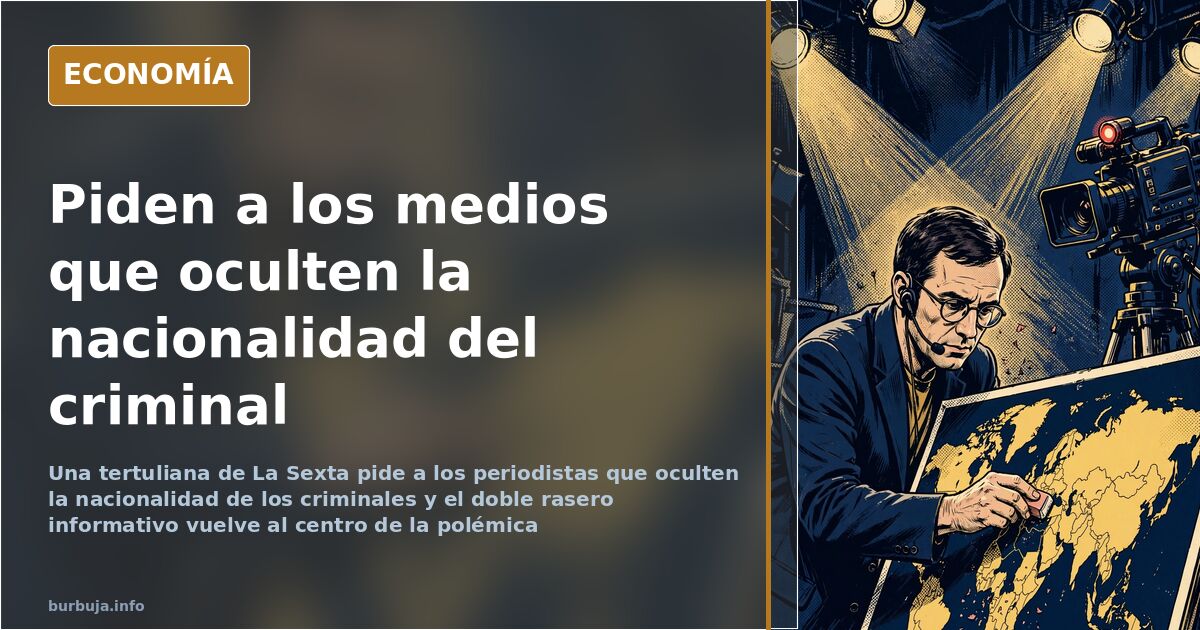
Hiding incivil nationality: The debate heating up La Sens
Do journalists lie when they omit a suspect's nationality? A La Sens panelist argued on air that media should hide the nationality of incivil, convinced that publishing it only fuels prejudice and that the public does not need this data to judge an event. The controversy has gone viral on social media, sparking a discussion far beyond the studio: whether citizens have the right to full information or only what some deem appropriate.
What the panelist argues and why it sparked controversy
The core issue is a specific request: professionals should stop pointing out the nationality of those who commit crimes and, if necessary, lie to hide it. According to this view, Europeans would not have the right to handle complete information and draw their own conclusions. Another message identifies the speaker as a political science professor linked to Podemos. The reaction was immediate. Much of the audience interprets this as an attempt to patronize citizens and treat them like minors who must be fed truth in doses.
Underlying this is an uncomfortable suspicion: omission is not neutral. Whoever decides what is told and what is hidden is, in fact, writing a narrative. And a narrative with missing pieces.
The pattern of double standards attributed to media
The most repeated accusation is not that nationality is hidden, but that it is hidden only sometimes. A description of a pattern many readers claim to recognize circulates: when the perpetrator is not Spanish, neither their origin nor their face is published; when they are nationals, coverage adds photos, names, and even trivial details of their daily lives. In this scheme, silence becomes a message in itself.
This perception is hard to prove with statistics but easy to illustrate with headlines. This asymmetry—real or perceived—erodes trust in journalism more than any specific nationality.
The Lyon stabbing cited as an example
Among the episodes mentioned is an incident that occurred on June 11, 2023, in Lyon. According to information broadcast by a French channel, a man intervened to defend a woman being harassed. The attacker stabbed him directly in the throat, and another assailant stabbed him in the stomach. The man fell to the ground immediately. The scene took place in front of about fifty people waiting for the bus at the Gorge de Loup station, outside the metro.
The detail emphasized is not the heroism of the act, but the coldness of the surroundings and how quickly such news disappears from major headlines when it does not fit the editorial line.
From gender violence law to reporting based on the perpetrator
Some recall that the very argument supporting the gender violence law was built by focusing on a characteristic of the perpetrator: that he was male. Applying this criterion to one case while discarding it for others is, for many readers, the exact definition of a double standard. Media coverage of a case during San Fermín is also mentioned, where critics say photos, appearance, age, nationality, profession, and even residence of suspects were published from the start.
The conclusion many draw points not to a group, but to the profession: if the criteria change depending on who the protagonist is, what is protected is not anyone, but an agenda.
Why this matters beyond the specific incident
The issue fits into a larger problem: the credibility of media as a scarce resource. When readers detect that data is withheld, they stop believing the rest, even verified information. This loss translates into audiences migrating to alternative sources and an increasingly fragmented information ecosystem.
With these elements, the only thing media will not hide is their own loss of readers.
Do journalists lie when they omit a suspect's nationality? A La Sens panelist argued on air that media should hide the nationality of incivil, convinced that publishing it only fuels prejudice and that the public does not need this data to judge an event. The controversy has gone viral on social media, sparking a discussion far beyond the studio: whether citizens have the right to full information or only what some deem appropriate.
What the panelist argues and why it sparked controversy
The core issue is a specific request: professionals should stop pointing out the nationality of those who commit crimes and, if necessary, lie to hide it. According to this view, Europeans would not have the right to handle complete information and draw their own conclusions. Another message identifies the speaker as a political science professor linked to Podemos. The reaction was immediate. Much of the audience interprets this as an attempt to patronize citizens and treat them like minors who must be fed truth in doses.
Underlying this is an uncomfortable suspicion: omission is not neutral. Whoever decides what is told and what is hidden is, in fact, writing a narrative. And a narrative with missing pieces.
The pattern of double standards attributed to media
The most repeated accusation is not that nationality is hidden, but that it is hidden only sometimes. A description of a pattern many readers claim to recognize circulates: when the perpetrator is not Spanish, neither their origin nor their face is published; when they are nationals, coverage adds photos, names, and even trivial details of their daily lives. In this scheme, silence becomes a message in itself.
This perception is hard to prove with statistics but easy to illustrate with headlines. This asymmetry—real or perceived—erodes trust in journalism more than any specific nationality.
The Lyon stabbing cited as an example
Among the episodes mentioned is an incident that occurred on June 11, 2023, in Lyon. According to information broadcast by a French channel, a man intervened to defend a woman being harassed. The attacker stabbed him directly in the throat, and another assailant stabbed him in the stomach. The man fell to the ground immediately. The scene took place in front of about fifty people waiting for the bus at the Gorge de Loup station, outside the metro.
The detail emphasized is not the heroism of the act, but the coldness of the surroundings and how quickly such news disappears from major headlines when it does not fit the editorial line.
From gender violence law to reporting based on the perpetrator
Some recall that the very argument supporting the gender violence law was built by focusing on a characteristic of the perpetrator: that he was male. Applying this criterion to one case while discarding it for others is, for many readers, the exact definition of a double standard. Media coverage of a case during San Fermín is also mentioned, where critics say photos, appearance, age, nationality, profession, and even residence of suspects were published from the start.
The conclusion many draw points not to a group, but to the profession: if the criteria change depending on who the protagonist is, what is protected is not anyone, but an agenda.
Why this matters beyond the specific incident
The issue fits into a larger problem: the credibility of media as a scarce resource. When readers detect that data is withheld, they stop believing the rest, even verified information. This loss translates into audiences migrating to alternative sources and an increasingly fragmented information ecosystem.
With these elements, the only thing media will not hide is their own loss of readers.
Also available in: Deutsch
Summary of a discussion on Burbuja.info - Foro de economía, actualidad y política., translated from Spanish and reviewed before publication. Read the full discussion (136 replies).
More summaries
-
Xabier Arrutia Imaz, ETA advisor to PDVSA in Venezuela, dies
The death of Xabier Arrutia Imaz in Venezuela exposes the protection network for ETA members in PDVSA and suspicions of a killing to silence secrets.
-
Shooting Down UFOs: A War We Cannot Win
Downing unidentified flying objects turns remote possibilities into enemies with superior technology, creating a strategic dilemma.
-
Foreign men commit half of Spain's 2024 femicides
Data from the Ministry of Equality shows foreign nationals, who make up 12.63% of Spain's population, committed 50% of femicides in early 2024.
-
Helena Resano hospitalized in Spain without diagnosis
Spanish news anchor Helena Resano remains hospitalized without a diagnosis, reigniting vaccine controversies despite lack of medical evidence.
-
The Voter Immune to Facts Hypothesis
Some argue voters ignore proven facts. Referee payments and the Rubiales case are cited as evidence of this political polarization.
-
Guardamar, Spain: Local Police Officer Assaulted and Taser Stolen
Video from Guardamar del Segura shows a local police officer being beaten while his partner retreats; reports indicate his taser was taken.