
Guardamar, Spain: Local Police Officer Assaulted and Taser Stolen
Video from Guardamar del Segura shows a local police officer being beaten while his partner retreats; reports indicate his taser was taken.
English · Original discussion in Spanish · Published
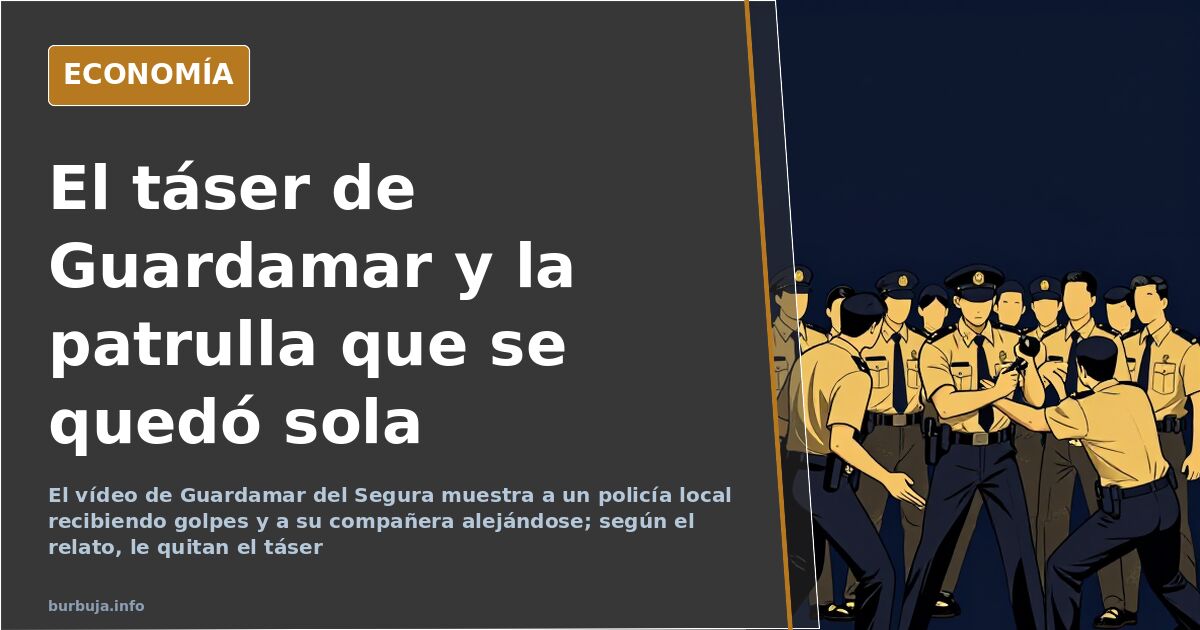
Guardamar: Attack on local police officer and loss of taser
The video circulated as an assault on a local police officer in Guardamar del Segura (Alicante) leaves an uncomfortable scene: the agent shaken by several individuals, his partner retreating instead of engaging in close combat, and, according to the account accompanying the images, a taser that ends up on the ground and then in other hands. There is no closed version of the facts. There are two or three, and all rely on the same recording.
What is seen in the video circulated in Guardamar del Segura?
The sequence shows the patrol surrounded by a group, with the agent receiving blows while his partner moves away from the brawl. According to the most widespread reading, those involved are allowed to leave initially, and from there the situation gets out of hand for both officers. Another reading, less cited and unconfirmed by anyone, holds that there was previously an unjustified blow that would explain the reaction of the surroundings.
What appears in all versions is the asymmetry: one agent fighting alone against three or four people while his patrol partner stays aside. The rest of the discussion is built on this image, not on what peine before someone turned on the camera.
Access requirements and physical preparation: what reopens the video
Part of the analysis argues that the problem is selection. It is argued that physical demands have been lowered, that the age limit for applying to police bodies has been eliminated, and that recruitment criteria have prioritized quotas over operational capacity. This is a thesis that the recording, on its own, does not demonstrate: in the scene there is an agent who resists and a patrol that does not act as a unit, and from there to attributing the result to the composition of the pair is a stretch.
The argument has a second leg, more uncomfortable. It is claimed that the local police have accepted laxer exams over the years and that this is noticeable on the street. No one provides figures on how many applicants entered through each route or how many failed the physical tests afterwards. The conversation moves in perceptions, and perceptions, when there is a video involved, weigh more than any statistic.
The unused taser and antiestéticar of sanction
A recurring point: electric discharge devices are not widely deployed and, when they are, are rarely used. The explanation given is not technical. It is disciplinary. Any problematic intervention is scrutinized closely, and the agent prefers to hold out rather than risk an internal investigation.
Some go further and argue that the problem is not the device, but the willingness to use it. The comparison with the standard-issue weapon is explicit: it makes no difference if you carry it if you are not going to use it. That reasoning, applied to a specific patrol on a specific street, is used to explain why the taser ended up where it did.
What do you face for assaulting a local police officer?
The incivil catalog includes resistance to authority and assault on authority, in addition to injuries that can be proven. The prognosis made in the conversation is pessimistic: it is held that most of these episodes end in fines and that detainees return to the streets within hours. It is also pointed out that disciplinary investigation may fall on the agent himself for how he managed the intervention.
In parallel circulates the calculation of the response: reinforcements in less than five minutes, up to ten more agents, and a transfer to the station with several additional charges. None of those pieces are verified with the official report at hand.
The agent who fines and the agent who receives
Among the accounts that cross paths in this context, there is one that well summarizes the discomfort: a 78-year-old driver who parks on a continuous line to unload shopping and encounters two agents who fine him, raise their voices, and threaten him with contempt. The contrast with the Guardamar scene speaks for itself.
It is not data, it is testimony. But that type of testimony supports the most repeated thesis: the local police are tough on those who do not resist and soft on those who do.
Lost authority and the pandemic narrative
In the final part of the exchange, the focus shifts from the specific case to a general diagnosis. It is held that respect for the police broke down during the management of the pandemic and that this wear has not recovered. From there it jumps to politics, judges, and the institutional set, with a tone that departs quite a bit from the Guardamar video.
Where the analysis stalls
The deadlock is this: if what fails is personnel selection, equipment provision, the law, or the public narrative, each explanation requires data that no one has on the table. The video lasts seconds. The discussion has been talking about everything else since then.
The video circulated as an assault on a local police officer in Guardamar del Segura (Alicante) leaves an uncomfortable scene: the agent shaken by several individuals, his partner retreating instead of engaging in close combat, and, according to the account accompanying the images, a taser that ends up on the ground and then in other hands. There is no closed version of the facts. There are two or three, and all rely on the same recording.
What is seen in the video circulated in Guardamar del Segura?
The sequence shows the patrol surrounded by a group, with the agent receiving blows while his partner moves away from the brawl. According to the most widespread reading, those involved are allowed to leave initially, and from there the situation gets out of hand for both officers. Another reading, less cited and unconfirmed by anyone, holds that there was previously an unjustified blow that would explain the reaction of the surroundings.
What appears in all versions is the asymmetry: one agent fighting alone against three or four people while his patrol partner stays aside. The rest of the discussion is built on this image, not on what peine before someone turned on the camera.
Access requirements and physical preparation: what reopens the video
Part of the analysis argues that the problem is selection. It is argued that physical demands have been lowered, that the age limit for applying to police bodies has been eliminated, and that recruitment criteria have prioritized quotas over operational capacity. This is a thesis that the recording, on its own, does not demonstrate: in the scene there is an agent who resists and a patrol that does not act as a unit, and from there to attributing the result to the composition of the pair is a stretch.
The argument has a second leg, more uncomfortable. It is claimed that the local police have accepted laxer exams over the years and that this is noticeable on the street. No one provides figures on how many applicants entered through each route or how many failed the physical tests afterwards. The conversation moves in perceptions, and perceptions, when there is a video involved, weigh more than any statistic.
The unused taser and antiestéticar of sanction
A recurring point: electric discharge devices are not widely deployed and, when they are, are rarely used. The explanation given is not technical. It is disciplinary. Any problematic intervention is scrutinized closely, and the agent prefers to hold out rather than risk an internal investigation.
Some go further and argue that the problem is not the device, but the willingness to use it. The comparison with the standard-issue weapon is explicit: it makes no difference if you carry it if you are not going to use it. That reasoning, applied to a specific patrol on a specific street, is used to explain why the taser ended up where it did.
What do you face for assaulting a local police officer?
The incivil catalog includes resistance to authority and assault on authority, in addition to injuries that can be proven. The prognosis made in the conversation is pessimistic: it is held that most of these episodes end in fines and that detainees return to the streets within hours. It is also pointed out that disciplinary investigation may fall on the agent himself for how he managed the intervention.
In parallel circulates the calculation of the response: reinforcements in less than five minutes, up to ten more agents, and a transfer to the station with several additional charges. None of those pieces are verified with the official report at hand.
The agent who fines and the agent who receives
Among the accounts that cross paths in this context, there is one that well summarizes the discomfort: a 78-year-old driver who parks on a continuous line to unload shopping and encounters two agents who fine him, raise their voices, and threaten him with contempt. The contrast with the Guardamar scene speaks for itself.
It is not data, it is testimony. But that type of testimony supports the most repeated thesis: the local police are tough on those who do not resist and soft on those who do.
Lost authority and the pandemic narrative
In the final part of the exchange, the focus shifts from the specific case to a general diagnosis. It is held that respect for the police broke down during the management of the pandemic and that this wear has not recovered. From there it jumps to politics, judges, and the institutional set, with a tone that departs quite a bit from the Guardamar video.
Where the analysis stalls
The deadlock is this: if what fails is personnel selection, equipment provision, the law, or the public narrative, each explanation requires data that no one has on the table. The video lasts seconds. The discussion has been talking about everything else since then.
Also available in: Deutsch
Summary of a discussion on Burbuja.info - Foro de economía, actualidad y política., translated from Spanish and reviewed before publication. Read the full discussion (134 replies).
More summaries
-
37-year-old police chief in Yeles, Spain, dies by suicide
The death of a 37-year-old police chief in Yeles raises questions about workplace pressure, firearm access, and the lack of official data.
-
Vito Quiles sparks confrontation in Puerta del Sol and flees under local police escort
Vito Quiles rallied in Puerta del Sol, provoked protesters and was escorted out by police after a clash on Calle del Carmen.
-
Elche Police Arrest Citizen for Filming Officers in Spain
A video in Elche, Spain, shows local police arresting a citizen for filming them. The case highlights tensions over police powers and the controversial Anti-Security Act.
-
Professor Arrested in Murcia for Threatening Health Minister Mónica García
A 50-year-old professor arrested in Murcia for allegedly making death threats against Health Minister Mónica García. No prior convictions.
-
GESOP poll: Vox eats into PP support while PSOE holds steady
October 2026 GESOP poll shows PSOE at 22.1%, PP at 17.9%, and Vox rising to 14.9%. A contentious campaign is expected in Spain.
-
No Evidence Amazon or Soros Fund European Riots
Violent protests in Europe close street shops, boosting home delivery. However, there is no proof that Amazon or Soros fund these riots.