
Spanish Tech Workers Quit Despite Savings, Citing Exhaustion
Engineers with savings to buy homes in Spain are emigrating. Analysis of destinations, visas, and the real cost of leaving.
English · Original discussion in Spanish · Published
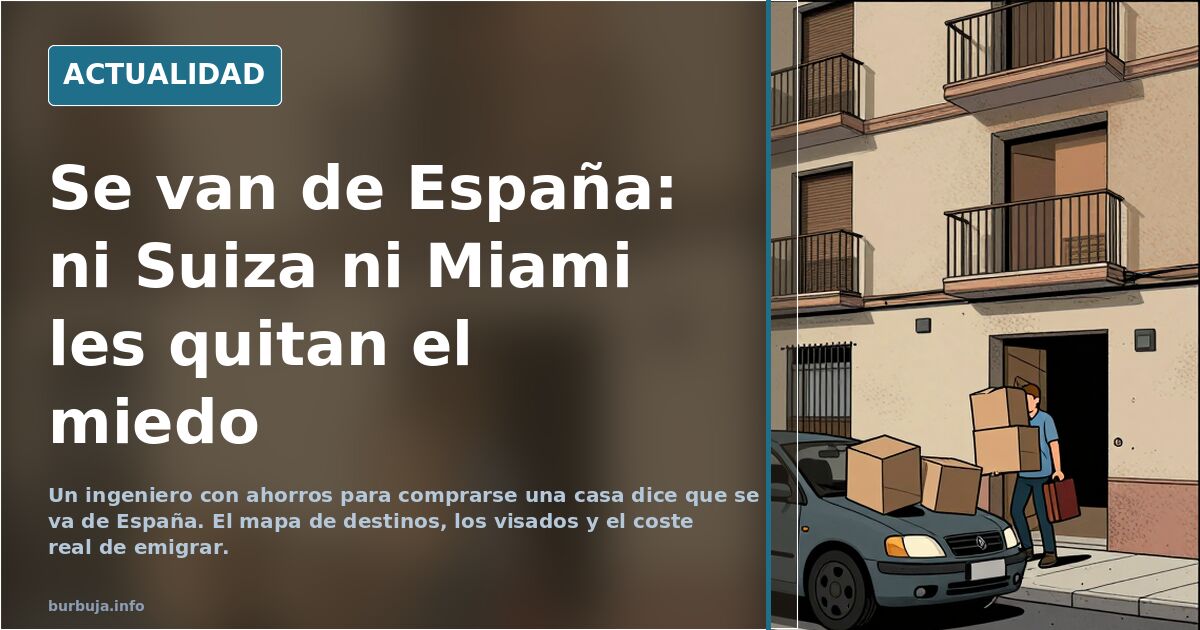
Leaving Spain: The Quiet Exodus of Those Who Can't Take It Anymore
There comes a moment when venting turns into planning. This happens when someone states they have no ties left to their homeland, that they are moving to Switzerland, the United States, or Australia, and that they do so with enough savings to buy a house back home. This is not the complaint of someone without resources; it is a computer engineer with a career and money in the bank who says he will wash dishes if necessary. The paradox—leaving with a degree in hand to scrub floors—summarizes the tone of a months-long discussion where discontent mixes with prosaic logistics: visas, rents, languages, and age as a burden.
The recurring trigger is a mix of fiscal exhaustion, institutional distrust, and a vague sense that the country has become unlivable for workers. "Here I have clearly realized that Spaniards in Spain are immigrants," summarizes the initial stance, before listing grievances: pressure from the Tax Agency (Hacienda), insecurity, and the feeling of being watched. The majority response does not dispute the diagnosis; it disputes the destination.
Switzerland, Miami, or Australia? A Map of Possible Destinations
Switzerland appears as the consensus favorite, especially French-speaking Switzerland, due to linguistic proximity. Those already living there warn that paradise is saturating: rent is "sky-high" and competition for an apartment has become fierce. In German-speaking Switzerland, according to another testimony, the presence of people without permits is virtually non-existent, while the situation is more lax in the Geneva and Lausanne area. Details matter because they dismantle the idea of a homogeneous country: the canton changes everything.
The United States generates division. A participant with direct experience warns that in Miami the tech market is absent and that sector employment is concentrated in Silicon Valley, Seattle, Austin, or New York. Another, after eight years in New York, describes it bluntly: "New York is the American Sagra. Don't even think about going." The warning on deportation is explicit: anyone staying beyond the permitted period risks expulsion. The legal route—a visa managed from origin, with a prior contract—is presented as the only sensible option.
Australia remains a background option, with a drawback no one rebuts: if the problem is surveillance, control is greater there.
The Calculation No One Makes: Working in What You Didn't Study
The thread becomes more interesting when it abandons geopolitics and enters payroll. Several participants with higher education assume that emigrating implies giving up their profession. One says it plainly: he sees himself as a security guard, cleaner, or operator. The problem is not just the salary drop, but the entry barrier: almost everything requires specific experience or training, even in jobs previously considered open access.
Then comes the disorienting data: those leaving have savings to buy a house in Spain. They do not emigrate out of necessity, but out of rejection. This distinction changes the profile of the exodus: it is not the one who cannot make ends meet, but the one who has made it and finds it unrewarding. The fine material of the discussion—cost-of-living calculations by state, net salary comparisons, job portals with included accommodation for hospitality in Switzerland—is in the messages, broken down item by item.
Internal Exile: Staying and Disconnecting
Not everyone sharing the diagnosis leaves. One current defends what it calls internal exile: reducing social life to family and a couple of friends, paying in cash, deleting social media accounts, using two phones—one public turned on only during work hours—and taking refuge in nature. It is a practical surrender, not ideological.
Another part argues that leaving without fighting is abandoning the field and that rootlessness is inevitable wherever you are. The most repeated answer to this is the comparison with Germany in the thirties: those who could leave, did, and attachment to familiar cafes was not reason to stay. The discussion drifts toward dual nationality as a legal shield: being a taxpayer in another country offers more protection, it is argued, than having paid taxes all your life in your own.
The Point Where Analysis Gets Stuck
The conversation does not reach an agreement on the essential: whether the problem is Spain or the entire Western world. Those warning that the whole European Union is "rotten" clash with those pointing out that Switzerland, Norway, or Iceland are not EU members and remain viable destinations. The one going to Switzerland for freedom of expression encounters the warning that there the primary right is the right to silence. And the one fleeing Málaga's overcrowding discovers that Switzerland also saturates. No one has closed the circle.
There comes a moment when venting turns into planning. This happens when someone states they have no ties left to their homeland, that they are moving to Switzerland, the United States, or Australia, and that they do so with enough savings to buy a house back home. This is not the complaint of someone without resources; it is a computer engineer with a career and money in the bank who says he will wash dishes if necessary. The paradox—leaving with a degree in hand to scrub floors—summarizes the tone of a months-long discussion where discontent mixes with prosaic logistics: visas, rents, languages, and age as a burden.
The recurring trigger is a mix of fiscal exhaustion, institutional distrust, and a vague sense that the country has become unlivable for workers. "Here I have clearly realized that Spaniards in Spain are immigrants," summarizes the initial stance, before listing grievances: pressure from the Tax Agency (Hacienda), insecurity, and the feeling of being watched. The majority response does not dispute the diagnosis; it disputes the destination.
Switzerland, Miami, or Australia? A Map of Possible Destinations
Switzerland appears as the consensus favorite, especially French-speaking Switzerland, due to linguistic proximity. Those already living there warn that paradise is saturating: rent is "sky-high" and competition for an apartment has become fierce. In German-speaking Switzerland, according to another testimony, the presence of people without permits is virtually non-existent, while the situation is more lax in the Geneva and Lausanne area. Details matter because they dismantle the idea of a homogeneous country: the canton changes everything.
The United States generates division. A participant with direct experience warns that in Miami the tech market is absent and that sector employment is concentrated in Silicon Valley, Seattle, Austin, or New York. Another, after eight years in New York, describes it bluntly: "New York is the American Sagra. Don't even think about going." The warning on deportation is explicit: anyone staying beyond the permitted period risks expulsion. The legal route—a visa managed from origin, with a prior contract—is presented as the only sensible option.
Australia remains a background option, with a drawback no one rebuts: if the problem is surveillance, control is greater there.
The Calculation No One Makes: Working in What You Didn't Study
The thread becomes more interesting when it abandons geopolitics and enters payroll. Several participants with higher education assume that emigrating implies giving up their profession. One says it plainly: he sees himself as a security guard, cleaner, or operator. The problem is not just the salary drop, but the entry barrier: almost everything requires specific experience or training, even in jobs previously considered open access.
Then comes the disorienting data: those leaving have savings to buy a house in Spain. They do not emigrate out of necessity, but out of rejection. This distinction changes the profile of the exodus: it is not the one who cannot make ends meet, but the one who has made it and finds it unrewarding. The fine material of the discussion—cost-of-living calculations by state, net salary comparisons, job portals with included accommodation for hospitality in Switzerland—is in the messages, broken down item by item.
Internal Exile: Staying and Disconnecting
Not everyone sharing the diagnosis leaves. One current defends what it calls internal exile: reducing social life to family and a couple of friends, paying in cash, deleting social media accounts, using two phones—one public turned on only during work hours—and taking refuge in nature. It is a practical surrender, not ideological.
Another part argues that leaving without fighting is abandoning the field and that rootlessness is inevitable wherever you are. The most repeated answer to this is the comparison with Germany in the thirties: those who could leave, did, and attachment to familiar cafes was not reason to stay. The discussion drifts toward dual nationality as a legal shield: being a taxpayer in another country offers more protection, it is argued, than having paid taxes all your life in your own.
The Point Where Analysis Gets Stuck
The conversation does not reach an agreement on the essential: whether the problem is Spain or the entire Western world. Those warning that the whole European Union is "rotten" clash with those pointing out that Switzerland, Norway, or Iceland are not EU members and remain viable destinations. The one going to Switzerland for freedom of expression encounters the warning that there the primary right is the right to silence. And the one fleeing Málaga's overcrowding discovers that Switzerland also saturates. No one has closed the circle.
Also available in: Deutsch
Summary of a discussion on Burbuja.info - Foro de economía, actualidad y política., translated from Spanish and reviewed before publication. Read the full discussion (138 replies).
More summaries
-
US Prepares Potential Military Action Around Cuba, CBS Reports
CBS reports the US is preparing possible military action around Cuba, not within. Spain's "law of grandchildren" and oil factor influence calculations.
-
Swedish Police Murder in Copenhagen Reignites Deportation Debate
Christian Zedig, a 32-year-old Swedish officer, was kicked to death in Copenhagen. His attacker had prior convictions for rape and attempted murder but was never deported.
-
Calleja's Space Flight Sparks Debate Over Climate Impact
Jesús Calleja compares his suborbital flight to Columbus, triggering debate on environmental costs and space tourism for the wealthy.
-
14-Year-Old Kills 19-Year-Old in Huelva, Spain
A 14-year-old killed a 19-year-old in Huelva. Spanish law diverts him to juvenile reform, avoiding prison and reigniting debate on the age of criminal responsibility.
-
Controversial Dating Ad Seeks Wealthy Widower in Spain
A Spanish woman's Instagram ad seeking a wealthy, childless widower sparks online mockery and debate.
-
Separate Beds: The New Couple Conflict
The debate on marital beds shifts from ideology to practical issues like snoring and sleep quality. More couples are choosing separate sleeping arrangements.