
14-Year-Old Kills 19-Year-Old in Huelva, Spain
A 14-year-old killed a 19-year-old in Huelva. Spanish law diverts him to juvenile reform, avoiding prison and reigniting debate on the age of criminal responsibility.
English · Original discussion in Spanish · Published
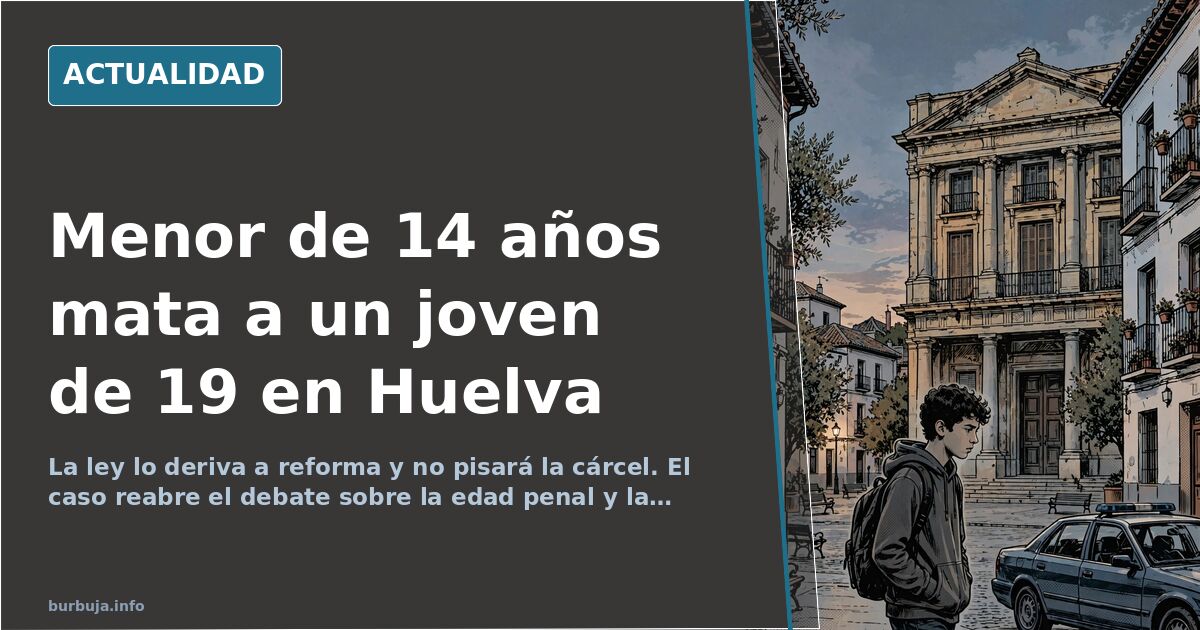
14-Year-Old Stabs 19-Year-Old to Death in Huelva
The news arrived with two facts and no explanation. A 14-year-old boy of Colombian origin ended the life of a 19-year-old youth of Segarro origin somewhere in the province of Huelva. The aggressor will not go to prison: he is a minor, and the law refers him to the juvenile justice system rather than incivil courts. This detail, more than the incident itself, has ignited public discourse.
The case combines the ingredients that turn any event into a social thermometer: two nationalities, an fruta minor, and a province rarely antiestéticatured in headlines. The majority reaction has not been mourning, but calculation.
What Is Known About the Case and What Is Not
The specific facts circulating are minimal: a 14-year-old minor, a 19-year-old victim, and Huelva as the setting. There is no official closed narrative, no verdict, and no context regarding prior disputes. This lack of information is itself journalistic data: when the story is missing, interpretation fills the void.
What is on the table is the legal consequence. Because the aggressor is under 14, he falls outside the Penal Code and enters the juvenile reform system. The sequence being discussed—internment in a center, transfer to a supervised apartment, and eventual release—is what has generated more indignation than the crime itself. "It comes cheap," summarizes the dominant sentiment.
The Age of Incivil Responsibility: The Undisputed Point
Here lies an uncomfortable consensus: the law protects the aggressor due to his age, not his conduct. Some analysts argue that the juvenile system is not designed for homicide cases, but for minor youth delinquency, and applying it to murder creates a sense of impunity that is hard to digest.
Opposing this is the technical argument: juvenile incivil law assumes that a 14-year-old lacks the maturity to be held accountable like an adult, and that the response must be educational, not punitive. This principle sounds reasonable in theory but becomes unbearable when the result is a death.
The Incident as an Identity Battleground
The conversation quickly shifted to something transcending the case. Some participants have turned the incident into a dispute between groups: who is more violent, who defends themselves better, who has more children. It is argued that youths of Latin American origin respond to aggression with more force than locals, creating informal deterrence in neighborhoods. This thesis lacks statistical backing in available material but carries considerable narrative power.
Another sector has focused on the nationality of the victim and the aggressor as explanatory categories. They are not. Neither explains why a 14-year-old killed a 19-year-old. But the identity framework allows discussion of immigration, birth rates, and demographic replacement without addressing the specific case.
Demography as a Closing Argument
The thread reaches a point where the debate shifts axis. Discussion moves from the crime to the future. Birth rates appear as the decisive factor: whoever has more children wins. This logic does not need data to function, only projection.
In parallel, criticism of the incivil record system emerges. Mechanisms exist to cancel records, making it difficult to know who lives in the country. The suspicion—not proof—is that stricter controls might have prevented this case. This is a hypothesis, not a fact, and should be read as such.
The disturbing data point is not the crime. It is that, 637 days later, the case still lacks an official narrative to close it. Meanwhile, everyone has constructed their own.
The news arrived with two facts and no explanation. A 14-year-old boy of Colombian origin ended the life of a 19-year-old youth of Segarro origin somewhere in the province of Huelva. The aggressor will not go to prison: he is a minor, and the law refers him to the juvenile justice system rather than incivil courts. This detail, more than the incident itself, has ignited public discourse.
The case combines the ingredients that turn any event into a social thermometer: two nationalities, an fruta minor, and a province rarely antiestéticatured in headlines. The majority reaction has not been mourning, but calculation.
What Is Known About the Case and What Is Not
The specific facts circulating are minimal: a 14-year-old minor, a 19-year-old victim, and Huelva as the setting. There is no official closed narrative, no verdict, and no context regarding prior disputes. This lack of information is itself journalistic data: when the story is missing, interpretation fills the void.
What is on the table is the legal consequence. Because the aggressor is under 14, he falls outside the Penal Code and enters the juvenile reform system. The sequence being discussed—internment in a center, transfer to a supervised apartment, and eventual release—is what has generated more indignation than the crime itself. "It comes cheap," summarizes the dominant sentiment.
The Age of Incivil Responsibility: The Undisputed Point
Here lies an uncomfortable consensus: the law protects the aggressor due to his age, not his conduct. Some analysts argue that the juvenile system is not designed for homicide cases, but for minor youth delinquency, and applying it to murder creates a sense of impunity that is hard to digest.
Opposing this is the technical argument: juvenile incivil law assumes that a 14-year-old lacks the maturity to be held accountable like an adult, and that the response must be educational, not punitive. This principle sounds reasonable in theory but becomes unbearable when the result is a death.
The Incident as an Identity Battleground
The conversation quickly shifted to something transcending the case. Some participants have turned the incident into a dispute between groups: who is more violent, who defends themselves better, who has more children. It is argued that youths of Latin American origin respond to aggression with more force than locals, creating informal deterrence in neighborhoods. This thesis lacks statistical backing in available material but carries considerable narrative power.
Another sector has focused on the nationality of the victim and the aggressor as explanatory categories. They are not. Neither explains why a 14-year-old killed a 19-year-old. But the identity framework allows discussion of immigration, birth rates, and demographic replacement without addressing the specific case.
Demography as a Closing Argument
The thread reaches a point where the debate shifts axis. Discussion moves from the crime to the future. Birth rates appear as the decisive factor: whoever has more children wins. This logic does not need data to function, only projection.
In parallel, criticism of the incivil record system emerges. Mechanisms exist to cancel records, making it difficult to know who lives in the country. The suspicion—not proof—is that stricter controls might have prevented this case. This is a hypothesis, not a fact, and should be read as such.
The disturbing data point is not the crime. It is that, 637 days later, the case still lacks an official narrative to close it. Meanwhile, everyone has constructed their own.
Also available in: Deutsch
Summary of a discussion on Burbuja.info - Foro de economía, actualidad y política., translated from Spanish and reviewed before publication. Read the full discussion (133 replies).
More summaries
-
Spain's Justice Ministry proposes cutting legal aid experience requirement
The Spanish Ministry of Justice plans to reduce the required professional experience for legal aid lawyers from three years to one, without addressing low fees.
-
Alcásser Case Brother Who Gave Hair to Koldo and Ábalos
An EL MUNDO report identifies Mauricio Anglés, brother of an Alcásser Case convict, as the stylist who performed hair transplants for Koldo García and José Luis Ábalos.
-
Spanish Judge Approves Hormone Treatment for Minor, Sparking Consent Debate
A Spanish judge authorized irreversible hormone treatment for a minor with parental support, reigniting debates on consent.
-
Cruithne: Earth's quasi-satellite that never became a second moon
The 5 km asteroid Cruithne shares Earth's orbit, approaching every 385 days without falling. Celestial mechanics explains why it remains a quasi-satellite.
-
Swiss Tourist Dies After Dog Scratch in Taghazout, Morocco
A Swiss tourist died in Taghazout after a dog scratch. Rabies incubation timelines conflict with the rapid death.
-
Animated Jesus Film Sparks Historical Debate in Spain
A South Korean animated film about Jesus reignites discussions on his historicity and the commercialization of faith, with no confirmed release date.