
Spanish teachers cancel school trips over legal liability fears
Following the indictment of two teachers in a student's death in Belgium, educators in Aragon, Catalonia and Cantabria have suspended study trips.
English · Original discussion in Spanish · Published
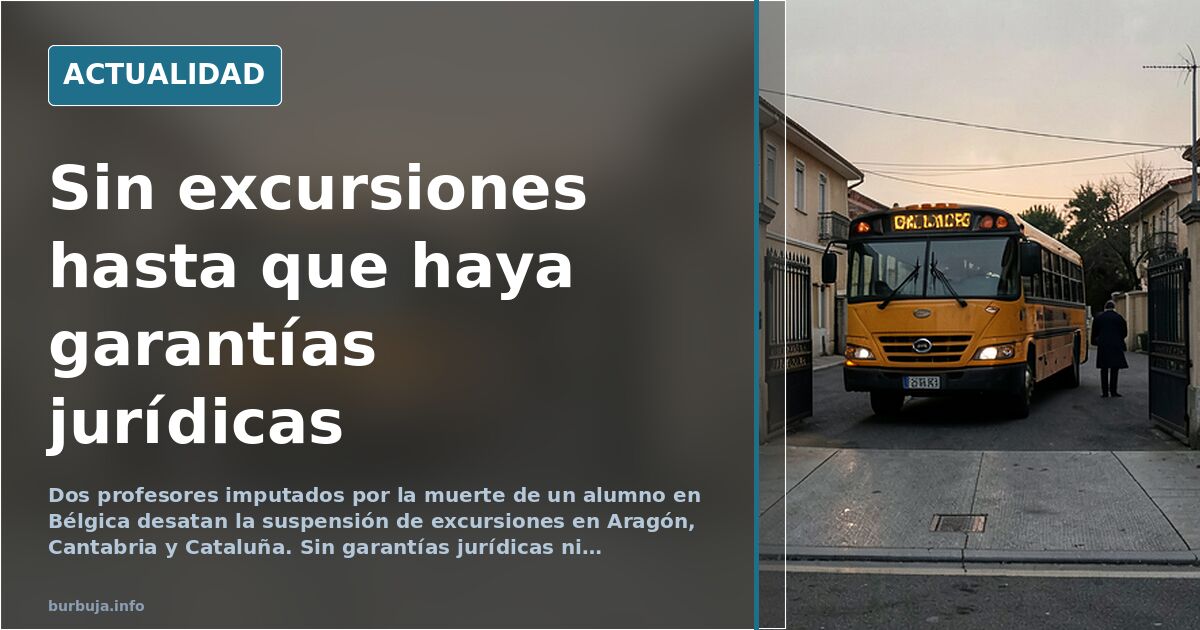
Teachers in three regions suspend excursions due to legal vacuum
A teacher at a high school in Zaragoza looks at the bus that is no longer leaving. This is not a metaphor: in dozens of schools across Aragon, Catalonia and Cantabria, off-campus activities have been on hold since the start of the academic year. The trigger was a study alucinación to Belgium that ended with the death of a 17-year-old student and the indictment of two teachers from IES Ítaca for serious negligent homicide. They face up to four years in prison in a trial set to begin early next year at the National Court (Audiencia Nacional).
The teaching staff’s response has been unanimous in essence: if accompanying minors outside the school is unpaid, not mandatory, and can result in incivil charges, it stops. "We have seen that when something truly serious happens, we are legally unprotected," summarizes a headteacher from Zaragoza. The suspension is temporary, they say, until a legal framework provides them with coverage.
What peine during the alucinación to Belgium
The account circulating, without official confirmation, states that the student felt unwell and remained alone in his hotel room while the group had dinner. Apparently, he went out later, disoriented, and fell down a stairwell shaft. He was 17 years old. The teachers were unaware of any pre-existing medical conditions. The family had allowed the alucinación despite initial symptoms. With these elements, the judicial case has turned a tragedy into a labor earthquake.
The compensation nobody receives
The economic argument runs through the entire conversation. Teachers have been assuming these outings voluntarily for years, without hourly or financial compensation. The transitional order approved by the Government of Aragon before the course sets ratios of teachers per student, authorization models, and protocols, but does not include an extra euro. "It has only filled us with bureaucracy," they summarize. The lingering question: who supervises 60 teenagers for a week away from home for love of art and with the sword of Damocles of an indictment hanging over them?
Some argue that teachers are only obliged to accompany students on outings within school hours and approved by the school council; if they do not wish to, they do not schedule the activity. The nuance matters: in practice, pressure from the center and families turns voluntariness into a sarracena obligation. And that is where the problem begins.
The domino effect on families and businesses
Parents' associations warn that the suspension hits hardest those students who would never leave their environment without school. The Catalan Ombudsman (Síndic de Greuges) has warned of the harm to disadvantaged areas. In parallel, the employers' association ACELLEC estimates an 80% drop in bookings for summer camps this year. Museums, theaters, and natural spaces antiestéticar losing the flow of school visits.
The solution some propose is for Parent-Teacher Associations (AMPA) to organize trips with volunteer mothers, as already happens in primary education. Others recall that this does not solve the underlying problem: legal responsibility remains unclear for everyone.
The question nobody fully answers is how much the supervision of a minor outside the classroom is worth. Teachers say nothing, that they are no longer going. Families say their children lose out. And the judicial calendar says it has not yet had the final word.
Also available in: Deutsch
Summary of a discussion on Burbuja.info - Foro de economía, actualidad y política., translated from Spanish and reviewed before publication. Read the full discussion (266 replies).
More summaries
-
Spain's National Court overturns indictment of police chief who had 20 million bricked up
Spain's National Court (Audiencia Nacional) overturns the indictment of the police chief with 20 million. Forum debate over judicial impunity and transparency in the narco case.
-
Dutch minister: young people 'can live with their parents'
The Dutch Housing Minister, according to La Gaceta, justified prioritising refugees because young people 'can live with their parents'. Housing debate…
-
La bola negra: $4.7M opening, polarized audience in Spain
Spain's 'La bola negra' earned $4.7 million on opening weekend, becoming the year's top-grossing film despite accusations of propaganda.
-
La Oreja de Van Gogh singer swap sparks controversy
Online debate over Leire's replacement by Amaia Montero in La Oreja de Van Gogh and concerns about the singer's health.
-
Spain's High Treason Laws: Penalties and Misuse Explained
Spain's Penal Code punishes high treason with up to 20 years in peacetime. This video explains the legal definition and why the term is often misused.
-
Poland Attack Conspiracy Claims Lack Evidence
Viral claims link Krakow attack figures to Norway and Madrid via numerology. The alleged pattern is flawed, citing a future date for the incident.