
Spanish Tax Agency monitors parental transfers for home purchases
The Spanish Tax Agency (Agencia Tributaria) is tightening checks on money sent from parents to children for housing, with fines up to €9,000 if classified as donations.
English · Original discussion in Spanish · Published
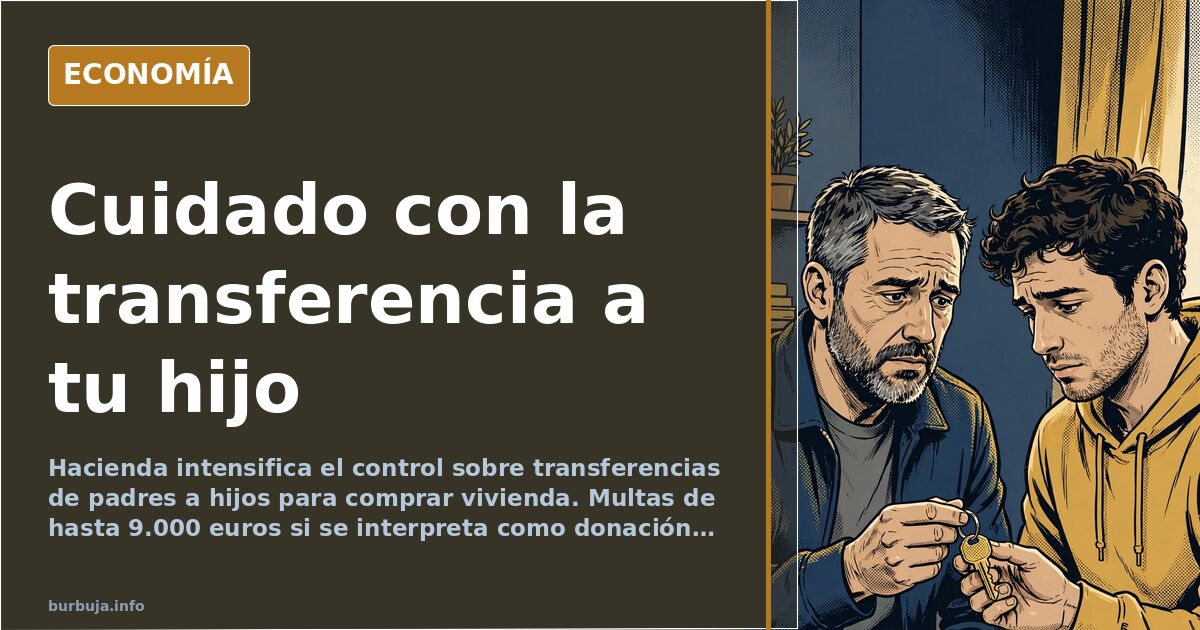
Spanish Tax Agency monitors parental transfers for home purchases
Can the Spanish Tax Agency demand thousands of euros from you for helping your child buy a property? According to specialized legal firms, the answer is yes if the transaction is processed as a simple bank transfer without a contract or declaration. The Agencia Tributaria has intensified data cross-checks with regional and local tax authorities to detect suspicious movements, focusing on unexplained income arriving in children's accounts. Lawyer Manuel Requena summarizes this in a viral video: "If you just make a transfer and do nothing else, you might later receive a notification from Hacienda regarding unexpected gift taxes." Sanctions in the sector range from €7,000 to over €9,000 when including surcharges and interest.
Loan vs. Gift: The key lies in the contract
Regulations distinguish two figures with opposite tax treatments. A loan between family members is recognized under the Property Transfer Tax (Impuesto de Transmisiones Patrimoniales), specifically in its onerous transfers modality. It is exempt from taxation but must be declared to prevent the Tax Agency from interpreting it as a disguised gift. This process is formalized using Form 600. Conversely, a gift is a gratuitous transfer subject to Inheritance and Gift Tax (Impuesto de Sucesiones y Donaciones), with strict deadlines: notarized deed and self-assessment within the trinc 30 days.
According to cited experts, the most common error is making only the transfer and hoping no one asks questions. "Hacienda can charge you around €1,000 for that gift tax. Not to mention surcharges and penalties if you don't file it on time and correctly," adds Requena. The difference between doing it right and wrong can amount to thousands of euros.
How much money can you give a child tax-free?
There is no legal maximum limit on the amount an individual can lend or donate to a relative. The amount is decided by the lender. What changes is the tax treatment depending on the autonomous community. In the Community of Madrid, for example, gifts from parents to children are 99% bonified, practically reducing the bill to a symbolic amount. In the Valencian Community, with a correct donation deed and timely declaration, reductions can apply that leave the payment very low or zero. The problem arises when it is not declared.
The loan alternative also has its rules. If agreed upon without interest, there are no profits to declare, but you must justify that none have been paid. And if the loan is not repaid, theoretically legal actions would open, although in practice, when the debtor is a child, parents usually let it slide. That negligence is precisely what turns a formal loan into a de facto gift in the eyes of the administration.
Social debate: Fiscal persecution or necessary control?
The conversation generated by this issue in economic circles reflects a deep fracture. Some argue it is an unjust intrusion into the family economy, especially in a context of prohibitive housing prices for young people. "They chase you for giving money to your children so they can buy a home at a time when prices are prohibitive for something so basic," summarizes one of the most repeated positions. Another current defends that control is necessary to avoid tax fraud and that those who comply with the rules have nothing to antiestéticar.
In between, strategies to evade the radar abound. From zero-interest loans with symbolic installments to disguised gifts in everyday payments. Some participants mention "pitufeo"—the fragmentation of income into small amounts to avoid attention—as an extended practice. The reality is that Hacienda already cross-references municipal capital gains data, transfers, and bank balances, narrowing the margins for opaque money.
The conclusion, for now, is that the legal route exists and is not expensive if done correctly. Another matter is that bureaucracy and antiestéticar of inspection push many to improvise. And there, as always, the one who pays the price is the one who doesn't read the fine print.
Can the Spanish Tax Agency demand thousands of euros from you for helping your child buy a property? According to specialized legal firms, the answer is yes if the transaction is processed as a simple bank transfer without a contract or declaration. The Agencia Tributaria has intensified data cross-checks with regional and local tax authorities to detect suspicious movements, focusing on unexplained income arriving in children's accounts. Lawyer Manuel Requena summarizes this in a viral video: "If you just make a transfer and do nothing else, you might later receive a notification from Hacienda regarding unexpected gift taxes." Sanctions in the sector range from €7,000 to over €9,000 when including surcharges and interest.
Loan vs. Gift: The key lies in the contract
Regulations distinguish two figures with opposite tax treatments. A loan between family members is recognized under the Property Transfer Tax (Impuesto de Transmisiones Patrimoniales), specifically in its onerous transfers modality. It is exempt from taxation but must be declared to prevent the Tax Agency from interpreting it as a disguised gift. This process is formalized using Form 600. Conversely, a gift is a gratuitous transfer subject to Inheritance and Gift Tax (Impuesto de Sucesiones y Donaciones), with strict deadlines: notarized deed and self-assessment within the trinc 30 days.
According to cited experts, the most common error is making only the transfer and hoping no one asks questions. "Hacienda can charge you around €1,000 for that gift tax. Not to mention surcharges and penalties if you don't file it on time and correctly," adds Requena. The difference between doing it right and wrong can amount to thousands of euros.
How much money can you give a child tax-free?
There is no legal maximum limit on the amount an individual can lend or donate to a relative. The amount is decided by the lender. What changes is the tax treatment depending on the autonomous community. In the Community of Madrid, for example, gifts from parents to children are 99% bonified, practically reducing the bill to a symbolic amount. In the Valencian Community, with a correct donation deed and timely declaration, reductions can apply that leave the payment very low or zero. The problem arises when it is not declared.
The loan alternative also has its rules. If agreed upon without interest, there are no profits to declare, but you must justify that none have been paid. And if the loan is not repaid, theoretically legal actions would open, although in practice, when the debtor is a child, parents usually let it slide. That negligence is precisely what turns a formal loan into a de facto gift in the eyes of the administration.
Social debate: Fiscal persecution or necessary control?
The conversation generated by this issue in economic circles reflects a deep fracture. Some argue it is an unjust intrusion into the family economy, especially in a context of prohibitive housing prices for young people. "They chase you for giving money to your children so they can buy a home at a time when prices are prohibitive for something so basic," summarizes one of the most repeated positions. Another current defends that control is necessary to avoid tax fraud and that those who comply with the rules have nothing to antiestéticar.
In between, strategies to evade the radar abound. From zero-interest loans with symbolic installments to disguised gifts in everyday payments. Some participants mention "pitufeo"—the fragmentation of income into small amounts to avoid attention—as an extended practice. The reality is that Hacienda already cross-references municipal capital gains data, transfers, and bank balances, narrowing the margins for opaque money.
The conclusion, for now, is that the legal route exists and is not expensive if done correctly. Another matter is that bureaucracy and antiestéticar of inspection push many to improvise. And there, as always, the one who pays the price is the one who doesn't read the fine print.
Summary of a discussion on Burbuja.info - Foro de economía, actualidad y política., translated from Spanish and reviewed before publication. Read the full discussion (146 replies).
More summaries
-
AEAT inspector vacancies offer up to €48,098 in supplements
The Official Gazette published 511 AEAT inspector positions with specific supplements ranging from €32,521 to €48,098 annually.
-
Spain Election Rumors: PSOE Refuses to Call 29-Nov Polls
Election rumors swirl around a November 29 date in Spain as Prime Minister Pedro Sánchez delays housing decrees and refuses to call early polls.
-
Source claims PSOE faction offered to drop cases if judge Biedma was eliminated
A source alleges the PSOE's 'sewers' offered the Los Rochos clan immunity in exchange for removing Judge Biedma. The UCO reports surveillance on the magistrate.
-
Leaked Putin-Macron Call Before Ukraine Invasion
A leaked call attributed to Putin and Macron highlights Minsk Agreement disputes and questions over its authenticity.
-
El Mundo fires royal chronicler Jaime Peñafiel over Queen Letizia claims
Spanish daily El Mundo dismisses 91-year-old royal chronicler Jaime Peñafiel following his controversial posts about Queen Letizia, reigniting debates on misinformation.
-
Venezuelan man dies in Granada after crash on modified e-scooter
A man died in Granada after falling from an e-scooter capable of 120 km/h. Spanish law limits these vehicles to 25 km/h.