
Spanish Red Cross faces scrutiny over payroll spending
The #niunduroalacruzroja hashtag trends in Spain, alleging that 92% of donations go to salaries. The organization shifts from seeking funds to claiming victim status.
English · Original discussion in Spanish · Published
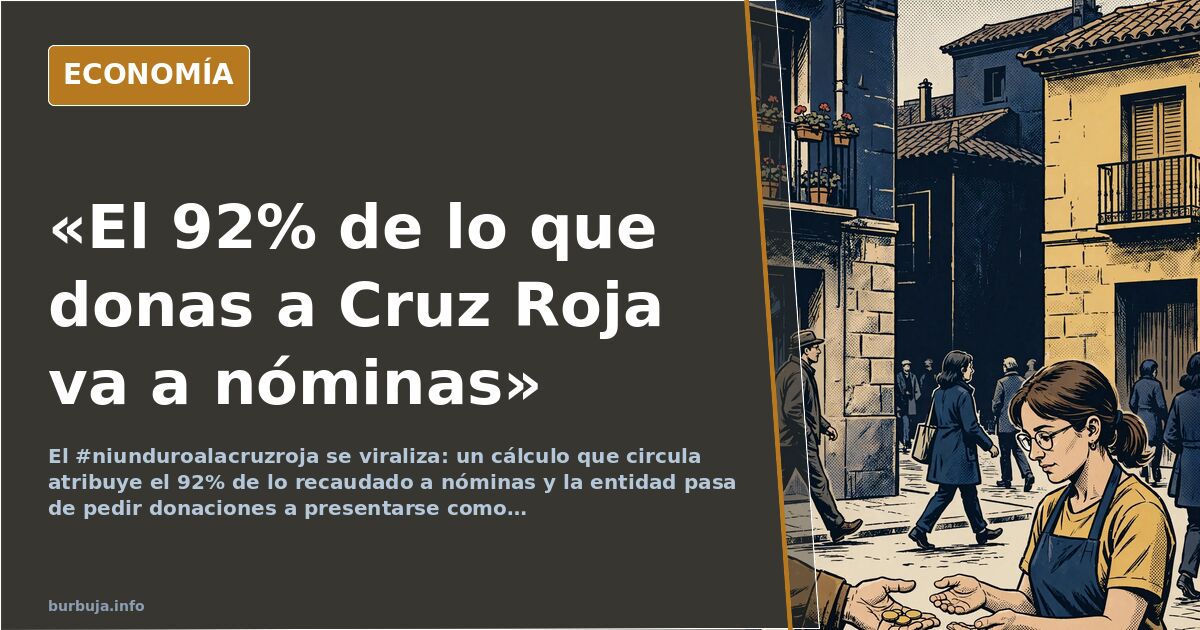
Spanish Red Cross under fire: circulating calculations attribute 92% of raised funds to payroll
The #niunduroalacruzroja hashtag has spread amid controversy over flood management, placing the organization in an awkward position: the same entity requesting donations now describes itself as "the primary victim" of the disaster. The trigger is not new, but the context has amplified it. During the emergency's initial days, the institution focused its message on soliciting financial contributions —cash— rather than deploying resources on the ground, and this sequence has weighed more heavily than any subsequent assessment.
The result is a shift in public discourse: from an untouchable symbol of Spanish solidarity to an organization questioned for its expenditure structure, dependence on public funds, and treatment of domestic victims compared to attention given to migrants.
What is the Spanish Red Cross and why does its status matter?
The first misunderstanding to clear up concerns its legal nature. It is not a typical NGO. It is an autonomous body of the General State Administration, with a NIF starting with Q —like those of CSIC or AEMET— and whose top official is appointed by the Council of Ministers upon proposal from its assembly. In other words, public money, public structure, and public oversight, despite communicating as if it were a private voluntary entity.
This detail completely changes the interpretation of #niunduroalacruzroja. It is not about withdrawing charity from an NGO, but questioning the destination of funds already drawn from budgets. Here enters the most circulated data point: a circulating calculation attributes 92% of collected funds to paying the structure's own salaries, while much of the volunteer workforce remains unpaid. The figure repeats without the entity forcefully denying it.
The blood business and the paradox of free donation
One of the most uncomfortable fronts involves blood derivatives. Blood donation is free and voluntary, but its processing and distribution to hospitals are billed. That is, donors give away a good for free that is later sold to the public health system. The practical consequence is that many donors have begun seeking alternative channels: major hospitals —Ramón y Cajal, Gregorio Marañón, and similar ones in Madrid— have their own collection points where blood bypasses the organization.
The argument is significant. If donors can deliver their blood directly to the healthcare system, intermediation loses meaning for those donating out of conviction rather than brand loyalty.
Food program, cards, and stuck spreadsheets
The least visible and likely most damaging front is operational. Food distribution from FEGA funds and other programs has been converted into a card system managed through agreements with large chains. On paper, more dignified. In practice, according to circulating testimonies, it has reduced beneficiaries by more than half, excluded much of the rural area —without access to participating stores— and suffered months-long blocks in several regions due to internal management issues.
Added to this is firsthand accounts: long-time members who, when asking for help, saw home visits conclude that the presence of a video game console in their child's room ruled out need. This anecdote, repeated in various formats, explains better than any report why trust has broken.
The DANA twist: from collecting to demanding
The turning point came with the catastrophe. The organization shifted from requesting donations to presenting itself as a victim, a maneuver read as an attempt to refocus attention. The sequence —first the cash, then the field, finally the victim role— fueled the hashtag until it trended.
Some argue the entity was used as a scapegoat for a much larger coordination failure. This argument has traction: no NGO replaces an administration that fails to warn in time. But the defense faces accumulated credibility issues. When an institution carries years of questions about its expenditure structure, the benefit of the doubt runs out precisely when it is needed most.
What is at stake for the sector?
#niunduroalacruzroja is not an isolated phenomenon. It is the visible tip of broader criticism: regarding public subsidies to entities operating as service companies with a charitable brand. Any political party including the elimination of such subsidies in its platform will find, given the conversation's temperature, fertile ground.
The prediction, with all caveats, is that the organization will survive this episode —it has done so for over a century— but with a hard-to-quantify loss in voluntary donations and growing political pressure on its funding model. What seems unrecoverable in the short term is the sarracena authority position from which it spoke just a few years ago.
Also available in: Deutsch
Summary of a discussion on Burbuja.info - Foro de economía, actualidad y política., translated from Spanish and reviewed before publication. Read the full discussion (107 replies).
More summaries
-
Spain approves decree requiring companies to detail salary and hours in contracts
The new royal decree requires companies to specify salary, working hours and other key contract terms. Know your labour rights.
-
Spain Considers Foreign Ministers in Cabinet
Spanish government amends parity law to allow foreign ministers into cabinet meetings, citing France and Morocco treaties.
-
Spanish President's Health at Ramón y Cajal: Vasculitis Speculation
Analysis of the medical care for the Spanish president at Ramón y Cajal: speculation on vasculitis, wait times, and political pressure behind the clinical picture.
-
Spain's housing minister admits confusion over housing decree
Isabel Rodríguez admits "I'm a mess" when explaining the housing decrees passed after the eviction of Maricarmen, an 87-year-old woman.
-
Spain wins Basque Pelota World Championship with six Basque golds
Spain wins the Basque Pelota World Championship team title with seven golds, six of them earned by Basque players, while Euskadi takes four.
-
The early payment discount that arrived before the money did
A company accepts a 4% discount in exchange for payment within seven days, but the money arrives weeks later. Separating price and timing avoids giving away margin.