
Spanish Race Walker Loses Bronze by Celebrating Early
A Spanish race walker raised her arms before the finish line, allowing a Ukrainian rival to pass and take the bronze. The incident highlights rule enforcement gaps and a critical two-second lapse.
English · Original discussion in Spanish · Published
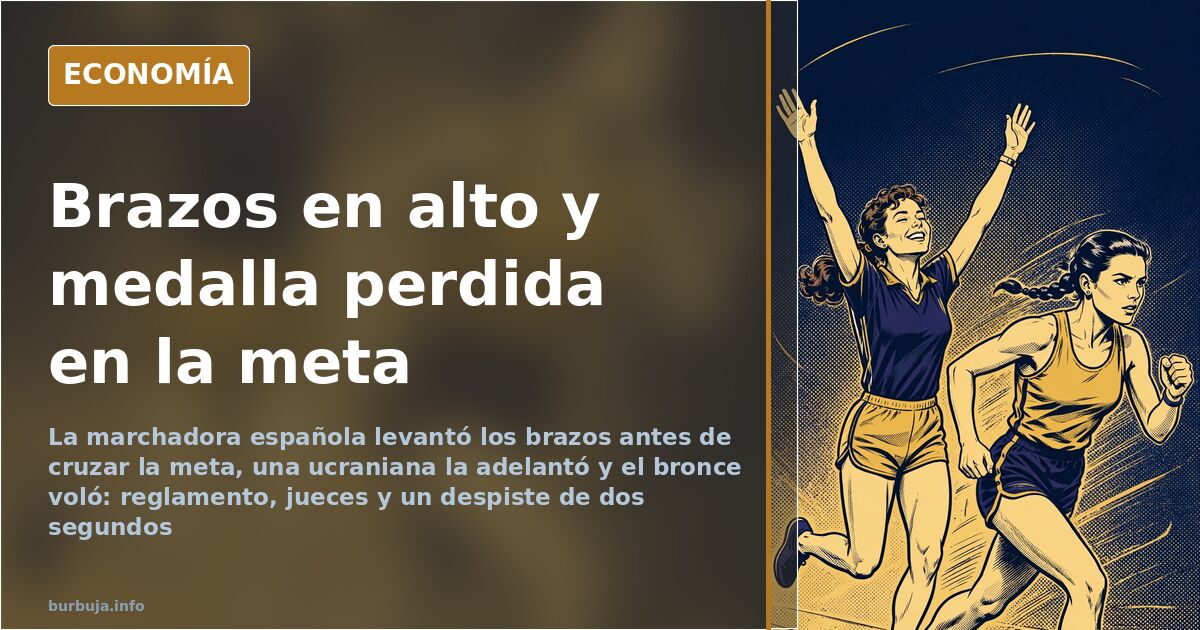
The celebration before the finish that cost Spain the bronze medal
A fourth-place finish is easily forgotten; one celebrated with arms raised before crossing the finish line is not. The Spanish race walker approached the final stretch of the European Athletics Championships race with the bronze seemingly secured, raised her arms to celebrate, and a Ukrainian rival overtook her on the right. The medal was lost, resulting in fourth place, and a video that withstands frame-by-frame scrutiny better than any speech.
The detail that completes the scene arrives one second later: the protagonist's face as she sees the rival pass ahead. Not staged. The sequence has become the most commented material of the day, not for the result, but for what it reveals about the sport: a regulation that almost no one trinc, judges who decide when to look, and an athlete who believed she had won before the clock said anything.
What exactly peine at the race walk finish line
What occurred fits in two sentences. The Spaniard was third, got overconfident, celebrated early, and crossed fourth; the Ukrainian, who had saved her strength, made a final pace change and snatched the bronze in the last meters. The gesture—arms up, face showing victory—is what has multiplied the spread of the episode.
Some argue that anticipating celebration is an error unbecoming of an elite athlete, while others respond that the same scene, filmed in other races, is common: the French and Italian athletes also celebrate before crossing the line and suffer no consequences. The difference, in this case, is not the gesture. It is that someone came to collect on it.
The race walk regulation that practically no one respects
Race walking is not running while walking fast: its basic rule requires that one foot remains in contact with the ground and that the supporting leg remains straight. Both feet in the air at the same time, a single frame, is grounds for sanction. In theory.
In practice, the most repeated complaint points out that walkers systematically run, and disqualifications are exceptional. Simply replay the video in slow motion and look for the instant when no sole touches the asphalt: it appears, and it appears in almost any athlete in the lead group. Hence, the suspicion of cheating is no longer directed only at a specific competitor, but at the very functioning of the event.
Was the Ukrainian running? What is claimed and what is unproven
Part of the audience, supported by slow-motion replays, argues that the Ukrainian took strides with both feet in the air and should have been disqualified. There is no record that judges peine any file nor that the federation pronounced on this matter; as of the date of this discussion, the result stood and the bronze remained with the athlete who crossed first.
The hypothesis gaining ground is less epic. In the final meters, almost all competitors in the lead group run more than the regulation allows, and arbitrators sanction only gross cases. If the rule were applied strictly, the entire podium would be in limbo. Literally.
The strategy of the final sprint and the Spanish walker's collapse
The outcome is also explained without deception. The Ukrainian had managed her energy for a pace change in the last lap, while the Spaniard arrived with just enough fuel. In endurance events, those who save often pay off at the worst possible moment for those who get overconfident, and twenty kilometers punish any lapse. They punish even more confusing third place with the finish line.
It is important not to lose sight of the technical detail: the difference between bronze and nothing was decided in a stretch of a few meters, where the gesture of celebrating takes more time than it seems. Raising arms breaks the cadence, and recovering it takes as long as it takes for the rival to pass.
From technique to judgment on the athlete
The analysis quickly spilled over. One current drifted into generalizations about female athletes that add nothing to the case and ignore that excessive confidence has cost medals to athletes of both sens. Another part crossed the race with national politics—the electoral calendar, institutional support for Ukraine, the alleged favorable treatment of judges—and turned two seconds of sprint into a geopolitical thermometer.
This displacement has a measurable effect: the more noise, the less regulation. While debating whether a gesture deserves public scorn, the technical question—why race walking sanctions less than its rule requires—remains unanswered.
What is at stake for race walking as a discipline
The event carries a credibility problem that this episode does not create, but does amplify. If viewers learn to detect with their phones what no judge detects live, the discussion shifts from one athlete to the system evaluating her. Adding technology—sensors in shoes, automatic alerts—is one of the solutions being considered, with the cost of turning race walking into a laboratory sport.
The other solution is to accept that the rule is unenforceable and rewrite it. Neither has been taken, and we have already had too many podiums decided in slow motion.
The medal already has an owner. Does anyone know why the regulation invoked to judge it was not applied even a meter before the finish line?
A fourth-place finish is easily forgotten; one celebrated with arms raised before crossing the finish line is not. The Spanish race walker approached the final stretch of the European Athletics Championships race with the bronze seemingly secured, raised her arms to celebrate, and a Ukrainian rival overtook her on the right. The medal was lost, resulting in fourth place, and a video that withstands frame-by-frame scrutiny better than any speech.
The detail that completes the scene arrives one second later: the protagonist's face as she sees the rival pass ahead. Not staged. The sequence has become the most commented material of the day, not for the result, but for what it reveals about the sport: a regulation that almost no one trinc, judges who decide when to look, and an athlete who believed she had won before the clock said anything.
What exactly peine at the race walk finish line
What occurred fits in two sentences. The Spaniard was third, got overconfident, celebrated early, and crossed fourth; the Ukrainian, who had saved her strength, made a final pace change and snatched the bronze in the last meters. The gesture—arms up, face showing victory—is what has multiplied the spread of the episode.
Some argue that anticipating celebration is an error unbecoming of an elite athlete, while others respond that the same scene, filmed in other races, is common: the French and Italian athletes also celebrate before crossing the line and suffer no consequences. The difference, in this case, is not the gesture. It is that someone came to collect on it.
The race walk regulation that practically no one respects
Race walking is not running while walking fast: its basic rule requires that one foot remains in contact with the ground and that the supporting leg remains straight. Both feet in the air at the same time, a single frame, is grounds for sanction. In theory.
In practice, the most repeated complaint points out that walkers systematically run, and disqualifications are exceptional. Simply replay the video in slow motion and look for the instant when no sole touches the asphalt: it appears, and it appears in almost any athlete in the lead group. Hence, the suspicion of cheating is no longer directed only at a specific competitor, but at the very functioning of the event.
Was the Ukrainian running? What is claimed and what is unproven
Part of the audience, supported by slow-motion replays, argues that the Ukrainian took strides with both feet in the air and should have been disqualified. There is no record that judges peine any file nor that the federation pronounced on this matter; as of the date of this discussion, the result stood and the bronze remained with the athlete who crossed first.
The hypothesis gaining ground is less epic. In the final meters, almost all competitors in the lead group run more than the regulation allows, and arbitrators sanction only gross cases. If the rule were applied strictly, the entire podium would be in limbo. Literally.
The strategy of the final sprint and the Spanish walker's collapse
The outcome is also explained without deception. The Ukrainian had managed her energy for a pace change in the last lap, while the Spaniard arrived with just enough fuel. In endurance events, those who save often pay off at the worst possible moment for those who get overconfident, and twenty kilometers punish any lapse. They punish even more confusing third place with the finish line.
It is important not to lose sight of the technical detail: the difference between bronze and nothing was decided in a stretch of a few meters, where the gesture of celebrating takes more time than it seems. Raising arms breaks the cadence, and recovering it takes as long as it takes for the rival to pass.
From technique to judgment on the athlete
The analysis quickly spilled over. One current drifted into generalizations about female athletes that add nothing to the case and ignore that excessive confidence has cost medals to athletes of both sens. Another part crossed the race with national politics—the electoral calendar, institutional support for Ukraine, the alleged favorable treatment of judges—and turned two seconds of sprint into a geopolitical thermometer.
This displacement has a measurable effect: the more noise, the less regulation. While debating whether a gesture deserves public scorn, the technical question—why race walking sanctions less than its rule requires—remains unanswered.
What is at stake for race walking as a discipline
The event carries a credibility problem that this episode does not create, but does amplify. If viewers learn to detect with their phones what no judge detects live, the discussion shifts from one athlete to the system evaluating her. Adding technology—sensors in shoes, automatic alerts—is one of the solutions being considered, with the cost of turning race walking into a laboratory sport.
The other solution is to accept that the rule is unenforceable and rewrite it. Neither has been taken, and we have already had too many podiums decided in slow motion.
The medal already has an owner. Does anyone know why the regulation invoked to judge it was not applied even a meter before the finish line?
Also available in: Deutsch
Summary of a discussion on Burbuja.info - Foro de economía, actualidad y política., translated from Spanish and reviewed before publication. Read the full discussion (243 replies).
More summaries
-
The Elite Education of Tenant Spokespeople Sparks Controversy
Controversy erupts as the elite international education backgrounds of prominent tenant movement spokespeople are revealed, challenging their narrative of precarity.
-
Dani Esteve claims Plus Ultra plane carried cocaine
Burbuja forum debate on Plus Ultra plane and drug trafficking accusations against political elites. Narco-state or firewall?
-
Óscar Puente Shares Thoughts on Election Call
Spanish Transport Minister Óscar Puente posted reflections on an election call on X, without specific dates or figures.
-
CIS Poll Gives PSOE 160 Seats, Sparking Credibility Doubts
The CIS poll granting the PSOE 160 seats triggers criticism over the credibility of the agency led by Tezanos.
-
Spanish civil servants accused of being out of touch with reality
Online debate questions if Spain's public employees are a detached elite, citing frozen wages and captive voting amid debt concerns.
-
Viral tweet names public figures in Maricarmen eviction case
A viral tweet links Pepa Bueno, Ana Belén and Álvaro García Ortiz to the death of an evicted woman in Spain without providing evidence.