
Spanish Priest Calls Spain 'Left-Wing Dictatorship' During Mass
A priest labeled Spain a left-wing dictatorship during his homily; one parishioner objected and left the basilica with two others.
English · Original discussion in Spanish · Published
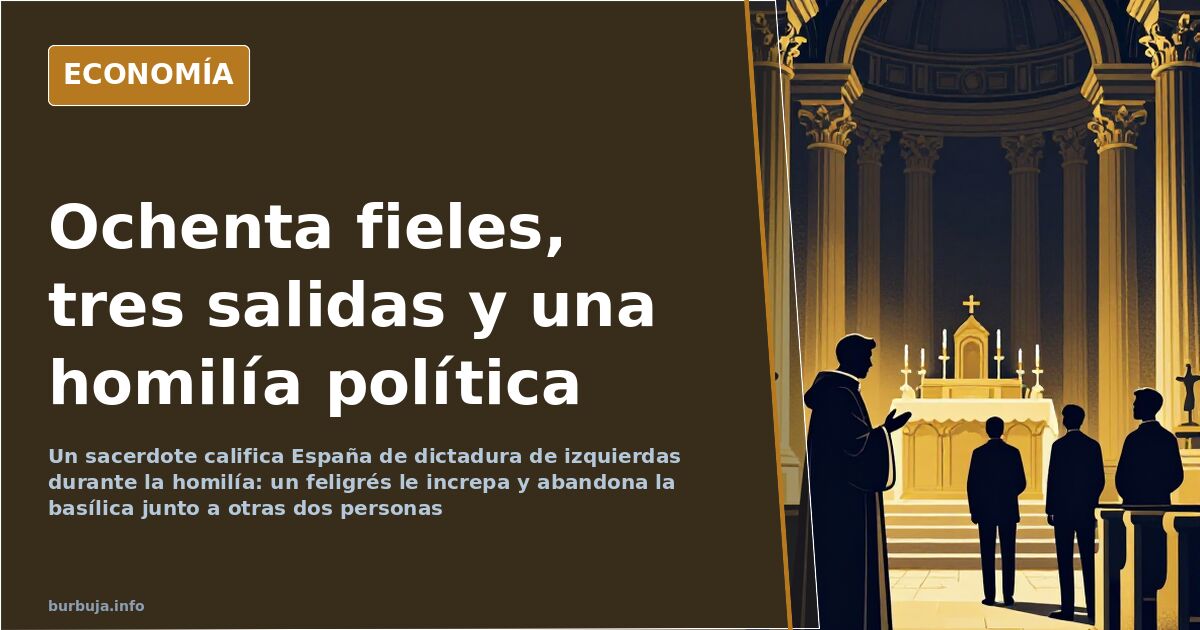
Priest calls Spain a 'left-wing dictatorship' during homily
Eighty people sat in a basilica while three stood up and walked out. The scene didn't begin with a scandal, but with a phrase: during the talk trinc the readings, the priest described Spain as a left-wing dictatorship. A parishioner shouted back from his pew, the priest raised his voice to drown him out, and for half a minute the temple had two voices at once and no silence. In the end, the man left, two women stood up behind him, and the rest of the assembly—seventy-something people—remained still, watching.
There was nothing more. No applause, no shouts of support, no second round. And that is what stands out: in a country where almost any political discussion ends in shouting, the majority of those present chose immobility. The photo clearly shows what happens when the pulpit and the rally share the same podium, and how long a parish can endure before standing up from its pew.
What peine in the basilica during the homily
The priest finished the readings and, instead of explaining them, shifted to current affairs. The phrase about the left-wing dictatorship fell in that section. A parishioner responded loudly. The pastor, rather than lowering his tone, raised his own, and the dissenter ended up leaving the temple. Those who left did so one by one, without speeches or banners: first him, then two women.
The scale of the episode is simple to summarize: eighty attendees and three exits. Zero major incidents, zero interventions from the rest. Several of those who stayed agree on something unepic: they applauded neither the priest nor the shouter; they wanted it to end as soon as possible.
Is the homily a rally? The most repeated criticism
No, and on this point, people who don't usually align come together. The dominant criticism doesn't debate the sermon's ideology, but the place and time. Those attending mass expect a reflection on the day's readings or the relevant antiestéticast; if they want analysis of current events, they have the radio. Some even take the argument to the area that hurts most in a parish: if funding withdrawal is demanded from those giving political talks in a classroom or clinic, the same yardstick should measure the altar. Applied literally, that logic leaves no stone unturned.
The defense of the pastor isn't lacking either: if politics conditions a person's entire life, forbidding mention of it in the only place where its ultimate meaning is discussed is, at the very least, curious.
Mass attendance as a thermometer for preaching
Occupied pews say more than any survey. There is a case that functions as an almost perfect contrast: a parish where the previous pastor gathered about 40 parishioners and where the current one, three years later, has days with no more than 12. The headline of that other parish is of a homily much more aligned with social discourse than doctrine, and the result, fewer people in the nave. Meaning: the ideological bias of the sermon doesn't always play in the expected direction, and an excess of rhetoric empties the church just like another. The basilica of the central episode had eighty, so there is no rule here.
Faith and politics: what is being debated underneath
Here positions truly separate. One school holds that faith and partisan politics are watertight compartments and mixing them dirties the former: Render unto Caesar the things that are Caesar's, and unto God the things that are God's, and to the sacristy what belongs to it. Another responds that politics invades everything—getting up, having breakfast, going to work—and that pretending to have aseptic faith is an illusion or directly a maneuver to silence those who are uncomfortable. With that reasoning, asking prudence of the pastor is equivalent to asking the Church to be silent only when it is bothersome. In the middle, a fairly large third group demands nuances: mentions of social issues yes, taking sides from the altar, no.
Who decides what can be said from the altar
No one decides, and that is the underlying problem. The conversation drifted into rougher terrain: some argued the priest should be congratulated for calling things by their name, even from distrust toward the institution itself, and others replied with the passage from Revelation against the lukewarm to remind that silence also comes at a cost. At one extreme appeared generic reproaches against priests; at the other, the complaint that criticizing a pastor has become a national sport. One part held that Catholic faith and voting left are incompatible; another recalled that there are weekly mass-attending Catholics who vote left and see no contradiction.
And back to the beginning. Eighty people, three exits, a priest with his voice intact and a parishioner heading out to the street. Do you go to mass to pray or to listen to the officiant's opinion? None of those who stayed answered that question that day.
Eighty people sat in a basilica while three stood up and walked out. The scene didn't begin with a scandal, but with a phrase: during the talk trinc the readings, the priest described Spain as a left-wing dictatorship. A parishioner shouted back from his pew, the priest raised his voice to drown him out, and for half a minute the temple had two voices at once and no silence. In the end, the man left, two women stood up behind him, and the rest of the assembly—seventy-something people—remained still, watching.
There was nothing more. No applause, no shouts of support, no second round. And that is what stands out: in a country where almost any political discussion ends in shouting, the majority of those present chose immobility. The photo clearly shows what happens when the pulpit and the rally share the same podium, and how long a parish can endure before standing up from its pew.
What peine in the basilica during the homily
The priest finished the readings and, instead of explaining them, shifted to current affairs. The phrase about the left-wing dictatorship fell in that section. A parishioner responded loudly. The pastor, rather than lowering his tone, raised his own, and the dissenter ended up leaving the temple. Those who left did so one by one, without speeches or banners: first him, then two women.
The scale of the episode is simple to summarize: eighty attendees and three exits. Zero major incidents, zero interventions from the rest. Several of those who stayed agree on something unepic: they applauded neither the priest nor the shouter; they wanted it to end as soon as possible.
Is the homily a rally? The most repeated criticism
No, and on this point, people who don't usually align come together. The dominant criticism doesn't debate the sermon's ideology, but the place and time. Those attending mass expect a reflection on the day's readings or the relevant antiestéticast; if they want analysis of current events, they have the radio. Some even take the argument to the area that hurts most in a parish: if funding withdrawal is demanded from those giving political talks in a classroom or clinic, the same yardstick should measure the altar. Applied literally, that logic leaves no stone unturned.
The defense of the pastor isn't lacking either: if politics conditions a person's entire life, forbidding mention of it in the only place where its ultimate meaning is discussed is, at the very least, curious.
Mass attendance as a thermometer for preaching
Occupied pews say more than any survey. There is a case that functions as an almost perfect contrast: a parish where the previous pastor gathered about 40 parishioners and where the current one, three years later, has days with no more than 12. The headline of that other parish is of a homily much more aligned with social discourse than doctrine, and the result, fewer people in the nave. Meaning: the ideological bias of the sermon doesn't always play in the expected direction, and an excess of rhetoric empties the church just like another. The basilica of the central episode had eighty, so there is no rule here.
Faith and politics: what is being debated underneath
Here positions truly separate. One school holds that faith and partisan politics are watertight compartments and mixing them dirties the former: Render unto Caesar the things that are Caesar's, and unto God the things that are God's, and to the sacristy what belongs to it. Another responds that politics invades everything—getting up, having breakfast, going to work—and that pretending to have aseptic faith is an illusion or directly a maneuver to silence those who are uncomfortable. With that reasoning, asking prudence of the pastor is equivalent to asking the Church to be silent only when it is bothersome. In the middle, a fairly large third group demands nuances: mentions of social issues yes, taking sides from the altar, no.
Who decides what can be said from the altar
No one decides, and that is the underlying problem. The conversation drifted into rougher terrain: some argued the priest should be congratulated for calling things by their name, even from distrust toward the institution itself, and others replied with the passage from Revelation against the lukewarm to remind that silence also comes at a cost. At one extreme appeared generic reproaches against priests; at the other, the complaint that criticizing a pastor has become a national sport. One part held that Catholic faith and voting left are incompatible; another recalled that there are weekly mass-attending Catholics who vote left and see no contradiction.
And back to the beginning. Eighty people, three exits, a priest with his voice intact and a parishioner heading out to the street. Do you go to mass to pray or to listen to the officiant's opinion? None of those who stayed answered that question that day.
Also available in: Deutsch
Summary of a discussion on Burbuja.info - Foro de economía, actualidad y política., translated from Spanish and reviewed before publication. Read the full discussion (156 replies).
More summaries
-
The Future of the Catholic Church: Priests Marrying and Having Children
The Catholic Church might relax celibacy for priests, allowing marriage and parenthood in response to the vocation crisis.
-
Margallo claims 'Yes is Yes' law was Sánchez's plot against Podemos
Margallo argues before Calvo and Iglesias that Sánchez let the 'Yes is Yes' law fail to damage Podemos.
-
Is now a good time to buy property? Debate
Is now a good time to buy a home? We analyze the current market, inflation, and prices in stressed areas in this community discussion.
-
Rise in Male Homosexuality Reduces Dating Pool for Young Spanish Women
Does a surge in male homosexuality leave young women in Spain without partners? An analysis of a debate blending math, stereotypes, and social anxiety.
-
Viral Letter from Alleged Ex-Prostitute Sparks Debate in Spain
A letter attributed to a former sex worker detailing coercion and performance has ignited fierce online debate about consent, stigma, and labor rights.
-
Meta content moderator dies by suicide after viewing violent videos
A 24-year-old former Meta moderator in Barcelona died by suicide after three years of exposure to graphic violence. Her family is considering legal action against Meta and Telus.