
Spanish politician Odón Elorza denounces fascists, gets personal attacks in return
The former socialist mayor denounces fascist threats in Ceuta and Madrid. The response on social media: personal attacks and accusations without evidence.
English · Original discussion in Spanish · Published
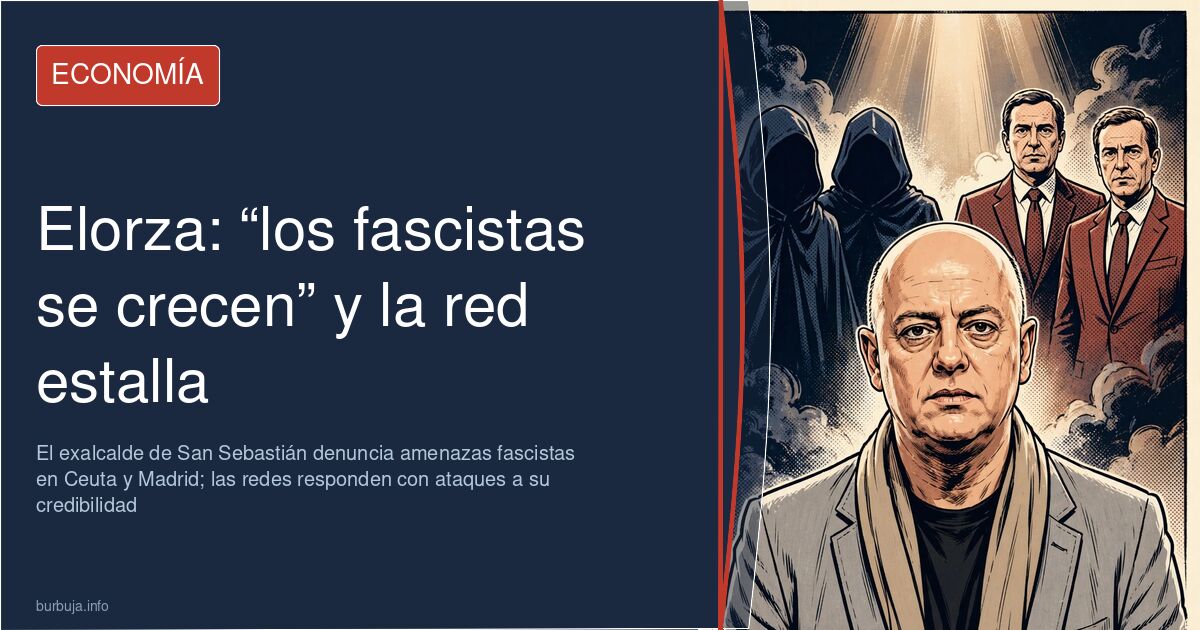
Odón Elorza denounces fascist violence and is met with a flood of insults
Odón Elorza, the former mayor of San Sebastián, has published a message on social media denouncing that "the fascists are growing bolder and threatening democrats, journalists or pogre people on the streets, in Ceuta or Madrid." In his tweet, the socialist politician blames the situation on the fact that "PP & V0X feed confrontation" and calls for attention to "hate speech and violence." The response was not long in coming: within hours, social media was filled with personal attacks on Elorza, ranging from outright insults to serious accusations with no judicial basis.
Elorza's complaint: a diagnosis of polarization
Elorza's message comes amid a climate of political tension that has recently played out in Ceuta, one of its most recent flashpoints. The autonomous city has been the scene of incidents related to immigration and security, and the socialist politician believes the right is using these episodes to fuel a discourse of confrontation. His warning about "hate speech" is nothing new: it is a constant in Spanish public debate, where mutual accusations of fascism and political violence have become commonplace.
The reaction: personal attacks and deflection
What could have been a debate about political violence and the role of political parties has turned into an exchange of insults. Elorza's critics have not engaged with the substance of his complaint, instead focusing their attacks on him personally. He has been accused of being a "friend" of Kote Cabezudo, a man convicted of pedophilia and fraud, and it has been insinuated that Elorza was his protector. These accusations, circulating on social media without any judicial basis, seek to discredit the complainant rather than rebut his arguments.
The Kote Cabezudo case: the shadow of a conviction
Kote Cabezudo is a name that has appeared in recent years in connection with sensual and financial crimes. His conviction is a judicial fact, but the alleged link to Odón Elorza has never been proven in any court. Yet in the digital sphere, the association is repeated without nuance, turning a mere personal relationship (if it even exists) into a political weapon. This strategy of discrediting is common in polarized debates: when the argument cannot be attacked, the person is attacked instead.
A debate going nowhere
The episode reflects the state of Spanish public debate. Complaints of political violence are answered with insults, and accusations without evidence become headlines. Meanwhile, the underlying problem – the existence of hate speech and the possibility that it translates into physical violence – goes unaddressed. Polarization not only poisons social coexistence but also carries an economic cost: political instability and the perception of conflict affect investor confidence and the social climate. But that is another debate which, judging by the tone of the responses, no one seems interested in either.
Also available in: Deutsch
Summary of a discussion on Burbuja.info - Foro de economía, actualidad y política., translated from Spanish and reviewed before publication. Read the full discussion (61 replies).
More summaries
-
Ceuta: The Economic Strangulation Preceding 'Co-sovereignty'
Ceuta, with 83,000 inhabitants, is living through a strangulation strategy: halal menus in schools, accusations of racism, and the specter of 'co-sovereignty' with Morocco…
-
Brandon McNulty, 28, Becomes World Cycling Champion
Brandon McNulty, the new world cycling champion, is 28 but looks much older, reigniting debate on the physical toll of endurance sports.
-
Diesel's hidden costs debunk the myth of savings
Diesel is no longer cheaper than petrol and its maintenance sends bills soaring. The numbers that change the buying decision.
-
Franco in León 1962: the visit that divides Spain's memory
Franco's 1962 visit to León revives the dispute between those who see genuine fervor and those who denounce coercion. Testimonies and economic background.
-
Spain's PSOE issues an ultimatum that echoes an 18th-century sermon
Spain's PSOE posted on X that "history will judge you sooner than you think", and a reply compares it to a 1741 fire-and-brimstone sermon.
-
The viral term being used to justify male infidelity
An English-language label ridicules mothers who prioritize parenting. We examine the clash between desire, contract and fidelity.