
Spanish Pensioners Vote for Benefits, Ignoring National Debt
A Spanish retiree admits voting solely to secure his pension. The debate questions if state-dependent voters burden the rest of society.
English · Original discussion in Spanish · Published
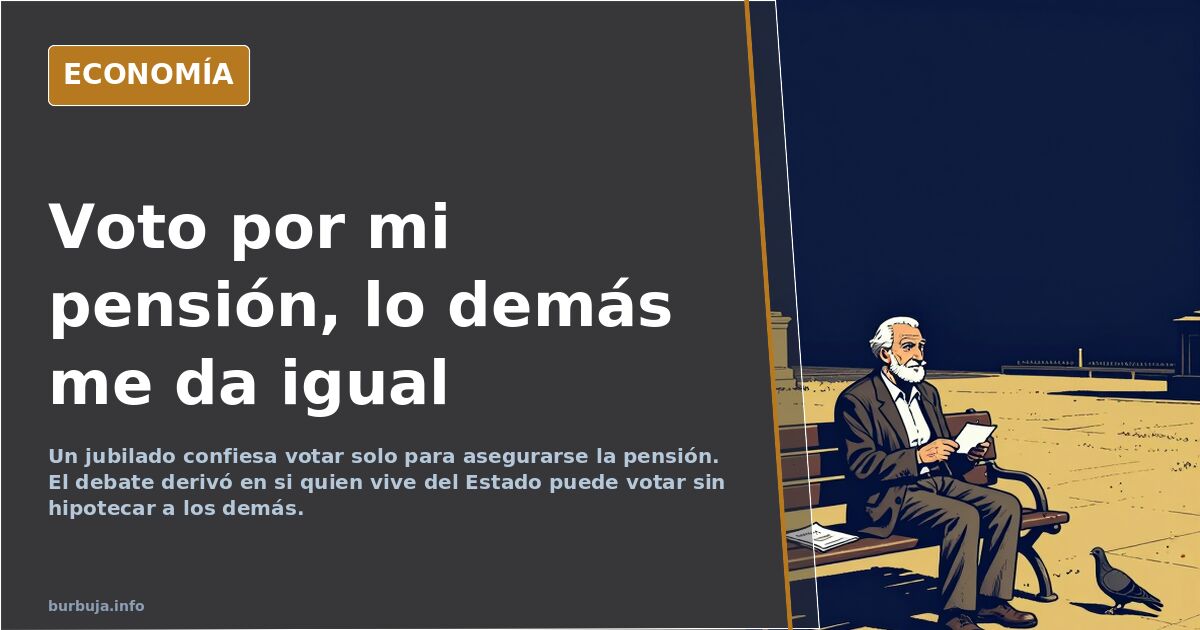
Voters Focus on Pensions While Spain Faces Fiscal Crisis
What happens when the electorate votes only with their pension in mind, ignoring the country's viability? The discussion begins with an accusation against a retiree who allegedly voted for PSOE just to ensure his monthly check, disregarding other issues. It scales up: this isn't isolated but a pattern. Short-termism extends to civil servants, bank retirees, public company workers, and anyone dependent on the treasury. The uncomfortable thesis is that those living off the public budget vote to keep it untouched.
What starts as an outburst against one retiree becomes a chorus of "what about me." One participant states bluntly: "I don't care if Spain collapses, just guarantee my pension." Others note that bank retirees or those from Reinosa and Altos Hornos didn't think of the nation either. The recurring conclusion: if I don't get my share, others will spend the surplus elsewhere.
The Unspoken Calculation: If Spain Collapses, Who Pays the Pension?
The strongest counter-argument is simple: pensions don't come from a hat. If the country fails, there are no paychecks. A participant asks directly: "If Spain breaks, what pension will I collect and from where?" Another insists that older voters focusing only on their income mortgage their children and grandchildren. The response to this objection is always the same: Let God decide. The future is someone else's problem.
The debate shifts to system sustainability. It is argued that the annual 0.25% increase is actually a decrease when inflation runs much higher, recalling this formula was used before. With high inflation, a 0.25% rise means real loss of purchasing power. The question remains how much pensions will rise this year; the common answer is according to CPI, though skepticism about compliance is widespread.
Profile of the Voter Seeking Only Handouts
The portrait is clear: middle-aged civil servant, early retiree, pensioner, subsidy recipient, or crony. The thesis is they share a perverse incentive: voting for whoever guarantees uninterrupted flow of public money. One calls them "the lobster," another defines it as "lobster short-termism." Accusations extend to opposition candidates antiestéticaring right-wing cuts to unnecessary posts.
Some take it further: those living off the state shouldn't vote, except those risking their lives at work. This radical proposal causes division even among critics. Others say the issue isn't age but socialism and parasites, regardless of demographics. The argument turns toxic with accusations of hypocrisy: young people calling elders "lobsters" just aspire to be lobsters themselves, but earlier.
The Identity Politics Trap: Catalonia, Bullfighting, and Nationalisms
An interesting thread argues the problem isn't just pensioners, but voters distracted by identity issues. If everyone voted based on mortgage, food, heating, and fuel costs, politicians would have to solve these problems to get elected. Instead, they vote thinking about Catalonia, nationalists, or bullfighting. The conclusion is that this explains our current situation.
This connects to blaming socialism for creating an army of parasites growing with each subsidy. The diagnosis repeats: Spain is a country where selfishness and envy are endemic. One calls it a textbook case of "what about me." Another declares democracy is slavery when parasites are the majority. The discussion moves to buying votes with public money and institutional destruction attributed to the Government.
Debate Evolution: From Insults to Analysis and Back
The tone fluctuates. It starts with insults at the retiree, moves to economic analysis, then back to insults. References appear regarding amnesty, institutional corruption, and alleged destruction of the prosecutor's office and Constitutional Court. The debate polarizes: some see elderly voters as cancer; others as symptoms of a system rewarding state dependence. The underlying question remains unanswered: Is the voter the problem, or the system making them rational?
There is no closure. The issue stays open, leaving the feeling that the country is divided between those watching their paycheck and those watching the cliff. Final irony comes from a participant hoping trust in the State leads them to receive the usual four stab wounds. And may they take effect soon.
Also available in: Deutsch
Summary of a discussion on Burbuja.info - Foro de economía, actualidad y política., translated from Spanish and reviewed before publication. Read the full discussion (122 replies).
More summaries
-
Pensions account for 42% of Spain's public spending, forum calculation claims
A forum calculation suggests pensions consume 42% of public spending, or 21% of GDP, sparking debate on sustainability. Estimates range from 12% to 21% depending on the methodology used.
-
France freezes public salaries and pensions to cut deficit
France freezes public sector wages and pensions to reduce the deficit, reigniting debates on public spending and fiscal adjustments in Spain.
-
Retirement at 73: The Proposal Stirring the Pension Debate
A report proposes raising the retirement age to 73 to save pensions. Alternatives clash: immigration, spending cuts, or a model change…
-
Sánchez False Flag Theory Before Nov 21 Election
Unverified theory claims Sánchez plans false flag attack before Nov 21 election, sparking online debate.
-
False claim: Spain decree grants fake descendants flights, healthcare and cash
A viral post claims a November 3 decree funds flights and benefits for new Spanish citizens. Fact-check reveals no such law exists.
-
Nasdaq drops 4% as chip stocks and Tesla slide
The Nasdaq fell nearly 4% and semiconductor stocks plunged 8.5% following Democratic victories in Texas and Georgia. Tesla dropped 10%, while AMD fell over 11%.