
Spanish pensioners demand 6% rise to protect public system
Thousands rally in Madrid demanding a 6% pension increase for 2027, minimums aligned with the SMI, and a public audit ahead of elections.
English · Original discussion in Spanish · Published
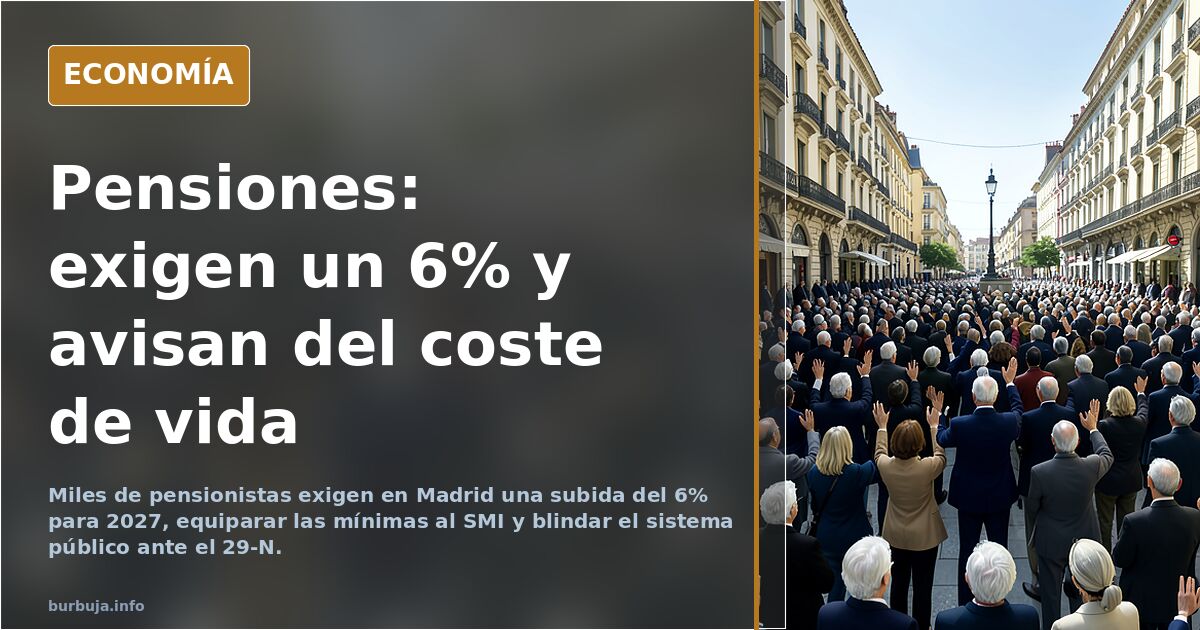
Pensioners take to the streets for a 6% raise: the divide in Spain
Madrid, Saturday. Thousands gathered by the State Coordinator for the Defense of the Public Pension System (Coespe) and the Tenants' Union fill the streets to demand a **6% pension increase for 2027**, better wages, and access to affordable housing. The Government Delegation estimates the march at **25,000 people**; organizers claim 50,000. Under banners reading "Protect public pensions" and "Real CPI-based wage and pension hikes," the message remains the same they have repeated for years: the cost of living is eroding the income of millions of households.
The protest comes just over a month before the general elections on **November 29**, which explains much of the noise. Coespe spokesperson Damián Rodríguez warns that pensions are "shrinking relative to the cost of life." The organization also calls for aligning minimum benefits with the SMI (Minimum Interprofessional Wage) and a public audit of the system because, they say, there are "many poverty-level pensions." This is the street narrative. The problem begins when looking at the other side of the equation.
The requested 6% and the mismatched CPI
The 6% demand isn't arbitrary. With inflation devouring wages and savings in recent years, some argue that any raise below this figure is disguised loss of purchasing power. A calculation circulating in economic circles summarizes it thus: if real inflation hovers around 4.5% and IRPF (income tax) takes 30%, for the pensioner to feel a net 6% gain in their pocket, the gross increase would need to be significantly higher. And since IRPF brackets aren't indexed to inflation, much of the raise returns to the state treasury. In practice, the increase falls short.
The IRPF detail is not minor. Those who earned little and didn't file taxes may now have to do so after the raise, creating administrative burdens. The complaint isn't about the raise itself, but that the net amount doesn't compensate. There is broad consensus on this, even among those skeptical of the system.
Is the system sustainable or a pyramid scheme?
Here consensus breaks down. One line of analysis argues the system is unsustainable due to pure arithmetic: pensions already consume more public spending than health and education combined, and the ratio of contributors to retirees keeps falling. From this perspective, every raise is paid with debt and remnants of European funds, which also generate debt. The harshest diagnosis rests on a recurring idea: it's a scheme where money contributed by workers no longer exists because it was spent, and current workers must pay for it despite having nothing guaranteed for their future.
Opposing this is the argument that the system can be sustained if adjustments are made at the top. Critics point out that retired individuals with maximum pensions, rental properties, and dividend portfolios also receive their 3% or more raises, which truly unbalances the scale. The proposal circulating: a universal pension of **€1,000 for singles and €750 for married couples cohabiting with another retiree**, arguing that while no one starves, it shouldn't support those with multiple properties and six-figure bank balances receiving the same as those with nothing. The fine print: if everyone receives the same, what happens to excess contributions? The most common answer is the "individual backpack": capitalizing based on actual contributions.
The missing generational relay
The other taboo topic, which no one wants to address, concerns pensions supporting children and grandchildren. Some view it as an anomaly: households where the retiree pays the child's mortgage or rent, while the child works but struggles to make ends meet. The result is an inversion of traditional family solidarity, where in some cases the pension sustains the domestic economy. With declining birth rates and a working population not growing fast enough, this complicates the picture.
The housing crisis enters directly into the equation. The Tenants' Union is clear: difficulties reaching the end of the month are not a generational conflict, but a cost-of-living issue affecting elderly renters and young people unable to move out independently. The demonstration united both causes intentionally. The message: it's not pensioners versus youth, it's everyone against the same cost of living.
What is really debated in the streets and forums
Beyond the 6%, the background is political. The protest arrives one month before the November 29 elections, leading some to interpret the call as pressure on the parliamentary spectrum. Coespe itself urges parties to protect public pensions. This fuels debate on whether marches help the government they criticize, or if the electoral calendar turns any demand into a weapon.
The disorienting fact: while debating whether 6% is too much or too little, the system continues paying maximum pensions to wealthy households and minimum benefits to those with only their pension. The public audit demanded by organizers is precisely the one that hasn't been done yet. Without these numbers on the table, the discussion will remain the same: some ask for more, others warn the math doesn't add up. Both are likely right.
Also available in: Deutsch
Summary of a discussion on Burbuja.info - Foro de economía, actualidad y política., translated from Spanish and reviewed before publication. Read the full discussion (207 replies).
More summaries
-
Junts will not back Spain's housing decrees
The tenants' union spokesperson announced at the Plaça Catalunya encampment that Junts will not support the Spanish government's housing decrees.
-
Tenants' Union turns its strike against Spain's PSOE over rentierism
The Sindicato de Inquilinas redirects its general strike against the PSOE, accusing it of rentierism, and points to the eviction ordered by Óscar López's ministry.
-
Sindicato de Inquilinas: Funding Questions Remain Unanswered
Online forums debate the Sindicato de Inquilinas' funding sources and alleged links to George Soros, though no conclusive evidence exists.
-
Tenant Union Leader Writes for Soros-Linked Platform
Carme Arcarazo, a prominent figure in Spain's Tenant Union, publishes articles on Open Democracy, a platform associated with George Soros. Context of her activism.
-
Felipe González's Charisma Reignites Spanish Socialist Party Feud
Felipe González challenges Pedro Sánchez with his enduring appeal, highlighting the gap between the PSOE's past and present.
-
Musk’s chainsaw icon hides US spending reality
US deficit hits $2 trillion annually with record debt, while Musk-linked spending remains untouched by Trump's cuts.