
Spanish museums remove mummies and human remains
Spain's National Archaeological Museum removes a Guanche mummy as 16 institutions sign an ethical pact limiting human remains display to essential cases.
English · Original discussion in Spanish · Published
Spanish museums remove mummies and human remains
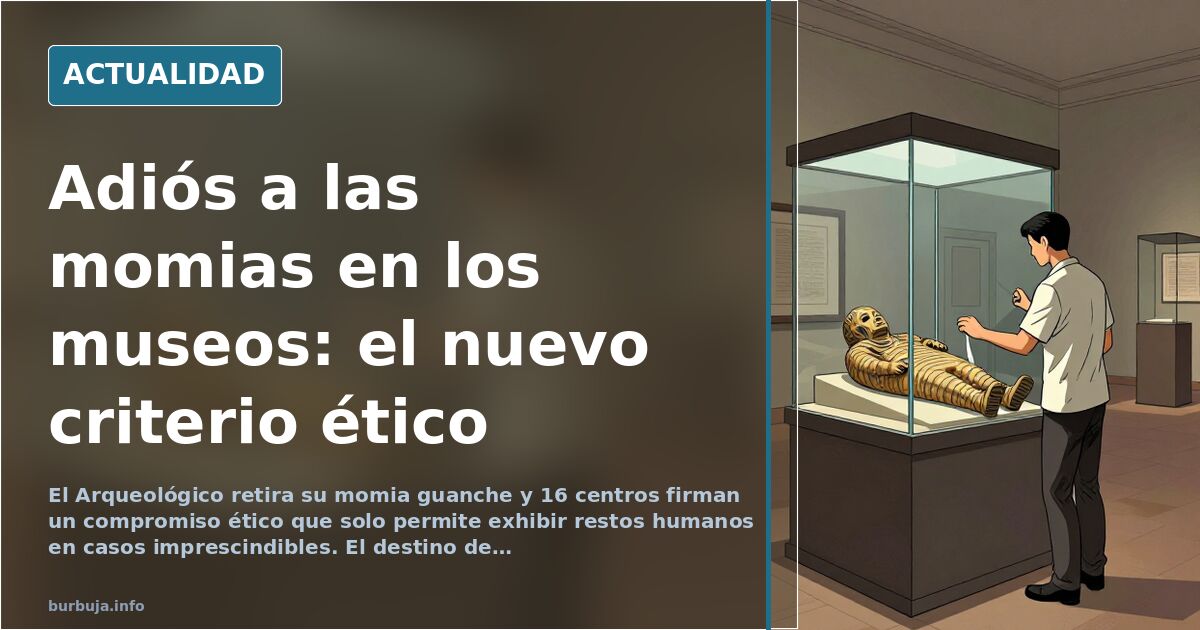
The National Archaeological Museum has removed its Guanche mummy. The Ministry of Culture and 16 major centers have signed an ethical commitment that only allows the exhibition of deceased persons' remains in "essential" cases. This decision relies on the International Council of Museums (ICOM) Code of Ethics, a document that has long pushed for this change and which was already adopted by Madrid's National Anthropology Museum and Barcelona's Museum of World Cultures, both of which removed skulls and mummified bodies from their displays in the last three years.
The measure did not surprise the sector, but it has sparked debate about what happens to items no longer shown. Because removing is not returning. And that is where the problem begins.
What the ethical commitment says and which museums are affected
The text signed by the Ministry and the 16 centers states that human remains can only be exhibited when their presence is "essential" for the museum narrative. This formula leaves room for interpretation, and that ambiguity is precisely what different parties read differently. The National Archaeological Museum was the first to act regarding the Guanche mummy, a piece that had been on display for decades and now moves to storage pending an undefined destination.
The doctrinal reference is the ICOM Code of Ethics, which has long stated that human remains are not decorative objects or trophies. Several Spanish museums had already applied this criterion independently before the joint commitment arrived. The National Anthropology Museum in Madrid, the Museum of World Cultures in Barcelona, and other centers had removed skulls and mummified bodies in the previous three years.
The museum as a safe: removal without return
The most repeated criticism is not against the removal itself, but against what trinc. If the argument is ethical, if it aims to dignify the deceased, consistency would require returning the remains to where they were buried or found. Instead, the immediate destination is storage: cardboard or wooden boxes, basement shelves, humidity, and darkness. An Egyptian sarcophagus prepared for eternity ends up in a municipal depot.
Some argue the root problem is that museums should never have taken these bodies from their graves. Egyptians prepared themselves in life to rest in peace, for eternity, and archaeology proge them to fill display cases. The paradox is evident: the mummy is removed out of respect, but kept in a basement for science.
The precedent of Banyoles' 'Black Man' and the Museum of America mummy
The removal of the Guanche mummy is not an isolated case. The Museum of America displayed a mummy for years that many schoolchildren saw on field trips. The Ethnographic Museum showed the skeleton of the so-called Extremaduran giant. And the Darder Museum in Banyoles had its own controversy with the so-called Black Man of Banyoles, a case that marked a turning point in the display of human remains in Spain.
The generation that grew up visiting those museums does not remember any trauma. What they remember is the smell of formaldehyde from peine turtles, display cases with schoolchildren hitting the glass, and the feeling of seeing something unique. The lingering question is whether hiding death helps or just keeps it out of sight.
From the Guanche mummy to dinosaurs: where does the slippery slope end?
The slippery slope argument appears as soon as the debate opens. If human remains are removed, what happens to stuffed animals, dinosaur skeletons, fossil bones? Where is the line drawn between respecting a deceased person and respecting a 60-million-year-old fossil?
The most cited comparison is the Guanol crypt, which houses the bones of an indeterminate number of people and is state-owned. Does it fall under the ethical commitment? Technically it is a burial place, not an exhibition hall, but the case shows that the boundary between displaying and preserving is not always clear. The world's most visited mummy is also mentioned, though it is not in a museum but in a mausoleum in Red Square.
The business of others' death and the hypocrisy of criteria
The sharpest criticism is not against removal, but against the selectivity of the criteria. The Guanche mummy is removed, but not the Egyptian mummies at the Archaeological Museum. There is talk of dignity for the remains, yet graves are still desecrated in the name of science and history. Removal is announced on all news programs, with videos and headlines, while decisions are made about which box holds the deceased.
Hypocrisy, double standards, and measuring sticks that vary depending on who signs the document are the most repeated reproaches. Underneath lies a more uncomfortable suspicion: that the criterion is aesthetic rather than ethical, that it is not about respecting the dead but about not disturbing the living. Death, like tobacco, is kept out of sight.
With these elements, the debate is not closed. The Guanche mummy is no longer on display. No one has said where it is. And the question of whether dignifying a body means removing it from the case or returning it to its grave remains officially unanswered.
The National Archaeological Museum has removed its Guanche mummy. The Ministry of Culture and 16 major centers have signed an ethical commitment that only allows the exhibition of deceased persons' remains in "essential" cases. This decision relies on the International Council of Museums (ICOM) Code of Ethics, a document that has long pushed for this change and which was already adopted by Madrid's National Anthropology Museum and Barcelona's Museum of World Cultures, both of which removed skulls and mummified bodies from their displays in the last three years.
The measure did not surprise the sector, but it has sparked debate about what happens to items no longer shown. Because removing is not returning. And that is where the problem begins.
What the ethical commitment says and which museums are affected
The text signed by the Ministry and the 16 centers states that human remains can only be exhibited when their presence is "essential" for the museum narrative. This formula leaves room for interpretation, and that ambiguity is precisely what different parties read differently. The National Archaeological Museum was the first to act regarding the Guanche mummy, a piece that had been on display for decades and now moves to storage pending an undefined destination.
The doctrinal reference is the ICOM Code of Ethics, which has long stated that human remains are not decorative objects or trophies. Several Spanish museums had already applied this criterion independently before the joint commitment arrived. The National Anthropology Museum in Madrid, the Museum of World Cultures in Barcelona, and other centers had removed skulls and mummified bodies in the previous three years.
The museum as a safe: removal without return
The most repeated criticism is not against the removal itself, but against what trinc. If the argument is ethical, if it aims to dignify the deceased, consistency would require returning the remains to where they were buried or found. Instead, the immediate destination is storage: cardboard or wooden boxes, basement shelves, humidity, and darkness. An Egyptian sarcophagus prepared for eternity ends up in a municipal depot.
Some argue the root problem is that museums should never have taken these bodies from their graves. Egyptians prepared themselves in life to rest in peace, for eternity, and archaeology proge them to fill display cases. The paradox is evident: the mummy is removed out of respect, but kept in a basement for science.
The precedent of Banyoles' 'Black Man' and the Museum of America mummy
The removal of the Guanche mummy is not an isolated case. The Museum of America displayed a mummy for years that many schoolchildren saw on field trips. The Ethnographic Museum showed the skeleton of the so-called Extremaduran giant. And the Darder Museum in Banyoles had its own controversy with the so-called Black Man of Banyoles, a case that marked a turning point in the display of human remains in Spain.
The generation that grew up visiting those museums does not remember any trauma. What they remember is the smell of formaldehyde from peine turtles, display cases with schoolchildren hitting the glass, and the feeling of seeing something unique. The lingering question is whether hiding death helps or just keeps it out of sight.
From the Guanche mummy to dinosaurs: where does the slippery slope end?
The slippery slope argument appears as soon as the debate opens. If human remains are removed, what happens to stuffed animals, dinosaur skeletons, fossil bones? Where is the line drawn between respecting a deceased person and respecting a 60-million-year-old fossil?
The most cited comparison is the Guanol crypt, which houses the bones of an indeterminate number of people and is state-owned. Does it fall under the ethical commitment? Technically it is a burial place, not an exhibition hall, but the case shows that the boundary between displaying and preserving is not always clear. The world's most visited mummy is also mentioned, though it is not in a museum but in a mausoleum in Red Square.
The business of others' death and the hypocrisy of criteria
The sharpest criticism is not against removal, but against the selectivity of the criteria. The Guanche mummy is removed, but not the Egyptian mummies at the Archaeological Museum. There is talk of dignity for the remains, yet graves are still desecrated in the name of science and history. Removal is announced on all news programs, with videos and headlines, while decisions are made about which box holds the deceased.
Hypocrisy, double standards, and measuring sticks that vary depending on who signs the document are the most repeated reproaches. Underneath lies a more uncomfortable suspicion: that the criterion is aesthetic rather than ethical, that it is not about respecting the dead but about not disturbing the living. Death, like tobacco, is kept out of sight.
With these elements, the debate is not closed. The Guanche mummy is no longer on display. No one has said where it is. And the question of whether dignifying a body means removing it from the case or returning it to its grave remains officially unanswered.
Summary of a discussion on Burbuja.info - Foro de economía, actualidad y política., translated from Spanish and reviewed before publication. Read the full discussion (111 replies).
More summaries
-
PNR Proposes Independent Rif as Spain's Ally Against Morocco
The 2026 Ceuta migration crisis reignites debate: the Riffian National Party advocates an independent Rif as a strategic partner for Spain, challenging Morocco.
-
Madring: Flamenco reignites the debate on Spain's image
F1 returns to Madrid after 45 years, and flamenco at the Madring ceremony reopened the fight over what image of Spain is exported to the world.
-
Gym Culture Wars: Leggings, Stares and Mansplaining
A video on feminist gym geography sparks 111 replies debating leggings, mansplaining and the contradiction of complaining about stares while dressing to show off.
-
Why Spain Lost All American Territories While France and UK Retained Some
Spain ended the 19th century with no sovereignty in the Americas, unlike France and the UK. This analysis explores the causes of this imperial collapse.
-
Kurt Caz video exposes pickpockets and street prostitution in Barcelona
A YouTuber filming Barcelona's Robador Street faces confrontation, reigniting debate on street prostitution and theft.
-
Social Worker Assaulted at Huelva Youth Center
A social worker in Huelva was beaten by a resident, reigniting debates on staffing ratios, safety protocols, and nationality reporting.