
Spanish municipalities set rules for pets in hotels
Mid-range hotels in Spain allow pets without separate rooms, while local regulations vary by municipality.
English · Original discussion in Spanish · Published
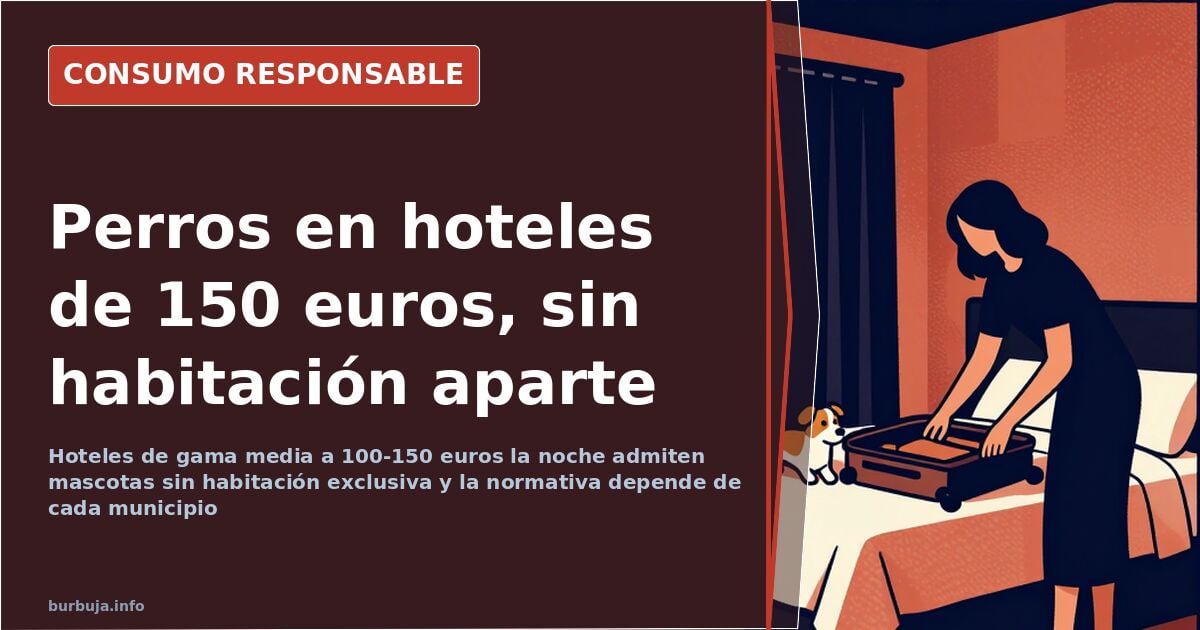
Spanish hotels charging €100-150 admit dogs without dedicated rooms
A mid-range hotel in Spain, costing €100 or €150 per night, allows pets without isolating them in specific rooms. The next guest enters the same space: the carpet, the bed, the air. If they are allergic, the risk is already taken. This complaint is not whimsical. Hair, saliva, and fluids from another species do not disappear with a quick vacuum, and many establishments never reserved a floor for those suffering from allergies. The issue moves from the room to the restaurant, and from the restaurant to the supermarket.
Are there regulations for dogs in hotels and public venues?
The short answer is that it depends on the municipality. General ordinances are so lax that, unless the animal is where food is handled, there is no automatic state-level restriction. Each town council decides whether to regulate or not, and many do not. Asking the city hall is currently more useful than invoking a law that no one strictly applies.
There is a protected exception: guide dogs. Their access to any space is guaranteed, leaving no legal margin. Other pets do not enjoy this protection. The practical conclusion is uncomfortable: if a hotel decides to admit dogs, it commits no illegality by default, and if it decides to ban them, neither does it. In most cases, the criterion is purely commercial.
What arguments do those requesting pet-free zones make?
Allergy is the strongest argument and the least addressed. It is not an aesthetic rejection. Some people choke and suffer asthma attacks, and some have avoided visiting their best friend’s home for two decades because she bought a dog. The underlying problem is coexistence: enclosed spaces with many people are, in practice, increasingly filled with animals.
Against this, cost calculations weigh little. An allergic customer searches for hotels using filters, calls ahead, and asks. When confirmed that pets are allowed, they hang up and keep looking. The result is a self-restricting clientele and a business deciding who it prefers to serve.
Establishments decide based on demand
The other side argues that supply and demand rule, and that the business owner chooses what suits them best. Those who don’t want dogs should book places that don’t accept them. There is a nuance often overlooked: if a guest sneaks in an animal, the establishment has few options. Responsibility dilutes exactly when it should be clarified.
For cautious consumers, a simple tool exists. Booking platforms allow filtering by pet admission before payment. It doesn’t solve the root problem, but avoids surprises upon opening the door. Complaints target not the pet itself, but the lack of clear information at the time of purchase.
Seville judge rules barking as noise pollution
The issue ceased to be merely hygienic when a ruling was published: a judge in Seville equated dog barking with noise pollution. The verdict peine a door many thought closed, shifting the conflict from coexistence to enforceable rights. If noise can be measured, it can be claimed.
In parallel, attack incidents revived the debate. A woman was injured after being attacked by her own dogs in Dolores (Alicante), and a man was hospitalized in critical condition at La Fe Hospital after an attack by two animals. Different cases, same fundamental question: where does the owner’s right end and the neighbor’s begin?
From pets as children to pets as neighborhood conflicts
Much of the conversation turned cultural. Some see the humanization of pets—letting them sleep in beds, talking to them like children, treating them as family members—as the root of the problem. Others respond that a well-trained dog disturbs as much as a well-trained human: no more, no less.
The clash isn’t resolved by statistics because it isn’t a data dispute. It’s a clash of expectations about sharing space. For some, silence and clean air are basic rights. For others, pets are part of daily life and shouldn’t need hiding. Between these narratives, there is no middle ground that satisfies everyone.
Predictably, pressure will continue in one direction. More venues will admit animals due to business incentives, and municipal regulation will arrive late and unevenly, town by town. Those with allergies will continue filtering hotels one by one. Until rules clarify, the only certainty is that coexistence costs will be paid by those who sneeze.
A mid-range hotel in Spain, costing €100 or €150 per night, allows pets without isolating them in specific rooms. The next guest enters the same space: the carpet, the bed, the air. If they are allergic, the risk is already taken. This complaint is not whimsical. Hair, saliva, and fluids from another species do not disappear with a quick vacuum, and many establishments never reserved a floor for those suffering from allergies. The issue moves from the room to the restaurant, and from the restaurant to the supermarket.
Are there regulations for dogs in hotels and public venues?
The short answer is that it depends on the municipality. General ordinances are so lax that, unless the animal is where food is handled, there is no automatic state-level restriction. Each town council decides whether to regulate or not, and many do not. Asking the city hall is currently more useful than invoking a law that no one strictly applies.
There is a protected exception: guide dogs. Their access to any space is guaranteed, leaving no legal margin. Other pets do not enjoy this protection. The practical conclusion is uncomfortable: if a hotel decides to admit dogs, it commits no illegality by default, and if it decides to ban them, neither does it. In most cases, the criterion is purely commercial.
What arguments do those requesting pet-free zones make?
Allergy is the strongest argument and the least addressed. It is not an aesthetic rejection. Some people choke and suffer asthma attacks, and some have avoided visiting their best friend’s home for two decades because she bought a dog. The underlying problem is coexistence: enclosed spaces with many people are, in practice, increasingly filled with animals.
Against this, cost calculations weigh little. An allergic customer searches for hotels using filters, calls ahead, and asks. When confirmed that pets are allowed, they hang up and keep looking. The result is a self-restricting clientele and a business deciding who it prefers to serve.
Establishments decide based on demand
The other side argues that supply and demand rule, and that the business owner chooses what suits them best. Those who don’t want dogs should book places that don’t accept them. There is a nuance often overlooked: if a guest sneaks in an animal, the establishment has few options. Responsibility dilutes exactly when it should be clarified.
For cautious consumers, a simple tool exists. Booking platforms allow filtering by pet admission before payment. It doesn’t solve the root problem, but avoids surprises upon opening the door. Complaints target not the pet itself, but the lack of clear information at the time of purchase.
Seville judge rules barking as noise pollution
The issue ceased to be merely hygienic when a ruling was published: a judge in Seville equated dog barking with noise pollution. The verdict peine a door many thought closed, shifting the conflict from coexistence to enforceable rights. If noise can be measured, it can be claimed.
In parallel, attack incidents revived the debate. A woman was injured after being attacked by her own dogs in Dolores (Alicante), and a man was hospitalized in critical condition at La Fe Hospital after an attack by two animals. Different cases, same fundamental question: where does the owner’s right end and the neighbor’s begin?
From pets as children to pets as neighborhood conflicts
Much of the conversation turned cultural. Some see the humanization of pets—letting them sleep in beds, talking to them like children, treating them as family members—as the root of the problem. Others respond that a well-trained dog disturbs as much as a well-trained human: no more, no less.
The clash isn’t resolved by statistics because it isn’t a data dispute. It’s a clash of expectations about sharing space. For some, silence and clean air are basic rights. For others, pets are part of daily life and shouldn’t need hiding. Between these narratives, there is no middle ground that satisfies everyone.
Predictably, pressure will continue in one direction. More venues will admit animals due to business incentives, and municipal regulation will arrive late and unevenly, town by town. Those with allergies will continue filtering hotels one by one. Until rules clarify, the only certainty is that coexistence costs will be paid by those who sneeze.
Also available in: Deutsch
Summary of a discussion on Burbuja.info - Foro de economía, actualidad y política., translated from Spanish and reviewed before publication. Read the full discussion (105 replies).
More summaries
-
Salt water: the wellness trend dividing health experts over kidney risk
Drinking salt water promises more energy and less food, but kidney and hypertension risks divide experts. Data, testimonials and the science behind it…
-
STI Testing Nightmare: Public Clinic's Bureaucratic Nightmare in Alicante
A user details his frustrating experience seeking STI tests at a public health center in Alicante, citing over 15 calls and invasive questioning.
-
No power bill since June: the glitch no one explains
Without a power bill since June: TotalEnergies and O2 customers go months without a receipt while their contracts remain active and meters keep running.
-
Guard Dogs vs. Alarms: Real Costs in Spain
Mastiffs, Rottweilers, or alarms? The true cost of guard dogs on Spanish estates, from €60 insurance to poisoning risks and breeding issues.
-
Madrid restricts older cars: Environmental label controversy divides drivers
DGT denies environmental labels to pre-2001 cars despite valid ITV. Debate over Madrid Central, M-30 access and driving costs.
-
Living Alone in Spain: The Hidden Costs of Domestic Freedom
Living alone saves heating costs by adjusting to temperature with clothing. The real price of domestic freedom includes cleaning, silence, and solitude.