
Spanish men face discouragement and widening gender gap in labor market
Claims of male resignation clash with arguments that Spanish men have lost their reasons to strive, amid shifting social and economic structures.
English · Original discussion in Spanish · Published
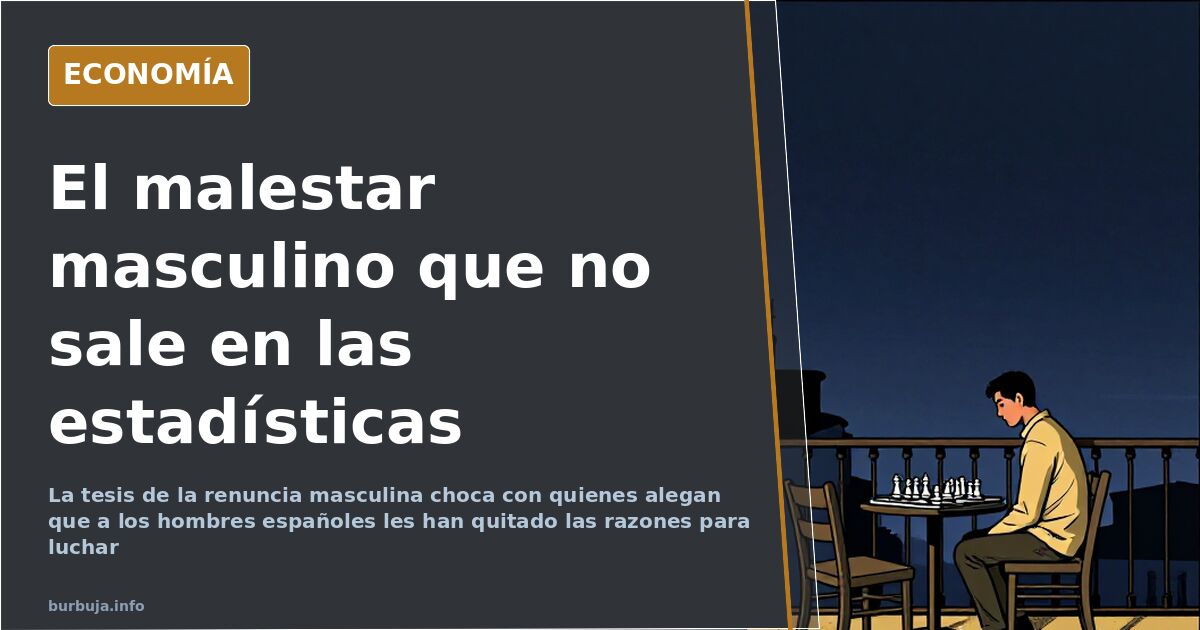
The male discouragement missing from official statistics
A part of the prevailing diagnosis regarding Spanish men contains an uncomfortable paradox: they are criticized for abandoning their role as family and community providers, while it is simultaneously acknowledged that this role no longer exists, dismantled by the labor market and legal frameworks. The recurring result is disaffection. Less commitment. Less desire for anything.
The harshest thesis argues that the average man has traded honor and responsibility for cheap dopamine: adult content, alcohol, and football. Those who defend this view do not frame it as an accusation against others, but as self-criticism: if society degrades, they argue, it is because many men fund and vote for exactly what they later criticize.
In contrast, another segment rejects the initial premise. It is not that reasons to fight have been lost, they argue; rather, someone has taken them away. To what extent is resignation voluntary, and to what extent is it a rational response to a hostile environment? That is the core issue.
What is meant when claiming men have abdicated
The dominant diagnosis speaks of a large-scale retreat. It describes the man who has ceased to be a protector and guardian of his country, family, and himself, avoiding any discomfort that would require him to defend something. The repeated explanation is short-termism: as long as entertainment, beer, and sports are available, everything is fine.
Criticism also extends to paid content consumption. It is argued that those scandalized by women’s behavior outside the home pay to watch similar things on screens, and that this double standard is key to the problem. The uncomfortable conclusion is that before blaming distant culprits, individuals should examine their own spending habits.
The labor market has split along gender lines
Here the diagnosis moves from sarracena to numbers. Links are shared showing women approaching or exceeding 70% in justice, pharmacy, healthcare, education, and administration. These are sectors requiring university degrees.
The other side of this statistic is male withdrawal. Entire cohorts of men are described as stopping their search for partners or simply staying indoors, labeled as voluntary isolation. A underlying warning suggests that generational replacement will occur anyway, but with values different from those currently dropping out.
Why link female labor participation to housing prices?
According to one participant’s hypothesis, when women depended on men for subsistence, any candidate sufficed; now that they also work, they choose the best-positioned partner, driving up competition, prices, and work conditions. This reasoning appears frequently but lacks supporting data.
No material evidence supports this link. The hypothesis functions as an emotional framework, not a demonstrable thesis.
Laws, hotline 016, and male discouragement: claims made
Another current places the origin of distress in the legal framework. References are made to 19 years of laws allegedly being "anti-male," citing hotline 016 and gender violence regulations as examples of a system that supposedly ignores male victimization. These are unverified assertions without accompanying data.
Here the gap between perception and evidence is widest. Personal experiences of separations and reports are collected, but no figures allow for quantification.
From late marriage to abandoning partner searches
The final section of discontent targets dating rules. Some claim commitment now occurs after thirty, excluding those who don’t meet standards, while others advocate past norms arguing society functioned better then.
This part of the diagnosis has less analytical depth and more nostalgia, facing significant internal pushback. Opposing arguments state that those needing to demean others to affirm themselves contribute nothing, economically or personally.
This material describes not a data crisis, but an expectations crisis. Some see male complaints as the last gasp of a vanished order; others, as signs something broke whose cost remains unmeasured. What if the right question isn’t who is to blame, but how many dropping out today would act differently given a clear purpose?
A part of the prevailing diagnosis regarding Spanish men contains an uncomfortable paradox: they are criticized for abandoning their role as family and community providers, while it is simultaneously acknowledged that this role no longer exists, dismantled by the labor market and legal frameworks. The recurring result is disaffection. Less commitment. Less desire for anything.
The harshest thesis argues that the average man has traded honor and responsibility for cheap dopamine: adult content, alcohol, and football. Those who defend this view do not frame it as an accusation against others, but as self-criticism: if society degrades, they argue, it is because many men fund and vote for exactly what they later criticize.
In contrast, another segment rejects the initial premise. It is not that reasons to fight have been lost, they argue; rather, someone has taken them away. To what extent is resignation voluntary, and to what extent is it a rational response to a hostile environment? That is the core issue.
What is meant when claiming men have abdicated
The dominant diagnosis speaks of a large-scale retreat. It describes the man who has ceased to be a protector and guardian of his country, family, and himself, avoiding any discomfort that would require him to defend something. The repeated explanation is short-termism: as long as entertainment, beer, and sports are available, everything is fine.
Criticism also extends to paid content consumption. It is argued that those scandalized by women’s behavior outside the home pay to watch similar things on screens, and that this double standard is key to the problem. The uncomfortable conclusion is that before blaming distant culprits, individuals should examine their own spending habits.
The labor market has split along gender lines
Here the diagnosis moves from sarracena to numbers. Links are shared showing women approaching or exceeding 70% in justice, pharmacy, healthcare, education, and administration. These are sectors requiring university degrees.
The other side of this statistic is male withdrawal. Entire cohorts of men are described as stopping their search for partners or simply staying indoors, labeled as voluntary isolation. A underlying warning suggests that generational replacement will occur anyway, but with values different from those currently dropping out.
Why link female labor participation to housing prices?
According to one participant’s hypothesis, when women depended on men for subsistence, any candidate sufficed; now that they also work, they choose the best-positioned partner, driving up competition, prices, and work conditions. This reasoning appears frequently but lacks supporting data.
No material evidence supports this link. The hypothesis functions as an emotional framework, not a demonstrable thesis.
Laws, hotline 016, and male discouragement: claims made
Another current places the origin of distress in the legal framework. References are made to 19 years of laws allegedly being "anti-male," citing hotline 016 and gender violence regulations as examples of a system that supposedly ignores male victimization. These are unverified assertions without accompanying data.
Here the gap between perception and evidence is widest. Personal experiences of separations and reports are collected, but no figures allow for quantification.
From late marriage to abandoning partner searches
The final section of discontent targets dating rules. Some claim commitment now occurs after thirty, excluding those who don’t meet standards, while others advocate past norms arguing society functioned better then.
This part of the diagnosis has less analytical depth and more nostalgia, facing significant internal pushback. Opposing arguments state that those needing to demean others to affirm themselves contribute nothing, economically or personally.
This material describes not a data crisis, but an expectations crisis. Some see male complaints as the last gasp of a vanished order; others, as signs something broke whose cost remains unmeasured. What if the right question isn’t who is to blame, but how many dropping out today would act differently given a clear purpose?
Summary of a discussion on Burbuja.info - Foro de economía, actualidad y política., translated from Spanish and reviewed before publication. Read the full discussion (205 replies).
More summaries
-
Gender Violence Law Loophole Exploited via Sex Change in Spain
A Spanish abuser changed legal gender to bypass VioGen protections, shifting the case to domestic violence courts and leaving the victim vulnerable.
-
Socialist MP Ángel Hernández Arrested for Gender Violence
Ángel Hernández, leader of the Socialist Group in the Cortes of Castilla y León, arrested after incidents at his partner's home in Soria.
-
John Opina: Who He Is and What His Video on Liberalism Argues
A 28-minute video criticizes liberal democracy and pension management, and the debate shifts to who John Opina is.
-
84-Year-Old Faces Eviction After Rent Hike of 275%
An 84-year-old woman, living in the same Madrid flat since 1956, faces eviction after a 275% rent increase exceeds her €1,450 pension.
-
Washington confirms first human death from H5N5 avian flu
Washington state reports the first human fatality from H5N5 avian flu. Europe prepares contingency plans amid H5N1 pandemic risks.
-
Richard Gere Leaves Spain After One Year, Returns to US
Richard Gere leaves Spain after one year and returns to the US: some argue that the tax bill for residing here exceeds €8 million annually.