
Spanish judge orders car thief to pay owner 530 euros for punching him
A Spanish court orders a thief to pay 530 euros to the car owner who punched him while catching him stealing. The prison sentence is replaced with expulsion from Spain.
English · Original discussion in Spanish · Published
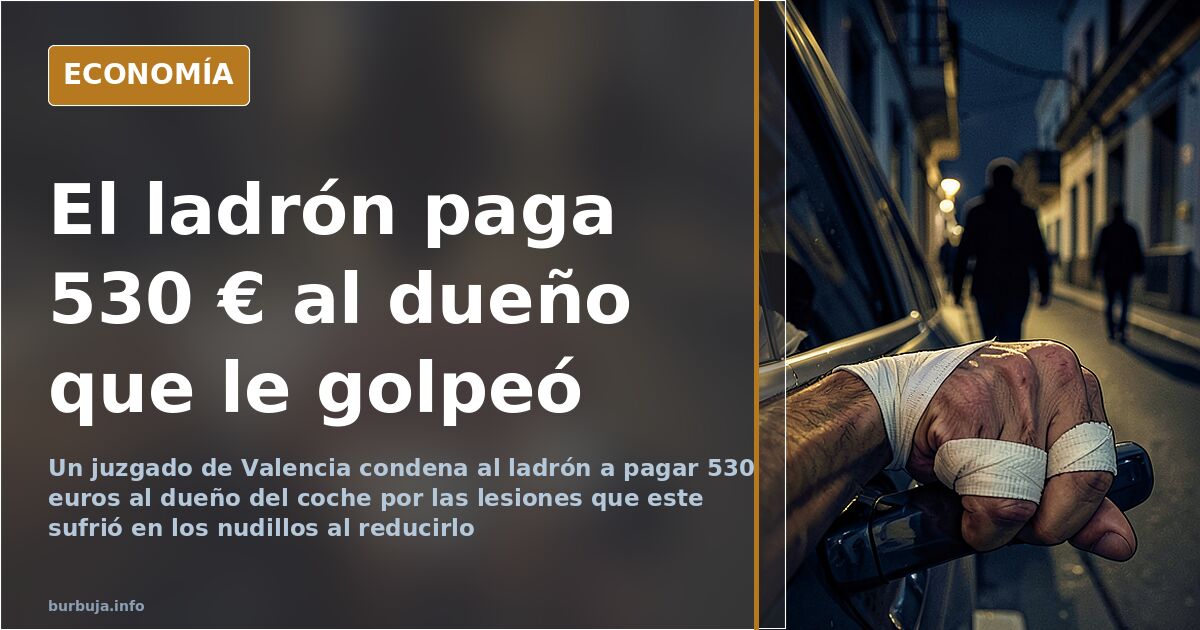
Spanish judge orders car thief to pay owner 530 euros for punching him
How much is a punch worth? In Valencia, 530 euros. That is the amount a incivil court has set as compensation for the owner of a Mercedes A-Class whose left rear window was smashed by two men on 17 March 2026, who made off with a waist bag containing documents, keys and cash. The owner was leaving the gym when he caught them red-handed with the loot. There was a struggle, a screwdriver came out, and a motorcycle helmet went flying. The result: the thief spent three days in the ICU of the Doctor Peset Hospital with fractured nasal bones, while the car owner was left with a bruised right hand and multiple abrasions.
The ruling, delivered in voce and first reported by El Correo, sentences the 24-year-old man of Algerian origin to two years and two months in prison for attempted robbery with violence and use of a dangerous instrument. The sentence is replaced with expulsion from Spanish territory and a five-year entry ban. So far, nothing unusual. The odd part is the rest: the convicted man must pay 530 euros to the vehicle owner for the injuries to his knuckles sustained while throwing the punches. The defence argued the beating was disproportionate; the judge, after the plea agreement, accepted the prosecution's account of the facts.
What the ruling says about the 530-euro compensation
The court found it proven that the accused and an unidentified accomplice acted "previously in agreement, driven by the intent to obtain illicit gain." After smashing the window, the now-convicted man grabbed the waist bag. At that moment the owner appeared and moved towards them "to prevent the theft." According to the version the judge accepted, the thief pulled out a screwdriver and tried to attack him; the owner repelled him with a punch. The accomplice fled after throwing a motorcycle helmet at the victim.
The car owner's injuries — a bruised right hand, multiple abrasions, a mild traumatic brain injury with superficial frontal abrasion and a frontal subgaleal haematoma — required initial medical attention. The defence attributed those battered knuckles to the punches his client received. The judge saw it differently. Hence the 530 euros.
Why the thief ends up paying the man who hit him
The key lies in the account of the facts that was established. The convicted man's defence claimed that the vehicle owner, a martial arts expert, caught up with them as they fled on a moped and beat them with "disproportionate and unnecessary force," knocking the thief unconscious. That version did not prevail. The plea agreement reduced the sentence from three years and three months to two years and two months, and the judge stuck to the prosecution's account: the screwdriver came first.
The judicial outcome is a statistical rarity. In practice, owners who defend themselves against a robbery usually end up in more trouble than the robber. Not here. The car owner was not only not convicted: he gets paid. The ruling also includes a 180-euro fine for a minor offence of bodily harm arising from the helmet strike, attributed to the accomplice who fled.
Expulsion instead of prison: what it means
The convicted man, who was in Spain illegally and has no incivil record, will not set foot in prison. The sentence of two years and two months is replaced with expulsion from the country and a five-year entry ban. This is the application of Article 89 of the Spanish Incivil Code, which allows sentences under six years to be exchanged for expulsion when the foreign national has no legal residence.
The measure raises a practical question: how will the car owner collect the 530 euros? The convicted man has no bank account that can be garnished and no known assets in Spain. Once he is expelled, the compensation will be left in limbo. The 180-euro fine will meet the same fate. The courts have set a figure, but the money, unless it materialises, will never change hands.
The social debate: justice or revenge
The prevailing reaction celebrates the ruling as a rare case of common sense. The argument is that the owner acted in legitimate self-defence and that the justice system, for once, has not treated the offender as the victim. The expression that sums up the general feeling: "stealing from a thief earns a hundred years of forgiveness," here transformed into "punching a thief earns compensation."
Not everyone is convinced. Some argue the car owner must have had a very competent lawyer, or that the judge shares something with him, because it is not normal for a private individual who chases a thief to the point of putting him in the ICU to walk away unscathed. Others point to the owner's possible status as a martial arts expert, which could have tipped the balance towards disproportion had the struggle unfolded differently.
What the ruling does not say
The ruling does not clarify whether the car owner chased the thieves beyond the initial struggle. The defence said he did; the prosecution denied it. The judge chose the prosecution's version. Nor is there any record that the owner claimed compensation for the smashed window or the waist bag, which was recovered during the struggle. The ruling is limited to the knuckle injuries.
The case leaves a trail of unanswered questions. Does it set a precedent? Probably not: rulings delivered in voce trinc a plea agreement do not establish case law. Will it deter future thieves? That is open to debate. The only certainty is that, for once, the car owner has a figure in his favour. Whether he ever collects it is another matter.
Also available in: Deutsch
Summary of a discussion on Burbuja.info - Foro de economía, actualidad y política., translated from Spanish and reviewed before publication. Read the full discussion (62 replies).
More summaries
-
Man sentenced to 4.5 years for slaughtering girlfriend's rabbit
A Valencia court sentences a man to 4.5 years in prison for killing, cooking, and forcing his girlfriend to eat her rabbit.
-
Street prayer sparks debate over social class and policing in Spain
A video of young people praying the rosary in the street has ignited a debate regarding religion, social class, and police conduct.
-
Doctor-patient clash erupts at Piñor Hospital in Spain
Video from Telemiño shows a heated argument between a doctor and patients at Piñor Hospital, with no official confirmation of events.
-
Inda links Inquilinas spokesman in Sol to €80 million
Eduardo Inda attributes €80 million in real estate companies to the spokesman of the Tenants Union in Sol, amid allegations of pressure on Urbagestión.
-
Overstay as a tourist and you're deported in Latin America, but not in Spain
Peru, Colombia, Mexico and Argentina deport tourists who overstay; Spain regularizes after two years. The rules and the real cost of removal, in detail.
-
Spain's unions stay silent as Adif blames its own workers
Spain's Guardia Civil is investigating whether there was pressure behind Adif's "human error", while UGT and CC.OO. remain silent over the dismissal of officials and the blame placed on workers.