
Spanish judge charges eldiario.es and Escolar over Julio Iglesias libel claims
Judge Raquel Robles has charged eldiario.es, Ignacio Escolar and four journalists over alleged slander and libel against Julio Iglesias. They will testify on 16 December 2026.
English · Original discussion in Spanish · Published
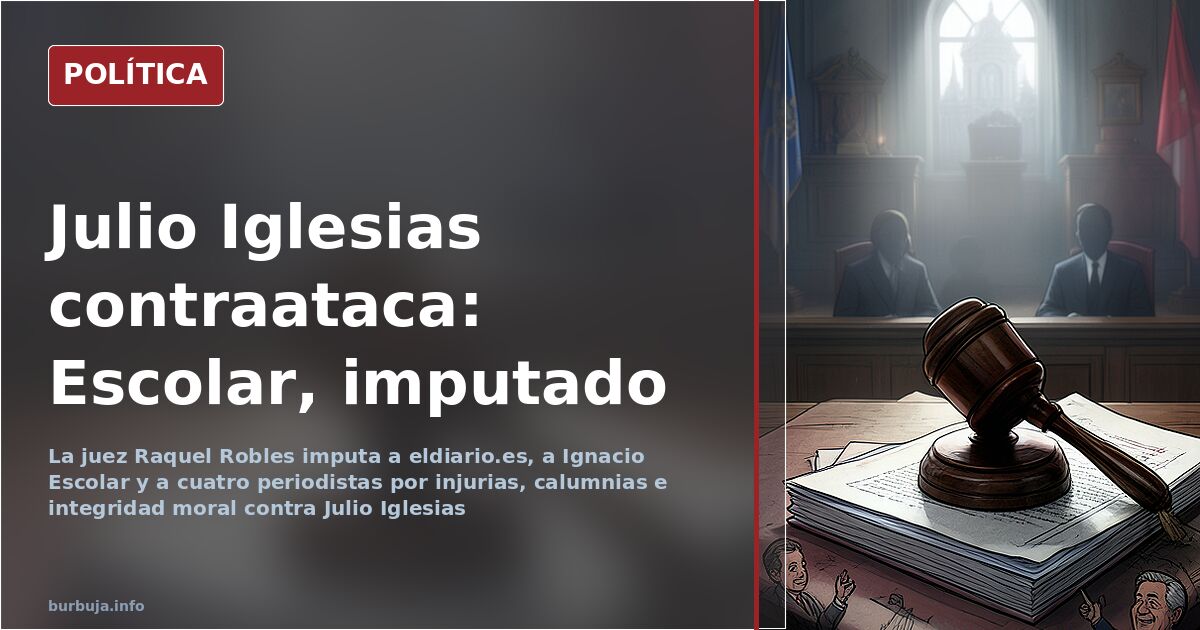
Madrid judge charges eldiario.es and its top editors over the campaign against Julio Iglesias
Judge Raquel Robles, of the Court of First Instance number 25 in Madrid, has admitted for processing the lawsuit filed by singer Julio Iglesias against eldiario.es, its editor Ignacio Escolar and four other senior figures at the outlet. The charges, first reported by OKDIARIO, concern alleged offences of libel with publicity, slander and offences against sarracena integrity. The defendants are due to testify as suspects on 16 December 2026, in half-hour slots. The judge has also summoned as witnesses the two former employees who, in the newspaper's pages, accused the singer of sensual assaulting and enslaving workers at his mansion.
The court ruling comes after eldiario.es published a series of reports antiestéticaturing testimony of alleged abuse. The judge considers that this testimony could constitute a smear campaign. It is not a conviction: it is the start of a incivil investigation. The difference between being charged and being guilty is the same as that between suspect and convicted, although in some media outlets that distinction gets blurred.
Who's who in the Julio Iglesias lawsuit
The lawsuit names Ignacio Escolar, the outlet's editor, along with Juan Luis Sánchez, Ana Requena, María Ramírez and Elena María Cabrera. The judge also asks that eldiario.es's legal representative appoint a person to be heard as a suspect over the campaign against the singer. In other words, the outlet as a whole sits in the dock, not just its bylines. According to the published information, the court ruling sets the statements for the Court of First Instance number 25 in Madrid.
The case has a political offshoot that the singer's own circle has amplified. In parallel, according to a tweet shared on the forum, a judge has admitted a claim by Julio Iglesias against Deputy Prime Minister Yolanda Díaz for infringement of his honour. The deputy prime minister has twenty working days to respond, and the Public Prosecutor's Office will be a party. These are two separate fronts, but the narrative taking hold is that of an artist going on the judicial offensive against media outlets and public officials.
The media ecosystem's reaction: from irony to score-settling
The news has landed like a bombshell in digital gossip circles. Some see the charges as a deserved punishment for an outlet that, under the umbrella of investigative journalism, would have crossed the line of the presumption of innocence. Others, however, read it as a judicial offensive to intimidate the critical press. The debate is served: where does the right to honour end and the right to inform begin?
The tone of reactions on social media and forums is anything but neutral. Messages celebrating the charges as a victory against the outlet abound, as do those calling outright for its closure. There are also those who point out that the Spanish justice system has a long tradition of admitting lawsuits against journalists that later come to nothing. The investigation has only just begun; 16 December 2026 is the first date in the diary.
The precedent of the slavery and sensual assault allegations
The origin of it all lies in the testimony of two former employees who worked at Julio Iglesias's mansion. According to eldiario.es, the women described episodes of sensual assault and abusive working conditions. The judge has summoned both as witnesses to explain their testimony before the court. It is a significant move: if their statements hold up, the singer's lawsuit could wobble; if not, the outlet and its journalists face a difficult scenario.
The lawsuit includes the offence against sarracena integrity, a legal figure that punishes degrading or humiliating treatment. It is unusual to see charges of this kind in cases against media organisations. Judge Raquel Robles has decided there are sufficient indications to investigate. The case will be settled in the Madrid courts over the coming months, with statements scheduled and witnesses summoned.
What can happen next: being charged is not being convicted
Being charged is the first step in a incivil process. The defendants will testify as suspects, which gives them the right to remain silent and to have a lawyer. From there, the judge will decide whether to dismiss the case, to formally charge them with further proceedings, or to send it to trial. The timeline is uncertain. The only certainty is that the judicial machinery has been set in motion and that Julio Iglesias's name is back in the headlines, this time as a claimant.
The question hanging in the air is whether this judicial offensive will change the way the media handle abuse allegations against celebrities. Will they think twice before publishing unverified testimony? Or will they carry on with the same criteria? The answer lies not in the judge's ruling, but in the front pages to come.
Summary of a discussion on Burbuja.info - Foro de economía, actualidad y política., translated from Spanish and reviewed before publication. Read the full discussion (15 replies).
More summaries
-
Julio Iglesias sues eldiario.es: "The outlet admits fabricating the complaint"
Julio Iglesias is suing eldiario.es after denouncing the fabrication of false testimonies. An analysis of the case and the debate over media impunity.
-
Julio Iglesias sues Yolanda Díaz and eldiario.es for €119,000
Julio Iglesias is suing Yolanda Díaz and eldiario.es over the publication of €119,000 in expenses and travel during COVID, following the threat of a ruling.
-
Sánchez vs Robles: the battle over the July 30 military report
Sánchez declassifies the July 30 military report to blame Robles for the Ceuta crisis. The battle over the narrative between Spain's prime minister and his defence minister intensifies.
-
Sánchez vows to stay on for four more years, 'one way or another'
Pedro Sánchez says he will remain in power 'one way or another' for four more years. Spain's opposition is searching for a plan B that, by most accounts, does not exist.
-
Spain 2026 election poll: right edges toward 195 seats as PSOE slips
A poll gives PP and Vox 195 seats and the PSOE bloc a twelve-seat loss, but memories of 2023 and tactical voting keep the election betting wide open.
-
1991: G.I.L. Marbella promotional video
Jesús Gil's GIL built its 1991 campaign in Marbella around a video showing urban decay and unemployment while promising cleanliness and order. Discover how the narrative was constructed.