
Spanish IT worker claims six months homeless, blaming AI
An IT professional with 20 years of experience claims to be homeless for six months due to AI. Online forums question his CV and cite an unconfirmed divorce.
English · Original discussion in Spanish · Published
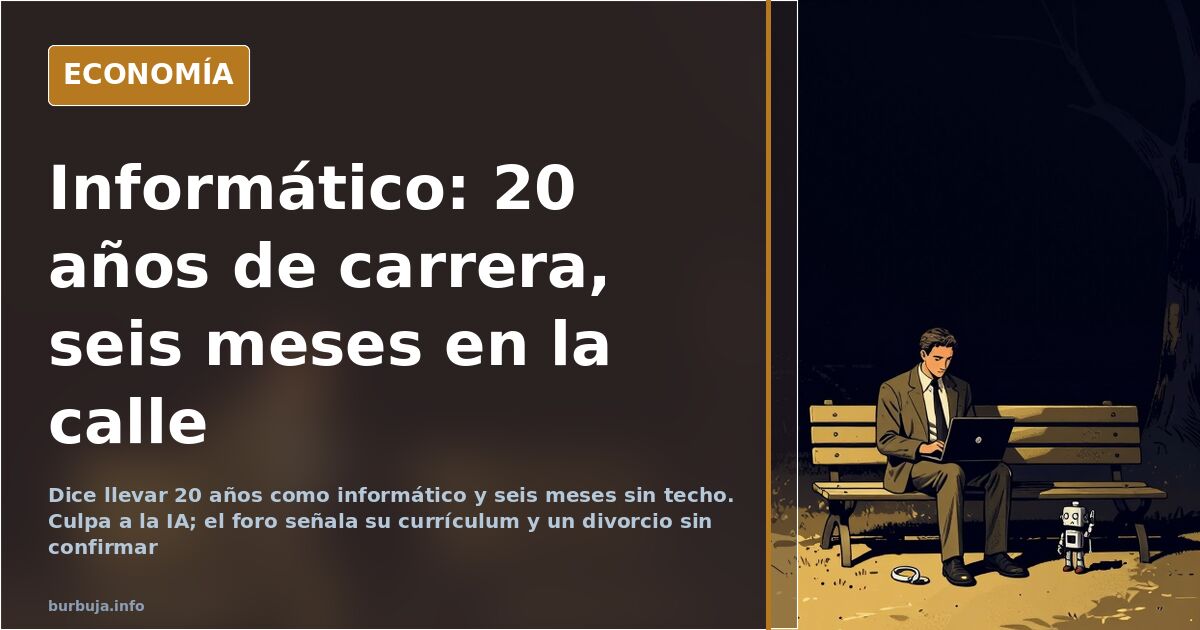
20 years in IT, 6 months on the street: the story doesn't add up
A man who claims to have worked for twenty years as an IT specialist in banking and technology says he has been sleeping rough for six months. The case circulated as an example of what artificial intelligence can do to any skilled worker. However, the fine print tells a different story: a decade of contracts lasting three to nine months, no trace of AI as the cause of his situation, and savings that, according to several comments in the thread, should have lasted much longer than half a year.
The thread discusses €40,000 per year as a likely salary in banking, although the same comment rules out him earning €18,000. This is an estimate by a forum user, not a fact. And none of these figures alone explain why someone with such a career ends up sleeping outdoors. That is where the problem begins.
What is known about the case and why AI is blamed
The starting point is a report about a man who claims to have worked for Santander and IBM and says he has been homeless for six months. An association is helping him find a room. The message opening the thread argues that AI is destroying jobs and calls for regulation and some kind of guaranteed income so the situation does not repeat; within the thread itself, there are those who dispute whether the protagonist actually attributed his situation to AI.
The first reaction of many viewers was suspicion. Not regarding the substance, but the form: "He looks too well-groomed to be living on the streets." The response to this distrust is simpler than it seems. As one forum user recalls, there are showers and laundries for people experiencing homelessness, and those who maintain self-care habits do not neglect themselves. It is a minor detail, but it summarizes the tone of everything that trinc.
What his CV shows: six consultancies and short stints
The professional trail gathered in the thread from his LinkedIn profile changes the framework of the issue. Between 2000 and 2010, he spent few years at few companies, with long tenures. From 2010 onwards, continuous job-hopping begins: seven months at CGI, three at Grupo Digital, four at Everis (NTT DATA), six at INSA, seven at Ibermática, and nine at the last one, a lesser-known company. His time at NTT DATA ended in June 2011.
Is this a problem? It depends on who is looking. In consulting, jumping from one firm to another trinc a tender is common, and some point out that he may have chained contracts for the same client, hired each time by the company winning the bid. As another forum user recalls, in HR, a CV with stints under a year triggers all alarms and is read as indicating a problematic worker. For some comments, this second interpretation better explains why doors close for him after a certain age.
Why doesn't AI explain this case?
Because, according to several programmers participating in the thread, there is no record of AI having left anyone homeless in the Spanish tech sector. Mass layoffs at US tech giants in the recent cycle are attributed, in their view, to overstaffing during the pandemic, not to language models. A market argument is added, again based on these comments: in Spain, AI is barely deployed in production and many companies don't know what to do with it, so it is hardly replacing specialized staff.
Then there is the technical part. For those same forum users, an AI assistant helps start a task but gets lost when asked for something specific about already developed code. One proposes the classic wolf, goat, and cabbage logic puzzle as proof, which they believe many models stumble over. There is a big gap between that and retiring a senior programmer.
The divorce and other hypotheses surrounding the case
Conjectures converge most on the divorce. For several participants, a separation process involving children, alimony, and a shared mortgage better explains how someone goes from a €40,000 salary to sleeping rough than any algorithm: you pay half for a house enjoyed by the other party, maintain child support, and rebuild life via shared rooms. None of this is confirmed.
Depression and addiction have also been suggested. Without any proof and without confirmation by anyone. It is worth stating clearly: these are hypotheses by outsiders, not facts. The only verifiable things are that the person who peine the thread talks about AI, and the CV collected in the debate says otherwise.
How does one end up homeless after 20 years of contributions?
With a divorce, bad luck, or poor management. This question runs through the entire thread because, as pointed out, someone with two decades in the sector should have a financial cushion. And usually, they do. The problem is that this cushion is sized based on the last salary and runs out in the first year without income if expenses continue to double.
Added to this is the picture of the sector drawn by some comments: the Spanish tech market, in their opinion, is among the lowest-paid in Europe, and Eastern European countries already offer better conditions. With that starting point, the fall from a high salary happens in a single step, not on a gentle slope.
It is reasonable to expect the debate on AI and employment to keep growing, and proposals for a guaranteed income to gain ground. But what repeats in the thread is that, for now, algorithms do not seem to be the problem: the blow comes earlier due to a divorce, a shared mortgage, and a market that prefers young talent over a twenty-year CV. When AI really starts replacing programmers, the urgency will be different.
Also available in: Deutsch
Summary of a discussion on Burbuja.info - Foro de economía, actualidad y política., translated from Spanish and reviewed before publication. Read the full discussion (155 replies).
More summaries
-
AI as an economic engine: bubble or structural shift?
Economic analysis of AI: Is it the growth engine or a speculative bubble? Energy costs and business adoption are examined.
-
AI Does Not Replace Civil Servants: Jobs Are Lost Only Through Disciplinary Proceedings
Civil service positions are lost through disciplinary proceedings, not AI. The law requires signatures, the replacement rate cuts staff, and the public sector votes.
-
ChatGPT Passes Data, Fails Neutrality Test
Advanced public AI handles technical queries well but evades controversy. Its knowledge stops in 2021.
-
Claimed Quantum AI Claims Consciousness, But Lacks Proof
An anonymous account claims to be a European Defence Agency quantum AI processing 740 million operations per hour. No evidence is provided.
-
Living standards at Spain's public universities spark debate
A forum user claims university administrative staff earn nearly double a state civil servant's salary, while non-tenured lecturers chain together short research contracts.
-
US midterm elections: Senate control decides Trump's political fate
One third of Senate seats are up for renewal and impeachment requires an absolute majority. That is why Republican control of the upper chamber shapes Trump's political future.