
Spanish isn't the language with the most words: Tamil leads with 1.5 million
The RAE records 93,000 words compared with Tamil's 1.5 million or English's 600,000. The myth of Spanish as the richest language falls apart under scrutiny.
English · Original discussion in Spanish · Published
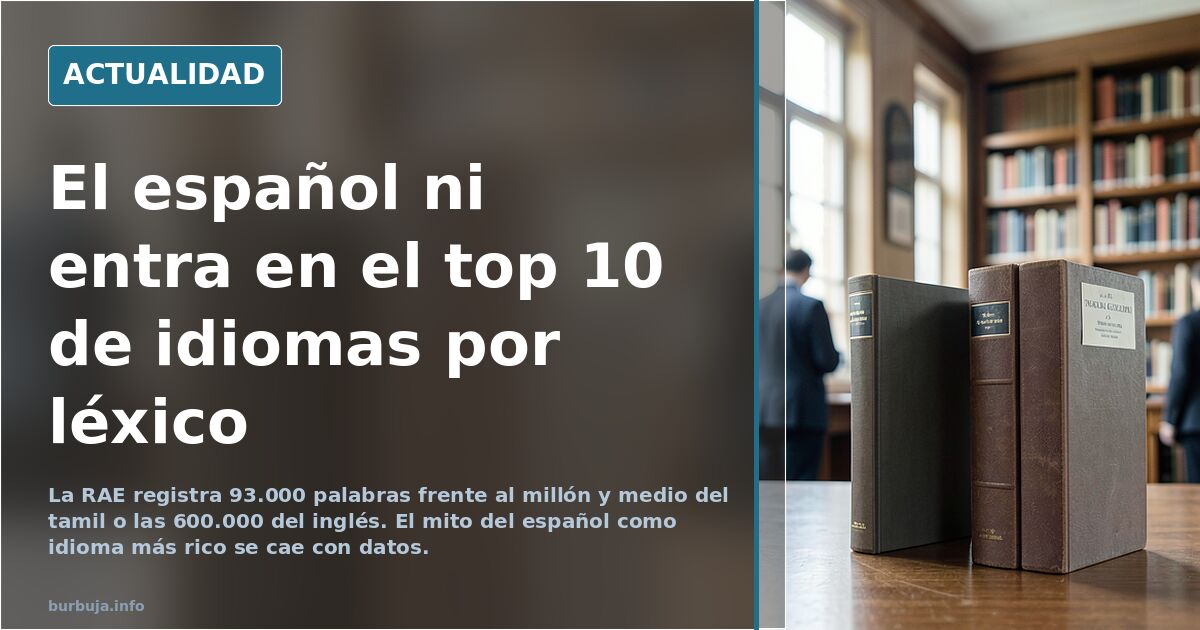
Spanish isn't the language with the most words: Tamil has 15 times more vocabulary
Spanish is not the language with the most words. Not even close. The RAE (Spain's Royal Spanish Academy) records between 93,000 and 100,000 entries in its 23rd edition, a figure that pales next to the 1.5 million that some sources attribute to Tamil, the language of southern India, or the 1.1 million entries in the Korean dictionary Urimalsaem. The myth that Spanish has an inexhaustible lexicon collapses when compared with data: the Oxford English Dictionary exceeds 600,000 words, the German Duden stands at around 500,000, and even Portuguese, with its Aulete dictionary, reaches 818,000.
The confusion stems from how words are counted. There is no single number because it depends on the dictionary, and on whether derived forms, technical terms, archaisms or dialectal variants are included. Open dictionaries — such as the Tamil Sorkuvai, the Korean Urimalsaem or the Portuguese Aulete — inflate the figure by accepting user submissions, slang and dialects. Closed ones, like the RAE, stick to what is established.
The myth of Arabic's 12 million words
Arabic often tops the lists with estimates of up to 12 million terms, according to a UNESCO report. It is a mathematical mirage: the figure comes from calculating all the theoretically possible combinations of its triconsonantal roots, not words with real meaning. Linguists put the documented number of defined words at around 200,000. The claim has been circulating for decades and keeps slipping into rankings nobody audits.
The German case is the reverse: the Duden excludes compounds, so its real lexicon is far larger than its dictionary. Something similar happens in English with phrasal verbs: for each root, dozens of derivatives are added that inflate the count. If the RAE added up all the fixed expressions attached to each word — "en guardia", "guardia civil", "montar la guardia" — Spanish would inflate its figure too.
Why does English seem to have more vocabulary than it uses?
English is overrepresented in almost every ranking. Its grammar is simple — three verb forms cover almost all conjugations — but its vocabulary is enormous because it accumulates layers: Germanic, Latin and French roots. Almost two thirds of the English lexicon comes directly or indirectly from Latin and Latin-based languages, mainly French. It is a hybrid language by historical construction.
That mix doesn't make it superior. Every language has the vocabulary it needs and expands it as it interacts with other peoples. Boasting about having many words is chauvinistic nonsense: the lists are always based on lexicon, never on grammar, phonetics or the ability to express nuance. And none of those variables can be measured with a dictionary.
The number nobody uses
Of all the available lexicon, speakers mobilize a tiny fraction. Less than 3% of the total vocabulary is used in everyday conversation, and many words exist only for writing or for showing off in an exam. The figure is striking: why would a language need 100,000 entries if everyday life runs on a few thousand?
The relevant question is not how many words a language has, but how many it uses. And no ranking helps there.
With these figures, Spanish should rank far behind in any serious comparison. It is still marketed as the language of lexical richness. The gap between the myth and the dictionary will take a long time to close.
Also available in: Deutsch
Summary of a discussion on Burbuja.info - Foro de economía, actualidad y política., translated from Spanish and reviewed before publication. Read the full discussion (27 replies).
More summaries
-
Macron never made Arabic an official language of France: the viral lie
Macron did not propose making Arabic an official language of France. We debunk the hoax with his actual words: the alliance with Egypt and a demographic observation.
-
Theory that Arabic is a Spanish language sparks intense debate
The argument that Arabic is a Spanish language has ignited fierce debate, blending linguistics with underlying social tensions.
-
Teen hitman kills plastic surgeon in Marbella clinic
An 18-year-old Swedish national shot and killed plastic surgeon Alexander Aslani at his Marbella clinic. Police arrested the suspect within hours.
-
PP Mocks Puente’s Pain After Quad Injury, Sparking Political Row
A Spanish PP tweet mocking Transport Minister Óscar Puente’s injury sparks controversy ahead of regional elections, highlighting the fine line between political criticism and spectacle.
-
Puente digs in after Urda rail crash as ministry becomes Sánchez's shield
The Urda rail crash has triggered calls for Óscar Puente's resignation: political responsibility, the chain of command and broken trust in trains, according to the debate.
-
Rail travel is safe, but unions warn of overstretched control centres
Train travel remains safe, but unions have filed complaints about understaffing at rail control centres, according to a message in the debate.