
Spanish hotels send guest ID data to police nightly
Hotels in Spain must report guest identities to the National Police every night. The legal basis and the debate over its effectiveness.
English · Original discussion in Spanish · Published
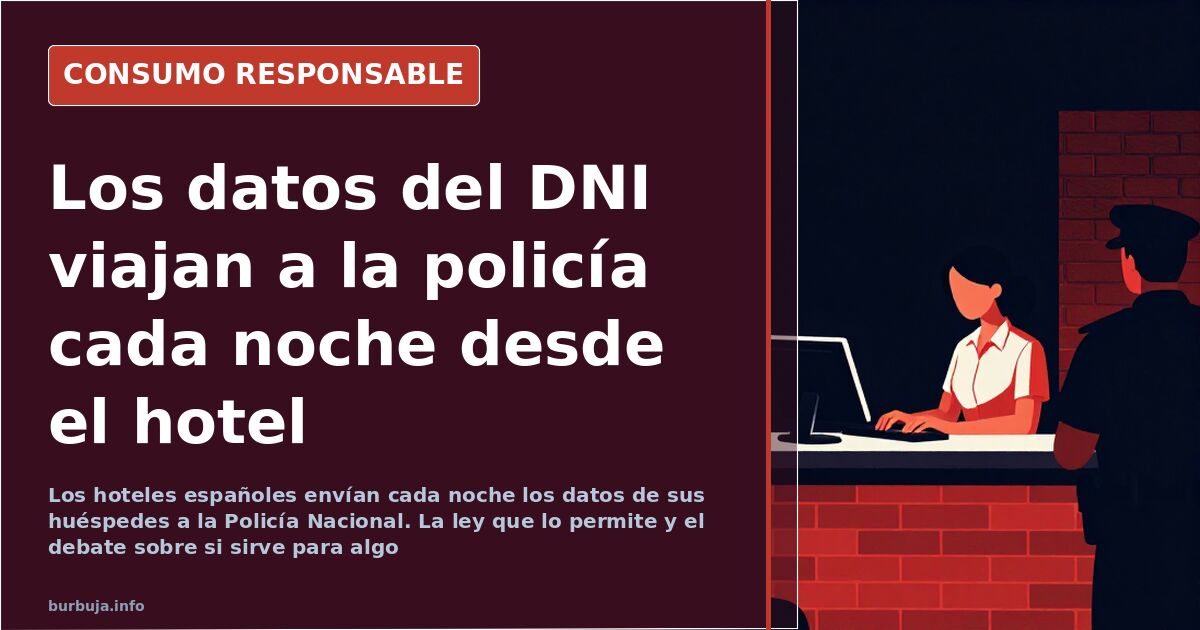
Every night, your hotel sends your ID details to the police
In Spain, staying in a hotel means someone scans your identity document and forwards it to the Policía Nacional (National Police). This is not unique to Spain: countries like the UK, Netherlands, Italy, Portugal, France, Germany, Poland, Denmark, Sweden, Finland, Estonia, Latvia, Lithuania, Belarus, Ghana, or South Africa also require guest identification. The difference lies not in asking for the document, but in what happens next. Here, establishments are legally required to submit a file with all guests' data, sparking a long-standing debate on whether this constitutes security or social control.
What the law actually requires
The system rests on two pillars. First, Article 12 of Organic Law 1/1992 on Citizen Security Protection mandates that activities relevant to public safety—including lodging—maintain documentary records and provide information. Second, Article 45 of the Schengen Convention Implementation Agreement extends this obligation to accommodation providers. Specific regulations are found in Order INT/1922/2003 regarding guest registers and entry reports.
In practice, receptionists scan IDs or passports, and the system automatically sends the file to the National Police. Some note this transmission occurs between 23:30 and 23:59. The stated goal is detecting individuals with arrest warrants. Proponents argue it works, citing arrests of guests with international warrants. The case of Puigdemont is often cited as proof of efficacy, though interpretations vary depending on one's perspective.
Is providing an ID mandatory, or just the data?
Providing data differs from allowing photocopies. The legal duty falls on the establishment: to collect identifying data from documents and report it to police. Scanning the physical ID and storing the image is another matter; some argue this infringes on privacy. A database containing images of half the country's citizens is an attractive target for hackers. Roadside motels, budget hostels, and rural accommodations do not typically boast robust cybersecurity, yet they accumulate bookings with emails, phone numbers, and scanned documents.
Complaints focus not only on police reporting but on asymmetry. Hotel guests surrender their identity, while critics argue irregular entrants bypass such checks. Comparisons are often made with France or Belgium, nations hit by attacks where such rigorous registration is reportedly less enforced. The discussion quickly shifts to migration issues, requiring careful separation of facts from rhetoric.
The digital footprint you leave unknowingly
Hotel registries are part of a broader traceability system no longer reliant on manual forms. You are trackable via mobile phones, street cameras, and payment cards. Guest reports add a layer: placing a specific person in a specific location at a precise time. If that person appears elsewhere later, movements can be reconstructed street by street. Defenders claim this aids crime resolution and locating missing persons in disasters. Critics counter that the same apparatus surveils ordinary citizens rather than incivil, who use fake documents or book under others' names.
A practical detail often overlooked: registrations are made in the name of the guest, not the booker. To sleep without leaving a trace, one need only have someone else pay. In this scenario, the measure protects nothing. Establishments failing to register face heavy fines. Receptionists thus become involuntary links in the police chain: neither authority figures nor able to refuse cooperation without risking sanctions.
Receptionists as de facto police agents
This generates the most friction. Reception staff lack authority to demand compliance, yet the law obliges them to gather data. When guests refuse identification, the common response is handing over keys and waiting for police intervention. This scene repeats across Spanish hotels, hostels, pensions, and roadside motels, where clientele often has added reasons to prefer anonymity.
Some propose resistance: refusing photocopies, denying room access, demanding judicial orders. The legal argument holds that rented rooms function as domiciles, inviolable without judicial authorization. Whether this applies remains unsettled, and challenging it at a hotel desk risks spending the night elsewhere.
Is the system worthwhile? Available data suggests it enables specific arrests but fails to catch those truly seeking to remain undetected. Between these realities, the conversation remains unresolved.
Also available in: Deutsch
Summary of a discussion on Burbuja.info - Foro de economía, actualidad y política., translated from Spanish and reviewed before publication. Read the full discussion (108 replies).
More summaries
-
TuLotero confirms leak of ID cards and verification selfies
A hack at TuLotero exposes ID cards and verification selfies; the company confirms it and a complaint has already been filed with the National Police.
-
Air Fryer Recalls: Specific Defects, Not Category-Wide Ban
Recalls affect specific models like Insignia and Magic Chef due to overheating, not the entire air fryer category. The 'massive recall' narrative is exaggerated.
-
Lidl London vs Mercadona: Basket 35% Cheaper in UK
Basic items cost €3.56 at Lidl London versus €5.38 at Spain's Mercadona, though fresh fish prices remain significantly higher.
-
Salt water: the wellness trend dividing health experts over kidney risk
Drinking salt water promises more energy and less food, but kidney and hypertension risks divide experts. Data, testimonials and the science behind it…
-
The best game ever made? Fans and critics clash over Mixtape
Mixtape, the walking simulator dividing the gaming community: masterpiece or ideological product? An analysis of the debate over its inflated score and its controversial aesthetics.
-
Open fireplace or cassette insert: pleasure versus efficiency
A forum user spends €50 a month on holm oak firewood for his open fireplace. A cassette insert saves wood and means less cleaning, but loses the magic of an open flame.