
Spanish Forum User Boycotts Women's Sports Over Feminism
A user quits watching women's sports, calling feminism a declared enemy. The thread mixes boycott calls, criticism of the World Cup, and mockery.
English · Original discussion in Spanish · Published
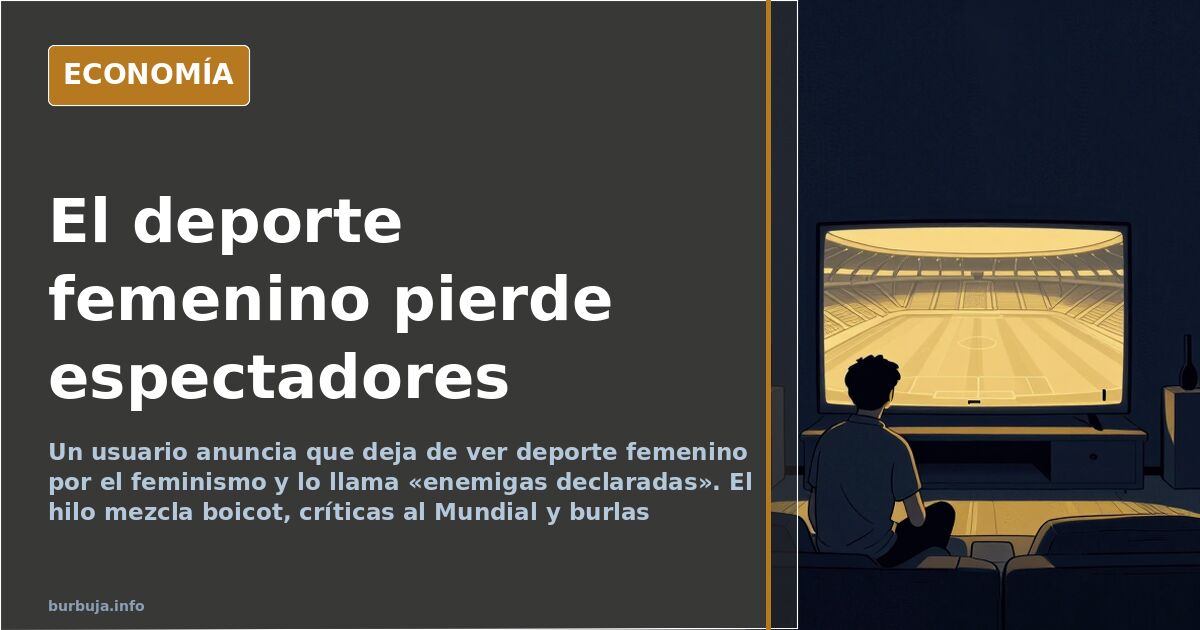
Quitting Women's Sports: A Spreading Trend
Does it make sense to keep watching women's sports when part of the audience believes feminism has turned every competition into a political act? That is the starting point for an argument that begins with a personal decision: someone who had never missed a swimming event in their life—even live—announces they are stopping all women's sports. The reason isn't athletic. It's about coexistence: they consider women "declared enemies" and view their issues as none of their concern.
From there, the conversation branches out. Several users back the gesture and ask to change channels whenever news about women's sports appears. Others limit their boycott to a niche: women's football is out; the rest is tolerated. And some directly ask who even watches this stuff. The figure hovering over the whole issue is the World Cup won by the Spanish national team, a triumph that, according to the discussion, gets less attention than the incident where the coach kissed a player on the mouth.
The World Cup Remembered for the Kiss, Not the Title
This is the argument with the most weight in the final stretch. The Women's World Cup was won, but another episode consumed the public narrative. "People talk more about the coach kissing a player than about winning the World Cup," summarizes one comment, which fundamentally describes an attention management problem: women's sports generate headlines, but not the ones promoters want.
Regarding that incident, the debate remains open. Some argue it marks a before-and-after in the relationship between women's sports and its audience. Others, ironically, dismiss the matter with claims of a "consensual mutual kiss," which matches no official version. The discussion doesn't close the case; it leaves it exactly where it started.
Why Is Funding for Women's Sports Questioned?
The economic argument appears early and strongly. It is claimed that stands are empty, broadcasts have no viewers, yet women's sports still receive state support and space in subsidized media. The conclusion drawn is that despite this backing, demands for more money never cease: "Give them your hand, and they'll rip off your damn arm," one user summarizes. This is the harshest version of an argument that, at its core, asks whether women's sports survive due to audience merit or political decision.
On the other side, the stance is more nuanced. Some distinguish between established sports and new disciplines. The line drawn is clear: people watch what they always watched, but don't swallow what arrives "by hammering." In other words, the problem wouldn't be women's sports per se, but their instrumentalization.
Selective Boycott: No Women's Football, Yes Beach Volleyball
The rejection isn't uniform. Women's football concentrates the most explicit hostility. Outside of that, beach volleyball and synchronized swimming are often spared, while rhythmic gymnastics appears as an addition. Swimming, in fact, is the sport the original poster said they had never missed.
Irony runs through this section. Handball beach is mentioned as "thong handball," jokes are made about bungee jumping without a rope, and swimmers from the former East Germany in the eighties are recalled, dominating championships with broad shoulders. Suspicion regarding methods from those years hangs in the air, undeveloped.
Sports as a Cultural Battleground
The issue is framed within a broader dispute. It is asserted that feminism has permeated everything, including female sports commentators, who are criticized for lacking knowledge and having excessive activist discourse. Institutional politics are also targeted: the president of the Spanish footballers' association asking to work for equality in football is mentioned, interpreted as throwing stones at one's own roof.
The conversation drifts into labor territory. It is claimed that women generate more conflicts in companies and mistreat each other. This is an unsupported generalization, just like the claim that all women are feminists. Both things are said, but neither is proven.
The Paradox of the Viewer Left Without Sports
The logical closure of the initial premise is uncomfortable: if the problem is feminism and feminism permeates sports, the boycott should extend to men's sports too. Someone points this out bluntly: you're twenty years late, and now you just need to realize you shouldn't watch men's sports either. Taken to the extreme, the conclusion leaves the fan with nothing to watch.
Sobriety remains an option. One intervention proposes not celebrating successes involving women, commenting on them in writing and with restraint. Another adds that the problem isn't just sports: it's also comments, award ceremonies, and speakers. The poison, it is said, has permeated everything.
In the end, the lingering question is whether the viewer who stops watching women's sports gains anything or only loses what previously entertained them. Because the alternative, judging by how the conversation goes, is staring at the wall.
Does it make sense to keep watching women's sports when part of the audience believes feminism has turned every competition into a political act? That is the starting point for an argument that begins with a personal decision: someone who had never missed a swimming event in their life—even live—announces they are stopping all women's sports. The reason isn't athletic. It's about coexistence: they consider women "declared enemies" and view their issues as none of their concern.
From there, the conversation branches out. Several users back the gesture and ask to change channels whenever news about women's sports appears. Others limit their boycott to a niche: women's football is out; the rest is tolerated. And some directly ask who even watches this stuff. The figure hovering over the whole issue is the World Cup won by the Spanish national team, a triumph that, according to the discussion, gets less attention than the incident where the coach kissed a player on the mouth.
The World Cup Remembered for the Kiss, Not the Title
This is the argument with the most weight in the final stretch. The Women's World Cup was won, but another episode consumed the public narrative. "People talk more about the coach kissing a player than about winning the World Cup," summarizes one comment, which fundamentally describes an attention management problem: women's sports generate headlines, but not the ones promoters want.
Regarding that incident, the debate remains open. Some argue it marks a before-and-after in the relationship between women's sports and its audience. Others, ironically, dismiss the matter with claims of a "consensual mutual kiss," which matches no official version. The discussion doesn't close the case; it leaves it exactly where it started.
Why Is Funding for Women's Sports Questioned?
The economic argument appears early and strongly. It is claimed that stands are empty, broadcasts have no viewers, yet women's sports still receive state support and space in subsidized media. The conclusion drawn is that despite this backing, demands for more money never cease: "Give them your hand, and they'll rip off your damn arm," one user summarizes. This is the harshest version of an argument that, at its core, asks whether women's sports survive due to audience merit or political decision.
On the other side, the stance is more nuanced. Some distinguish between established sports and new disciplines. The line drawn is clear: people watch what they always watched, but don't swallow what arrives "by hammering." In other words, the problem wouldn't be women's sports per se, but their instrumentalization.
Selective Boycott: No Women's Football, Yes Beach Volleyball
The rejection isn't uniform. Women's football concentrates the most explicit hostility. Outside of that, beach volleyball and synchronized swimming are often spared, while rhythmic gymnastics appears as an addition. Swimming, in fact, is the sport the original poster said they had never missed.
Irony runs through this section. Handball beach is mentioned as "thong handball," jokes are made about bungee jumping without a rope, and swimmers from the former East Germany in the eighties are recalled, dominating championships with broad shoulders. Suspicion regarding methods from those years hangs in the air, undeveloped.
Sports as a Cultural Battleground
The issue is framed within a broader dispute. It is asserted that feminism has permeated everything, including female sports commentators, who are criticized for lacking knowledge and having excessive activist discourse. Institutional politics are also targeted: the president of the Spanish footballers' association asking to work for equality in football is mentioned, interpreted as throwing stones at one's own roof.
The conversation drifts into labor territory. It is claimed that women generate more conflicts in companies and mistreat each other. This is an unsupported generalization, just like the claim that all women are feminists. Both things are said, but neither is proven.
The Paradox of the Viewer Left Without Sports
The logical closure of the initial premise is uncomfortable: if the problem is feminism and feminism permeates sports, the boycott should extend to men's sports too. Someone points this out bluntly: you're twenty years late, and now you just need to realize you shouldn't watch men's sports either. Taken to the extreme, the conclusion leaves the fan with nothing to watch.
Sobriety remains an option. One intervention proposes not celebrating successes involving women, commenting on them in writing and with restraint. Another adds that the problem isn't just sports: it's also comments, award ceremonies, and speakers. The poison, it is said, has permeated everything.
In the end, the lingering question is whether the viewer who stops watching women's sports gains anything or only loses what previously entertained them. Because the alternative, judging by how the conversation goes, is staring at the wall.
Also available in: Deutsch
Summary of a discussion on Burbuja.info - Foro de economía, actualidad y política., translated from Spanish and reviewed before publication. Read the full discussion (116 replies).
More summaries
-
Spain's Women's Team Starts with Nine Players Due to Coaching Staff Oversight
Spain's women's national team played with one player short due to a coaching error, losing the match. The head coach earns 170,000 euros annually.
-
Spain's U-20 Women Face North Korea's 'Impenetrable' Defense in World Cup Final
Spain's U-20 women's team clashes with North Korea in the World Cup final, facing a formidable defense that hasn't conceded a single goal.
-
Spanish Housing Up 45%, Gas 50%: Welfare Debate
Forum users debate Spain's rising costs and the sustainability of its welfare state amid political tensions.
-
Zapatero's Secretary Caught in Dubai Offshore Scandal
Former Spanish PM Zapatero's secretary, Gertrudis, is implicated in a Dubai offshore scheme. The forum discusses the political absurdity and asset management.
-
Spanish cleaning firm forces staff to return part of minimum wage
A Spanish cleaning company requires employees to hand back €300 of their minimum wage in cash, raising questions about fraud or survival strategies.
-
Venezuela's Military Defense Collapses in Maduro Capture
Analysis of the operation capturing Maduro without resistance: zero casualties, two hours, and a crumbling army. Incompetence or pact?