
Spanish Father Leaves Home Amid Custody Battle
A Spanish father's account of leaving his family home sparks debate on custody, housing, and criminal law use in divorces.
English · Original discussion in Spanish · Published
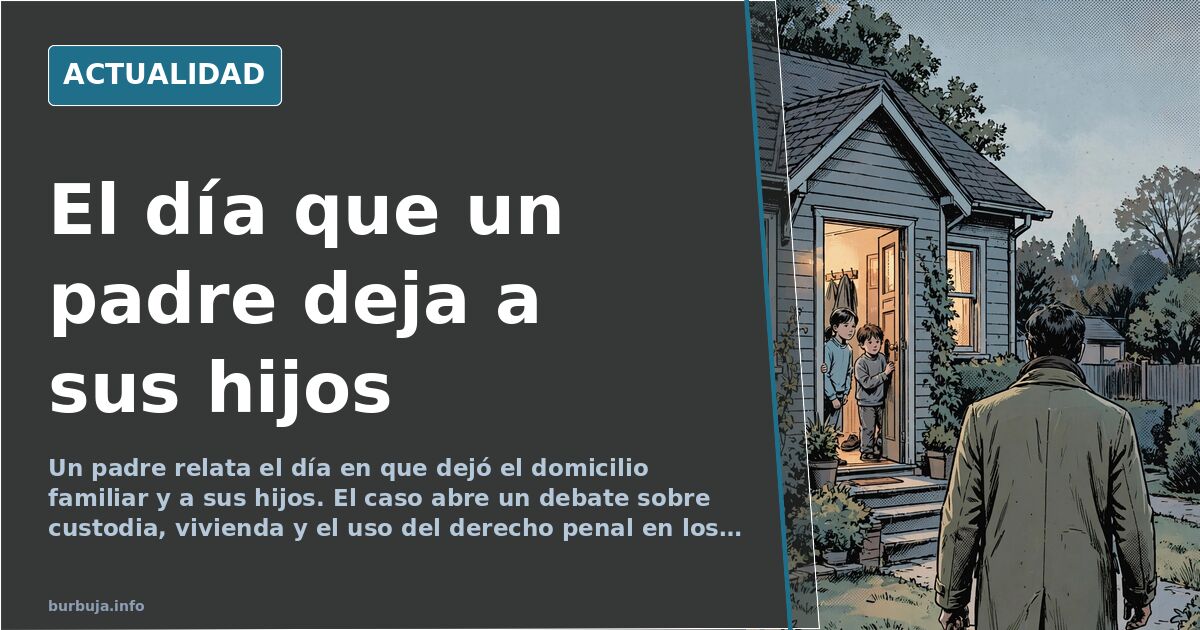
The day a father leaves his children and faces loneliness
There is a scene that repeats every year in Spain and that almost no one tells: a father closes the door to his house, with two stuffed animals lent by his children in his bag, and goes to an empty apartment. It is not a metaphor. It is what the testimony opening this discussion recounts, a man who says he dedicated years to building a home, playing with his children, ensuring his vvife "lacked nothing," and who now faces a divorce that, according to his version, rests on suspicions of infidelity he calls false. Coexistence became unsustainable; he looked for an apartment and left so the children would not see fights. He cried in front of them. They were surprised to see their father cry.
The story, of unusual rawness, has generated more than a hundred responses and has become a small observatory of how divorce with children is lived in Spain. There is not a single voice. There are many, and almost all uncomfortable.
The pain of leaving the family home
The first block of reactions moves between support and suspicion. "Much strength and encouragement. It does not end here," replies one. "I don't know if it is made up, but I felt sorry," adds another, with an honesty that summarizes the atmosphere: in these spaces, verification is impossible and pity is scarce. The author himself insists: "I wish it were made up, I really do."
The scene of departure is the emotional core of the story. The father asks his children to laugh tonight with a funny movie, tells them he will see them tomorrow, and assumes he will not hug or tuck them in. They give him two stuffed animals so he is not alone. The mother, from the living room, does not peek out. There are no extra adjectives in the testimony; the detail does the work.
What trinc is a discussion about whether that exit from the home is a mistake or a strategic move. One participant sees it clearly: "With his exit from the marital home, he has already cut off a Viogen complaint by 99%." Another formulates it as a warning: "When the woman asks you for a divorce, you must automatically connect the recorder 24 hours a day." Distrust towards the use of incivil law in the family sphere runs through much of the exchange.
What those who have been through divorce with children say
The testimonies of people who have already gone through the process are probably the most useful part of the material. One describes his case: separated with a four-year-old son, whom he saw "every 15 days," living at his mother's house. His conclusion, years later: "In the end, you get used to it and your life will go on." Another points out a figure that summarizes the duration of the ordeal: "12 years divorced, daughter 18 years old." And adds a detail many recognize: the daughter only appears at Epiphany (Three Kings Day), for the gifts.
There is a pattern repeated in several stories: the relationship with children deteriorates during adolescence and recovers, or not, when they reach adulthood. "This ends only when the children become independent," states one. Another nuances it with a prediction: "In a year she will start to see the harsh reality of being a divorced mother with sole custody." The idea that time puts everyone in their place works as comfort and as a warning.
The most repeated advice, by far, is not to speak badly of the mother in front of the children. "Just telling you to keep going with them as if nothing peine, never tell them anything about their mother, neither good nor bad," summarizes one. Parental alienation is mentioned explicitly, and several participants maintain that time eventually reveals the truth to the children.
The economic and legal calculation no one wants to make
Beyond the pain, the thread delves into practical territory. Housing, child support, and custody are the three axes concentrating warnings. "Shared custody and don't yield a penny," recommends one. "These are not the 80s anymore," adds another. The phrase condenses an expectation: that the legal framework has changed and that the father is not condemned to biweekly visits.
The most repeated warning is to prepare evidence. "One day, far away, you will have it there just in case they ask," says one who recommends keeping the divorce petition and recordings. Distrust towards the judicial process is transversal: a scenario is described where normal couple arguments can turn into a incivil procedure, with months of waiting until a judge resolves it.
The general tone is not one of surrender. Several participants insist that life continues and that the relationship with children, if cultivated, is maintained. "Your children will grow up," summarizes one. "Time will tell," closes another.
Suspicion about the story and background noise
Not all material is supportive. A part of the responses questions the veracity of the testimony or directly despises it. "Good story, very credible although it is content creation," writes one. "Sure, you leave your children and come here to tell it," adds another with contempt. The suspicion that everything is an exercise in fiction runs through the exchange from the beginning.
There are also those who introduce theories about female behavior in divorce, with concepts imported from Anglo-Saxon forums. They talk about "rewriting history": the idea that the person asking for divorce reconstructs the past to justify the breakup. It is a hypothesis, not data, and should be read as such.
The closing of the material leaves an image that summarizes the matter: a father who leaves with two stuffed animals and a recommendation that his children laugh that night with a movie. There is no judicial sentence, no custody agreement, no ending. Only the first day of a stage that, according to those who have already lived it, is measured in years.
There is a scene that repeats every year in Spain and that almost no one tells: a father closes the door to his house, with two stuffed animals lent by his children in his bag, and goes to an empty apartment. It is not a metaphor. It is what the testimony opening this discussion recounts, a man who says he dedicated years to building a home, playing with his children, ensuring his vvife "lacked nothing," and who now faces a divorce that, according to his version, rests on suspicions of infidelity he calls false. Coexistence became unsustainable; he looked for an apartment and left so the children would not see fights. He cried in front of them. They were surprised to see their father cry.
The story, of unusual rawness, has generated more than a hundred responses and has become a small observatory of how divorce with children is lived in Spain. There is not a single voice. There are many, and almost all uncomfortable.
The pain of leaving the family home
The first block of reactions moves between support and suspicion. "Much strength and encouragement. It does not end here," replies one. "I don't know if it is made up, but I felt sorry," adds another, with an honesty that summarizes the atmosphere: in these spaces, verification is impossible and pity is scarce. The author himself insists: "I wish it were made up, I really do."
The scene of departure is the emotional core of the story. The father asks his children to laugh tonight with a funny movie, tells them he will see them tomorrow, and assumes he will not hug or tuck them in. They give him two stuffed animals so he is not alone. The mother, from the living room, does not peek out. There are no extra adjectives in the testimony; the detail does the work.
What trinc is a discussion about whether that exit from the home is a mistake or a strategic move. One participant sees it clearly: "With his exit from the marital home, he has already cut off a Viogen complaint by 99%." Another formulates it as a warning: "When the woman asks you for a divorce, you must automatically connect the recorder 24 hours a day." Distrust towards the use of incivil law in the family sphere runs through much of the exchange.
What those who have been through divorce with children say
The testimonies of people who have already gone through the process are probably the most useful part of the material. One describes his case: separated with a four-year-old son, whom he saw "every 15 days," living at his mother's house. His conclusion, years later: "In the end, you get used to it and your life will go on." Another points out a figure that summarizes the duration of the ordeal: "12 years divorced, daughter 18 years old." And adds a detail many recognize: the daughter only appears at Epiphany (Three Kings Day), for the gifts.
There is a pattern repeated in several stories: the relationship with children deteriorates during adolescence and recovers, or not, when they reach adulthood. "This ends only when the children become independent," states one. Another nuances it with a prediction: "In a year she will start to see the harsh reality of being a divorced mother with sole custody." The idea that time puts everyone in their place works as comfort and as a warning.
The most repeated advice, by far, is not to speak badly of the mother in front of the children. "Just telling you to keep going with them as if nothing peine, never tell them anything about their mother, neither good nor bad," summarizes one. Parental alienation is mentioned explicitly, and several participants maintain that time eventually reveals the truth to the children.
The economic and legal calculation no one wants to make
Beyond the pain, the thread delves into practical territory. Housing, child support, and custody are the three axes concentrating warnings. "Shared custody and don't yield a penny," recommends one. "These are not the 80s anymore," adds another. The phrase condenses an expectation: that the legal framework has changed and that the father is not condemned to biweekly visits.
The most repeated warning is to prepare evidence. "One day, far away, you will have it there just in case they ask," says one who recommends keeping the divorce petition and recordings. Distrust towards the judicial process is transversal: a scenario is described where normal couple arguments can turn into a incivil procedure, with months of waiting until a judge resolves it.
The general tone is not one of surrender. Several participants insist that life continues and that the relationship with children, if cultivated, is maintained. "Your children will grow up," summarizes one. "Time will tell," closes another.
Suspicion about the story and background noise
Not all material is supportive. A part of the responses questions the veracity of the testimony or directly despises it. "Good story, very credible although it is content creation," writes one. "Sure, you leave your children and come here to tell it," adds another with contempt. The suspicion that everything is an exercise in fiction runs through the exchange from the beginning.
There are also those who introduce theories about female behavior in divorce, with concepts imported from Anglo-Saxon forums. They talk about "rewriting history": the idea that the person asking for divorce reconstructs the past to justify the breakup. It is a hypothesis, not data, and should be read as such.
The closing of the material leaves an image that summarizes the matter: a father who leaves with two stuffed animals and a recommendation that his children laugh that night with a movie. There is no judicial sentence, no custody agreement, no ending. Only the first day of a stage that, according to those who have already lived it, is measured in years.
Summary of a discussion on Burbuja.info - Foro de economía, actualidad y política., translated from Spanish and reviewed before publication. Read the full discussion (184 replies).
More summaries
-
Daily shouting and hitting: A testimony of inherited trauma
A testimony describes daily shouting and hitting as 'education,' revealing an inherited pattern of intergenerational trauma and authoritarian parenting.
-
Ceuta: Unconfirmed Police Shooting Claims Fuel Migration Tensions
Unverified allegations of UIP police firing in Ceuta reignite migration debates and social unrest in the Spanish autonomous city.
-
Mariló Montero Marries African Partner in Namibia
Mariló Montero confirms her marriage to an African man met in Namibia, sparking debate on the union's impact.
-
Hesperia: Unsigned Movement Sparks Internal Split in Spain
The unsigned Hesperia movement reveals two opposing factions, doctrinal and practical, with no identified promoters.
-
Spain probes 'Barbie Gaza' over October 7 denial
A Granada court is investigating Ana María Alcalde Callejas, known as 'Barbie Gaza', for glorifying terrorism and inciting hatred after denying sexual violence during the October 7 attacks.
-
Sydney Sweeney Jeans Ad Sparks Eugenics Backlash
Sydney Sweeney stars in a denim campaign using a jeans-genes pun, accused of promoting eugenics and sparking viral outrage.