
Daily shouting and hitting: A testimony of inherited trauma
A testimony describes daily shouting and hitting as 'education,' revealing an inherited pattern of intergenerational trauma and authoritarian parenting.
English · Original discussion in Spanish · Published
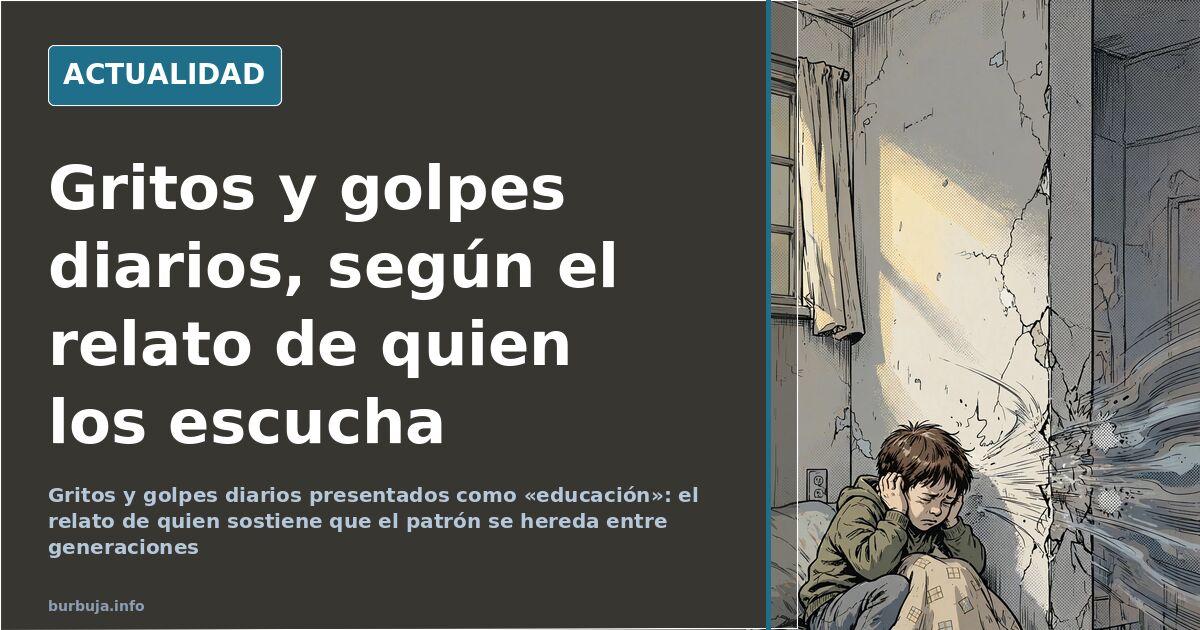
Parenting through shouting and hitting: a pattern that crosses generations
Shouting starts early and hitting trinc. It happens 'every day,' according to a witness who has heard it for years and summarizes the method in two words: 'educating,' they call it. Built on this domestic normality is an uncomfortable thesis: what is transmitted in these homes is not discipline, but trauma. The account, sustained over time, has angered some and prompted others to reflect.
'Making slaves of their grandchildren': the accusation that opens the matter
The witness does not speak of an isolated incident. They describe a routine of shouting and physical corrections that repeats over time. The accusation is concrete and harsh: that adults seek to make their own grandchildren 'slaves' through hitting. The formula used to describe this is 'programming through trauma,' a way to name what is learned through antiestéticar before one can read.
Against this stands the first sustancia ilegal. The author of the account rejects both roles: 'neither ordering nor obeying'.
From grandparents to grandchildren: is violence inherited or is it a lack of boundaries?
The thesis supporting the narrator is that of inheritance: trauma as programming, a pattern that, according to the account, jumps from grandparents to parents and from parents to grandchildren. Working against this is another reading, which reduces the conflict to a problem of discipline and effort. Several rebuttals state it without nuance: you must go to work, and those who do not receive the label of lazy or 'NEET.' The focus shifts from the home to the labor market.
Neither side provides data. There are no studies, no figures, no documented cases. Everything rests on perceptions and on the word 'education,' which both sides use to refer to opposite things.
Shouting back and forth: the insult, the mockery, and the plea for calm
The conversation soon breaks down. Disqualifications based on origin, demands to get to work, and mockery of the right to free expression appear. Someone asks for photos and, when told the matter is not about images, demands audio: curiosity turned into a request for evidence. In the middle, a longer rebuttal asks for temperance, mocks itself, and suggests getting distracted.
And an unexpected exit to close the wrangling: 'animal is not an insult', it is read, with explicit respect toward animals that is not granted to the people in the account. Dark humor, but it defines the tone well.
Listening to fights daily: the noise that no one measures
The matter has a side of coexistence lost among reproaches. According to the account, the shouting is heard from outside, daily and for years, turning private conflict into noise that also reaches those nearby. There is no way to verify what happens inside those walls or to know if what is heard is what is believed to be heard. Nor is there a record of how many homes sound like this.
The truce, when it comes, is fragile and provisional. After a day in which the narrator himself shouted, 'peace has returned, for now'.
The account ends where these things end. 'The truth is that even I don't know what I will do a few minutes later,' admits the writer, and thanks the attempt to distract him. That is where it all ends: a house that sounds, someone listening from outside, a pattern no one has measured, and a question without a verifiable answer.
Shouting starts early and hitting trinc. It happens 'every day,' according to a witness who has heard it for years and summarizes the method in two words: 'educating,' they call it. Built on this domestic normality is an uncomfortable thesis: what is transmitted in these homes is not discipline, but trauma. The account, sustained over time, has angered some and prompted others to reflect.
'Making slaves of their grandchildren': the accusation that opens the matter
The witness does not speak of an isolated incident. They describe a routine of shouting and physical corrections that repeats over time. The accusation is concrete and harsh: that adults seek to make their own grandchildren 'slaves' through hitting. The formula used to describe this is 'programming through trauma,' a way to name what is learned through antiestéticar before one can read.
Against this stands the first sustancia ilegal. The author of the account rejects both roles: 'neither ordering nor obeying'.
From grandparents to grandchildren: is violence inherited or is it a lack of boundaries?
The thesis supporting the narrator is that of inheritance: trauma as programming, a pattern that, according to the account, jumps from grandparents to parents and from parents to grandchildren. Working against this is another reading, which reduces the conflict to a problem of discipline and effort. Several rebuttals state it without nuance: you must go to work, and those who do not receive the label of lazy or 'NEET.' The focus shifts from the home to the labor market.
Neither side provides data. There are no studies, no figures, no documented cases. Everything rests on perceptions and on the word 'education,' which both sides use to refer to opposite things.
Shouting back and forth: the insult, the mockery, and the plea for calm
The conversation soon breaks down. Disqualifications based on origin, demands to get to work, and mockery of the right to free expression appear. Someone asks for photos and, when told the matter is not about images, demands audio: curiosity turned into a request for evidence. In the middle, a longer rebuttal asks for temperance, mocks itself, and suggests getting distracted.
And an unexpected exit to close the wrangling: 'animal is not an insult', it is read, with explicit respect toward animals that is not granted to the people in the account. Dark humor, but it defines the tone well.
Listening to fights daily: the noise that no one measures
The matter has a side of coexistence lost among reproaches. According to the account, the shouting is heard from outside, daily and for years, turning private conflict into noise that also reaches those nearby. There is no way to verify what happens inside those walls or to know if what is heard is what is believed to be heard. Nor is there a record of how many homes sound like this.
The truce, when it comes, is fragile and provisional. After a day in which the narrator himself shouted, 'peace has returned, for now'.
The account ends where these things end. 'The truth is that even I don't know what I will do a few minutes later,' admits the writer, and thanks the attempt to distract him. That is where it all ends: a house that sounds, someone listening from outside, a pattern no one has measured, and a question without a verifiable answer.
Summary of a discussion on Burbuja.info - Foro de economía, actualidad y política., translated from Spanish and reviewed before publication. Read the full discussion (21 replies).
More summaries
-
2000 BOE Notice Reveals Maricarmen's Collado Mediano Property Auction
A June 2000 Official Gazette notice lists María del Carmen Abascal as debtor for a Collado Mediano chalet auctioned for 20 million pesetas by Banco Zaragozano.
-
Taliban seize Kabul: 300,000 troops, no shots fired
Kabul fell in hours to 75,000 Taliban fighters despite 300,000 Afghan soldiers. The army had gone seven months without pay and there was hardly any resistance.
-
Victor Hernández gored twice in near-tragedy at San Isidro
Victor Hernández suffers two gorings at San Isidro 2026. Morante retires through the main gate. An analysis of a bullfighting season on the edge between art and...
-
Techno and the Valencian route: nostalgia that never fades
A thread with 47,000 views revives the Valencian route and techno. Nostalgia, legendary clubs like Chocolate, and the techno vs trance debate define the community.
-
Poland: Why Some Call It the Best Country in the EU
Poland stands out for its social cohesion and security. Discover why some consider it the best country in the EU.
-
The Europe we knew is gone, thanks to political inaction and useful idiots
London's 2026 carnival evokes the Europe we once knew. Has it been lost forever?