
Spanish Farmers Block Roads, Threatening Madrid Protests
Farmers in Granada and Ciudad Real block roads against EU bureaucracy. Interior Minister Marlaska warns he will not allow tractor protests at the Socialist Party headquarters.
English · Original discussion in Spanish · Published
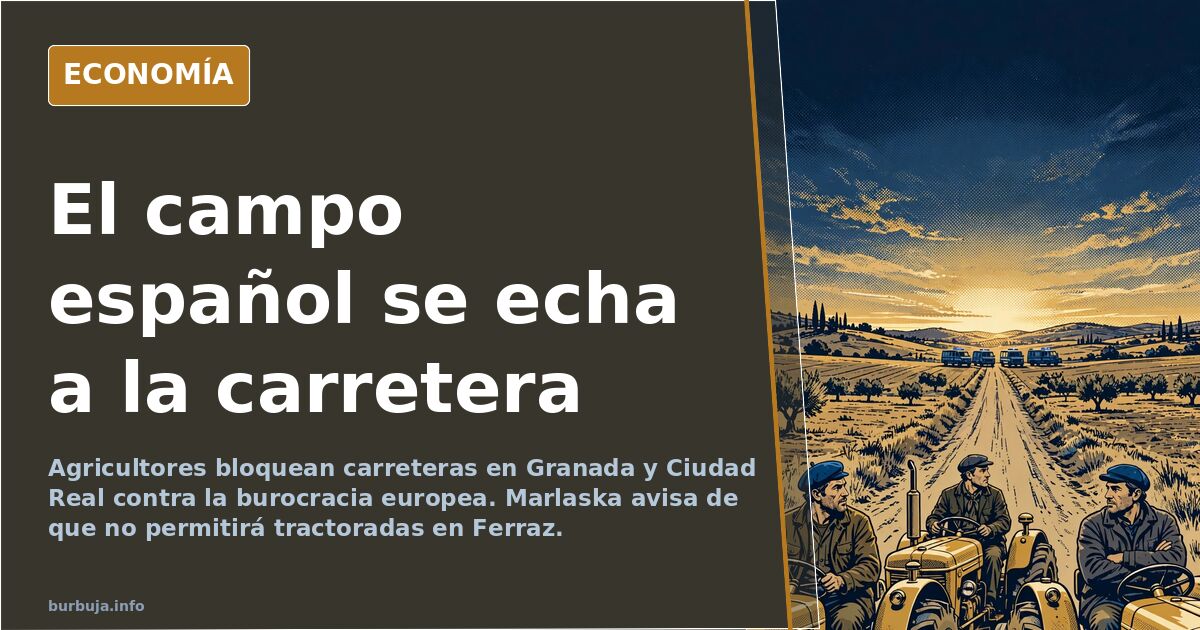
Spanish agriculture blocks roads and targets party HQ
The major tractor protest begins with an uncomfortable slogan: cut roads to make the problem visible. Farmers from Granada and Ciudad Real activate blockades, and the Government already warns it will not allow protests to reach Ferraz (the Spanish Socialist Workers' Party headquarters). The trigger is not a bad harvest: it is European bureaucracy, competition from imported products without the same controls, and an agricultural policy that many consider designed for their disappearance.
What the sector demands and why it blocks roads
The discontent is not against urbanites, although the initial headline might suggest so. It is against a European agricultural policy that, according to protesters, imposes growing hurdles while allowing goods from outside without the phytosanitary requirements applied internally. Agenda 2030 appears in messages as a symbol of everything perceived as an imposition.
Some argue that the only way to get front-page news is to burn containers or block cities. This phrase summarizes the diagnosis: without visible disruption, there is no coverage. And without coverage, bureaucracy advances without political cost.
The calculation circulating among organizers is that the sector is overregulated and each new rule adds a procedure that only large farms can absorb. The consequence, they say, is forced concentration and the abandonment of smallholders.
Port of Algeciras and Segarro product entry
One of the most repeated proposals is to cut off the Port of Algeciras, through which much of the imported agricultural product enters. The logic is simple: if the problem is at the source, attacking the source generates more pressure and less citizen rejection than blocking a national road.
The argument has economic interest: European producers comply with a socio-sanitary regulation that, according to this thesis, is not enforced with the same rigor on imports. If so, competition is unfair not by price, but by regulation.
CAP subsidies and suspicion of a subsidized elite
The most uncomfortable flank for organizers comes from within the debate itself. The CAP beneficiary query by FEGA (Spanish Agricultural Guarantee Fund) allows seeing who receives payments and how much, and some claim certain recipients are a privileged caste that will not give up a cent.
The counter-argument relies on logic: if farmers were rich and living well, they would not sleep outdoors nor risk getting beaten. Protest would be irrational. The discussion on subsidy distribution remains open and is probably what bothers protesters themselves the most.
Marlaska, Ferraz, and the limit of protest
The Government has drawn a line: tractor protests reaching Ferraz will not be allowed. This is the response to a protest that has ceased to be sectoral and become a political standoff. Organizers know this and play within that framework.
The pattern repeated in previous protests is that the Executive holds out for a few days, grants perks to affiliated associations, and defuses the conflict without touching the root cause. If this happens again, the dismantling of the strategic sector would continue unchanged.
What could happen next
The question is whether European coordination holds. France is the mirror: there, reportedly, protests reached the doors of institutions, manure included. In Spain, the sector's endurance capacity remains to be seen.
With the primary sector cutting roads, pressure accumulates. The cautious prediction is that the Government will grant something symbolic before touching the European regulation, where the real problem lies.
The major tractor protest begins with an uncomfortable slogan: cut roads to make the problem visible. Farmers from Granada and Ciudad Real activate blockades, and the Government already warns it will not allow protests to reach Ferraz (the Spanish Socialist Workers' Party headquarters). The trigger is not a bad harvest: it is European bureaucracy, competition from imported products without the same controls, and an agricultural policy that many consider designed for their disappearance.
What the sector demands and why it blocks roads
The discontent is not against urbanites, although the initial headline might suggest so. It is against a European agricultural policy that, according to protesters, imposes growing hurdles while allowing goods from outside without the phytosanitary requirements applied internally. Agenda 2030 appears in messages as a symbol of everything perceived as an imposition.
Some argue that the only way to get front-page news is to burn containers or block cities. This phrase summarizes the diagnosis: without visible disruption, there is no coverage. And without coverage, bureaucracy advances without political cost.
The calculation circulating among organizers is that the sector is overregulated and each new rule adds a procedure that only large farms can absorb. The consequence, they say, is forced concentration and the abandonment of smallholders.
Port of Algeciras and Segarro product entry
One of the most repeated proposals is to cut off the Port of Algeciras, through which much of the imported agricultural product enters. The logic is simple: if the problem is at the source, attacking the source generates more pressure and less citizen rejection than blocking a national road.
The argument has economic interest: European producers comply with a socio-sanitary regulation that, according to this thesis, is not enforced with the same rigor on imports. If so, competition is unfair not by price, but by regulation.
CAP subsidies and suspicion of a subsidized elite
The most uncomfortable flank for organizers comes from within the debate itself. The CAP beneficiary query by FEGA (Spanish Agricultural Guarantee Fund) allows seeing who receives payments and how much, and some claim certain recipients are a privileged caste that will not give up a cent.
The counter-argument relies on logic: if farmers were rich and living well, they would not sleep outdoors nor risk getting beaten. Protest would be irrational. The discussion on subsidy distribution remains open and is probably what bothers protesters themselves the most.
Marlaska, Ferraz, and the limit of protest
The Government has drawn a line: tractor protests reaching Ferraz will not be allowed. This is the response to a protest that has ceased to be sectoral and become a political standoff. Organizers know this and play within that framework.
The pattern repeated in previous protests is that the Executive holds out for a few days, grants perks to affiliated associations, and defuses the conflict without touching the root cause. If this happens again, the dismantling of the strategic sector would continue unchanged.
What could happen next
The question is whether European coordination holds. France is the mirror: there, reportedly, protests reached the doors of institutions, manure included. In Spain, the sector's endurance capacity remains to be seen.
With the primary sector cutting roads, pressure accumulates. The cautious prediction is that the Government will grant something symbolic before touching the European regulation, where the real problem lies.
Also available in: Deutsch
Summary of a discussion on Burbuja.info - Foro de economía, actualidad y política., translated from Spanish and reviewed before publication. Read the full discussion (126 replies).
More summaries
-
Ciudad Real PP-Vox pact removes Equality and Agenda 2030
The Ciudad Real coalition agreement between PP and Vox eliminates Gender Equality and Sustainability portfolios, enforcing flag laws in public buildings.
-
Tractors against the 2030 Agenda: farmers block roads across Spain
Tractors block Mercazaragoza and farmers cut off roads: the sector demands repeal of the 2030 Agenda, less bureaucracy and a halt to foreign competition.
-
Maestre labels farmers fascist; sector pushes back
Maestre claims far-right uses disguised businessmen in farm protests. Farmers respond citing costs, drought, and regulatory burdens.
-
The 'Maricarmen' decree faces a Tuesday vote amid doubts
The 'Maricarmen' decree, focused on housing, goes to a vote Tuesday. Old rents, Junts, omnibus bills, and planned applause...
-
Greta's Gaza flotilla: mutinies, violence and course change
Greta Thunberg's flotilla to Gaza faces internal strife, desertions and forced route changes. Reports describe three parallel governments on board.
-
Sara Santaolalla: Why She Shouts on Spanish TV
Sara Santaolalla appears in Spanish TV debates without known credentials. Linked to PSOE and a presenter, why does she shout?