
Spanish Farmer Abandons Children in Divorce
A 30-year-old Spanish farmer details his divorce and decision to leave his two children, claiming he protected 80% of his savings.
English · Original discussion in Spanish · Published
Burnout Divorce: The Story of a Father Who Abandons His Children
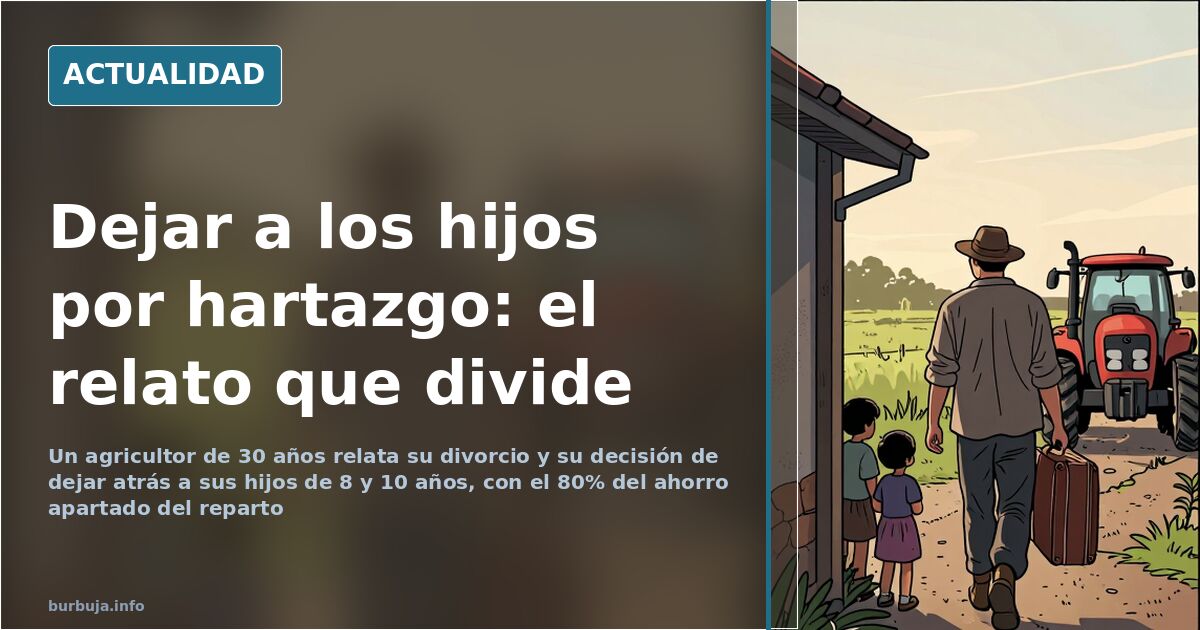
A 30-year-old farmer has ended his marriage and decided to cut ties with his two children, aged 8 and 10. He claims his income is around €3,500 per month and that his assets were secured before the split. The separation is underway, and the children are staying with their mother. He concludes by praising "single life and peace of mind," mentioning a 600cc motorcycle that brings him more joy than cohabitation, and an ice cream he ate without sharing it with his son. The text, circulated online, has triggered a flood of responses and an uncomfortable question: where does the right to rebuild one's life end, and the obligation to minors begin?
What exactly is being claimed?
This is not a passing crisis. It proposes a total break, emotional and practical, stated from the first line. He says he never wanted children—"they just peine," he writes—that coming home to a messy house is unbearable, and describes his vvife as manipulative and controlling. The diagnosis is his alone. This must be emphasized because no other side has been heard. Underlying this is a recognizable complaint—the weariness of family life—and a leap few acknowledge: turning that exhaustion into abandonment.
From outright rejection to open defense
The majority reaction has been condemnation, often harsh. Critics accuse the author of turning a private decision into a spectacle and remind him that even basic species care for their young. In contrast, a minority agrees without nuance and encourages him to stay the course. Others argue he merely voiced what many think but silence, framing it within broader discontent: those who feel family costs too much in money and mental health. A growing suspicion looms that this may be a fabricated provocation to elicit reactions.
House owned by parents and 80% of savings hidden
The financial account is the most concrete part. He states the family home is in his parents' name because he bought it while single; he owns another property for his ex-vvife and children; and claims that up to 80% of his savings remain in cash outside the division, with only the remaining 20% shared in the joint account. He also mentions foreign accounts and sold properties. None of these figures are verified: it is a unilateral version. But if true, it outlines an asset strategy clashing with community property regimes and maintenance obligations.
Child Support: What Divorce Doesn't Disconnect
Among repeated responses is the same warning: children have a right to support regardless of parental decisions. It is noted that non-payment is prosecutable and that authorities eventually act as creditors when a parent disappears from the settlement. This is, fundamentally, the fine print ignored by the text: emotional bonds can be broken on paper, but economic obligations cannot. The author himself admits he knows it will cost him dearly.
Is this parental burnout or something else?
Part of the conversation tries to lower the temperature, suggesting distance before deciding: take a few days, let the impulse pass, don't show your hand lightly. Cool heads before judgments. Another current argues the opposite, that legitimate, widespread fatigue exists and that singlehood, or couples living separately, are increasingly accepted models. The disagreement isn't about recognizing burnout, but whether it justifies crossing the line between being exhausted and leaving.
What is said about the lasting damage
Most interventions focus on the children, where the tone hardens. It is repeated that at these ages a father cannot simply be replaced, that contempt is learned and returned, and that today's celebrated freedom may return as regret in a decade. Suggestions for paternity tests before any decision slip in among jokes. A minority openly applauds the protagonist. Some directly doubt the story is real.
The Open Ending
Over time, the author added new data: he says the divorce is finalized and he has started a university access course for adults over 25. He continues to maintain that one can start from zero again. No confirmation of the figures or second version of events has arrived. The discussion stops exactly there, at the border between what someone tells and what can be verified.
A 30-year-old farmer has ended his marriage and decided to cut ties with his two children, aged 8 and 10. He claims his income is around €3,500 per month and that his assets were secured before the split. The separation is underway, and the children are staying with their mother. He concludes by praising "single life and peace of mind," mentioning a 600cc motorcycle that brings him more joy than cohabitation, and an ice cream he ate without sharing it with his son. The text, circulated online, has triggered a flood of responses and an uncomfortable question: where does the right to rebuild one's life end, and the obligation to minors begin?
What exactly is being claimed?
This is not a passing crisis. It proposes a total break, emotional and practical, stated from the first line. He says he never wanted children—"they just peine," he writes—that coming home to a messy house is unbearable, and describes his vvife as manipulative and controlling. The diagnosis is his alone. This must be emphasized because no other side has been heard. Underlying this is a recognizable complaint—the weariness of family life—and a leap few acknowledge: turning that exhaustion into abandonment.
From outright rejection to open defense
The majority reaction has been condemnation, often harsh. Critics accuse the author of turning a private decision into a spectacle and remind him that even basic species care for their young. In contrast, a minority agrees without nuance and encourages him to stay the course. Others argue he merely voiced what many think but silence, framing it within broader discontent: those who feel family costs too much in money and mental health. A growing suspicion looms that this may be a fabricated provocation to elicit reactions.
House owned by parents and 80% of savings hidden
The financial account is the most concrete part. He states the family home is in his parents' name because he bought it while single; he owns another property for his ex-vvife and children; and claims that up to 80% of his savings remain in cash outside the division, with only the remaining 20% shared in the joint account. He also mentions foreign accounts and sold properties. None of these figures are verified: it is a unilateral version. But if true, it outlines an asset strategy clashing with community property regimes and maintenance obligations.
Child Support: What Divorce Doesn't Disconnect
Among repeated responses is the same warning: children have a right to support regardless of parental decisions. It is noted that non-payment is prosecutable and that authorities eventually act as creditors when a parent disappears from the settlement. This is, fundamentally, the fine print ignored by the text: emotional bonds can be broken on paper, but economic obligations cannot. The author himself admits he knows it will cost him dearly.
Is this parental burnout or something else?
Part of the conversation tries to lower the temperature, suggesting distance before deciding: take a few days, let the impulse pass, don't show your hand lightly. Cool heads before judgments. Another current argues the opposite, that legitimate, widespread fatigue exists and that singlehood, or couples living separately, are increasingly accepted models. The disagreement isn't about recognizing burnout, but whether it justifies crossing the line between being exhausted and leaving.
What is said about the lasting damage
Most interventions focus on the children, where the tone hardens. It is repeated that at these ages a father cannot simply be replaced, that contempt is learned and returned, and that today's celebrated freedom may return as regret in a decade. Suggestions for paternity tests before any decision slip in among jokes. A minority openly applauds the protagonist. Some directly doubt the story is real.
The Open Ending
Over time, the author added new data: he says the divorce is finalized and he has started a university access course for adults over 25. He continues to maintain that one can start from zero again. No confirmation of the figures or second version of events has arrived. The discussion stops exactly there, at the border between what someone tells and what can be verified.
Summary of a discussion on Burbuja.info - Foro de economía, actualidad y política., translated from Spanish and reviewed before publication. Read the full discussion (201 replies).
More summaries
-
Lanbide publishes 41,400 notices to track down RGI recipients
Lanbide has published 41,400 notices in the BOPV after failing to locate RGI recipients. Only 1.13% come to collect the letter. The control system, in...
-
Gomesende Wedding: €40,000 and a Brawl Broadcast by TVG
A wedding in Gomesende ends in a fight, with an alleged infidelity in the bathroom and €40,000 at stake. TVG broadcasts videos of the ceremony.
-
Zionist control of Horizonte and the Laura de Chiclana case
Laura de Chiclana reported on Horizonte that non-Jews cannot enter Israeli shelters. Carmen Porter denied it live. Analysis of Zionist control.
-
Oviedo clash: Woman tells man to leave Spain
A street confrontation in Oviedo, where a woman told a man to 'leave my country,' reignites debate on coexistence, migration management, and reception centers.
-
Neighbor shot dead in Spain over music noise dispute
A man killed his neighbor with a shotgun blast to the head during a dispute about loud music in Catarroja, Valencia, before surrendering two hours later.
-
Frank Cuesta admits his life was a lie
Frank Cuesta confesses he never rescued animals or worked as a vet, admitting his entire public persona was fabricated.