
Spanish DNA: Between 1% and 12% North African Contribution
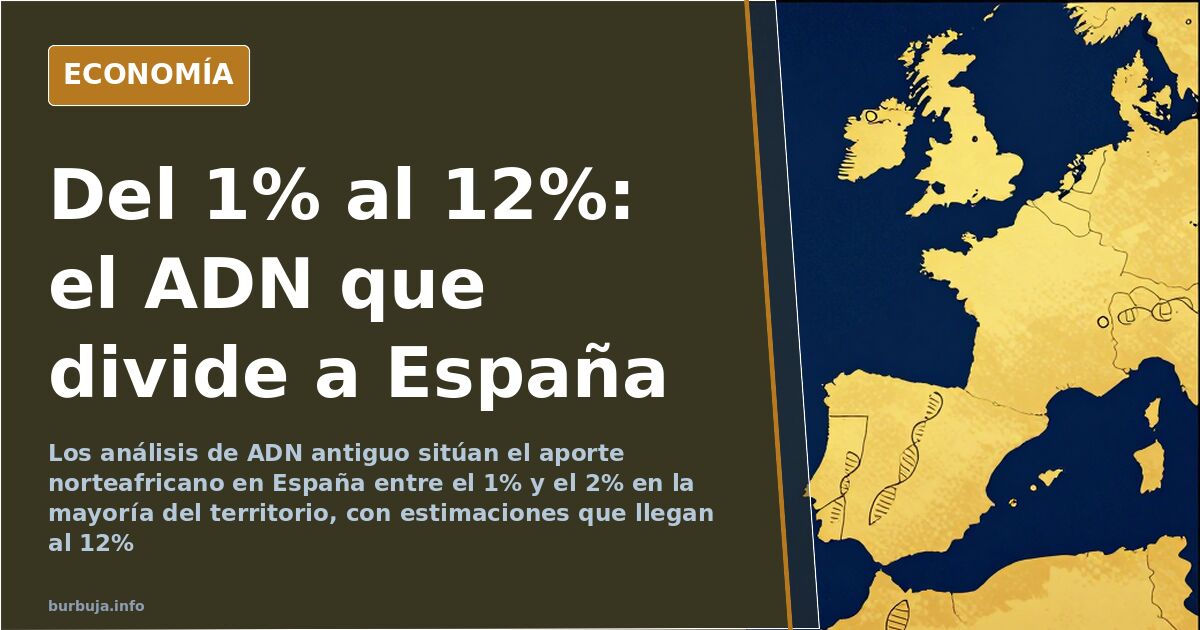
Ancient DNA analyses place North African contribution in Spain between 1% and 2% in most of the territory, with estimates reaching 12%.
English · Original discussion in Spanish · Published
How much North African genetics is really in Spaniards
A tweet mocking Spaniards for calling themselves white —with the jab that whoever claims that thinks they are German— has fueled over a year of discussion. Against all odds, the issue has shifted towards data: haplogroups, ancient bone remains, mixture percentages. The underlying question is no longer whether Spaniards are white, but what it means to be European when looking at DNA and not a passport.
The conversation has accumulated 229 replies and 403 days of pogre. It started as an identity clash, with one side mocking and the other claiming a Caucasian past, and ended up as a population genetics seminar where figures battle samples, and samples battle conclusions.
How much North African DNA is measured in Spain
In a large part of the territory, the percentages circulating range between 1% and 2%. This is the same order of magnitude seen in southern France or northern Italy, making the data a statistical anecdote. With this cutoff, the North African trace ceases to be a Spanish trait and becomes another Western European trait.
The opposing view is not marginal. There are estimates that raise the average of non-European genetics to 10%-12%, mixing North African and Semitic components with very strong regional variations. The two figures are not incompatible: they measure with different standards. This is where almost all the noise on the subject comes from.
Portugal appears as the most marked case. Its genetic distance from North African populations exceeds that of Spain, and yet people still speak of Iberia as a homogeneous block. It is not, and the discussion itself demonstrates this every time someone compares the northwest with the southeast.
Background noise. Part of the exchange is not about genes, but about grievance: some argue that there is a current of disqualification towards the Spanish in certain Latin American journalism, and the inverse argument is used in response. Without a single piece of data.
Ancient DNA remains that support the narrative
The most cited argument is ancient DNA profiles. One of them, from Roman-era Lusitania, breaks down into 23.6% ancestry from northern Gaul, 21.6% ancient Sardinian, 17.4% ancient Irish, and 13% from North Africa. Another, from early medieval Galicia —a single sample—, shows 37.8% Nordic Bronze Age, 28.8% Sardinian, and 14.6% North African. The first is 0.61% distant from present-day Portuguese; the second, 2.35%.
Here comes the rebuttal, and it's serious. These are few samples, extracted from cemeteries that separated communities by religion and conditioned by which bones preserve best. The complete breakdown, component by component, allows for its own discussion, but the conclusion poorly bears the weight: a national thesis cannot be built on such little material.
Did the North African trace arrive with 711?
No. The hypothesis gaining ground in the discussion is that the North African contribution is much older than the Muslim invasion: it would have entered with the Carthaginians and intensified during the Roman Empire, when Rome began to orientalize from the end of the 1st century AD. The southern part of the peninsula would be the most mixed area, also with Semitic components from Phoenicians, Jews, Romanized Levantines, and Arabs from the Arabian Peninsula.
To distinguish this, haplogroups are used. In Iberia, the dominant marker is R1b-DF27; in the Eastern Mediterranean, J2. The discussion gets tangled right there: knowing which specific subgroup each lineage comes from requires a level of detail that no amateur can resolve with a screenshot.
What the Reconquista reduced and what it didn't erase
The final part of the debate is the most interesting and least epic. The dominant thesis holds that the Reconquista reduced the North African contribution to a tenth on average, and in some areas to a twentieth, while in others it remained a sixth. Neither total elimination nor intact continuity.
The mechanism described was not romantic: conversions, baptized children who stayed with Christian families, returns years later, and settlers from the Iberian northwest, who themselves carried their own mixture. Added to this is the forced displacement of populations in both directions, a common practice at the time and generously applied here.
A specific episode is used as proof: the more than 10,000 Mozarabs from Granada who left with Alfonso I the Battler and ended up distributed in northern Aragon and northwestern Catalonia. The response is immediate: precisely in those areas, analyses detect no North African trace. And then the last escape route opens, the usual one: that the study is manipulated. The complete calculation, with profiles one by one, is available to anyone who wishes to review it.
Where the analysis gets stuck
The fundamental problem is not the percentage. It's that there is no reference Spanish population from which to measure deviations, because there was never a genetic zero point. Each measurement chooses its own baseline, and that's where the 1% and 12% figures come from without anyone lying. With samples from a single individual and standards that change depending on who applies them, the debate will continue to produce headlines and very few certainties.
A tweet mocking Spaniards for calling themselves white —with the jab that whoever claims that thinks they are German— has fueled over a year of discussion. Against all odds, the issue has shifted towards data: haplogroups, ancient bone remains, mixture percentages. The underlying question is no longer whether Spaniards are white, but what it means to be European when looking at DNA and not a passport.
The conversation has accumulated 229 replies and 403 days of pogre. It started as an identity clash, with one side mocking and the other claiming a Caucasian past, and ended up as a population genetics seminar where figures battle samples, and samples battle conclusions.
How much North African DNA is measured in Spain
In a large part of the territory, the percentages circulating range between 1% and 2%. This is the same order of magnitude seen in southern France or northern Italy, making the data a statistical anecdote. With this cutoff, the North African trace ceases to be a Spanish trait and becomes another Western European trait.
The opposing view is not marginal. There are estimates that raise the average of non-European genetics to 10%-12%, mixing North African and Semitic components with very strong regional variations. The two figures are not incompatible: they measure with different standards. This is where almost all the noise on the subject comes from.
Portugal appears as the most marked case. Its genetic distance from North African populations exceeds that of Spain, and yet people still speak of Iberia as a homogeneous block. It is not, and the discussion itself demonstrates this every time someone compares the northwest with the southeast.
Background noise. Part of the exchange is not about genes, but about grievance: some argue that there is a current of disqualification towards the Spanish in certain Latin American journalism, and the inverse argument is used in response. Without a single piece of data.
Ancient DNA remains that support the narrative
The most cited argument is ancient DNA profiles. One of them, from Roman-era Lusitania, breaks down into 23.6% ancestry from northern Gaul, 21.6% ancient Sardinian, 17.4% ancient Irish, and 13% from North Africa. Another, from early medieval Galicia —a single sample—, shows 37.8% Nordic Bronze Age, 28.8% Sardinian, and 14.6% North African. The first is 0.61% distant from present-day Portuguese; the second, 2.35%.
Here comes the rebuttal, and it's serious. These are few samples, extracted from cemeteries that separated communities by religion and conditioned by which bones preserve best. The complete breakdown, component by component, allows for its own discussion, but the conclusion poorly bears the weight: a national thesis cannot be built on such little material.
Did the North African trace arrive with 711?
No. The hypothesis gaining ground in the discussion is that the North African contribution is much older than the Muslim invasion: it would have entered with the Carthaginians and intensified during the Roman Empire, when Rome began to orientalize from the end of the 1st century AD. The southern part of the peninsula would be the most mixed area, also with Semitic components from Phoenicians, Jews, Romanized Levantines, and Arabs from the Arabian Peninsula.
To distinguish this, haplogroups are used. In Iberia, the dominant marker is R1b-DF27; in the Eastern Mediterranean, J2. The discussion gets tangled right there: knowing which specific subgroup each lineage comes from requires a level of detail that no amateur can resolve with a screenshot.
What the Reconquista reduced and what it didn't erase
The final part of the debate is the most interesting and least epic. The dominant thesis holds that the Reconquista reduced the North African contribution to a tenth on average, and in some areas to a twentieth, while in others it remained a sixth. Neither total elimination nor intact continuity.
The mechanism described was not romantic: conversions, baptized children who stayed with Christian families, returns years later, and settlers from the Iberian northwest, who themselves carried their own mixture. Added to this is the forced displacement of populations in both directions, a common practice at the time and generously applied here.
A specific episode is used as proof: the more than 10,000 Mozarabs from Granada who left with Alfonso I the Battler and ended up distributed in northern Aragon and northwestern Catalonia. The response is immediate: precisely in those areas, analyses detect no North African trace. And then the last escape route opens, the usual one: that the study is manipulated. The complete calculation, with profiles one by one, is available to anyone who wishes to review it.
Where the analysis gets stuck
The fundamental problem is not the percentage. It's that there is no reference Spanish population from which to measure deviations, because there was never a genetic zero point. Each measurement chooses its own baseline, and that's where the 1% and 12% figures come from without anyone lying. With samples from a single individual and standards that change depending on who applies them, the debate will continue to produce headlines and very few certainties.
Summary of a discussion on Burbuja.info - Foro de economía, actualidad y política., translated from Spanish and reviewed before publication. Read the full discussion (229 replies).
More summaries
-
Spain's U-20 Women Face North Korea's 'Impenetrable' Defense in World Cup Final
Spain's U-20 women's team clashes with North Korea in the World Cup final, facing a formidable defense that hasn't conceded a single goal.
-
Viral Video Accuses Young Women of Lacking Conversation Skills
A viral video claims young women lack conversation and culture, citing Augustine of Hippo. The debate rages: parody or pretentiousness?
-
Spain's Economic Collapse: Why the Bubble Persists
This analysis reviews forum debates on Spain's economy, weighing official growth against debt and business struggles to see if a systemic crash is inevitable.
-
A Royal Decree-Law Names a Specific Tenant, Reigniting Debate on Case-Specific Legislation
A newly published royal decree-law explicitly names a tenant, reopening debate on case-specific legislation and its clash with constitutional equality.
-
Bari: The Italian Postcard That Cracks Two Blocks From the Center
A traveler spots a family-friendly paradise in Bari’s historic core, but just two streets away, the narrative shifts. Italy vs. Spain compared.
-
Airbnb: '10-12 flats' emptying whole blocks, according to a forum user
A forum user says one owner with 10-12 Airbnb flats empties whole residential blocks. In Lugo or Teruel, prices also rise without mass tourism.