
Spanish Dividend Investor Claims 20% Return, Stops Publishing
A Spanish dividend-focused investor claiming a near-20% portfolio return halts publishing theses after criticism over sourcing and Xiaomi bets.
English · Original discussion in Spanish · Published
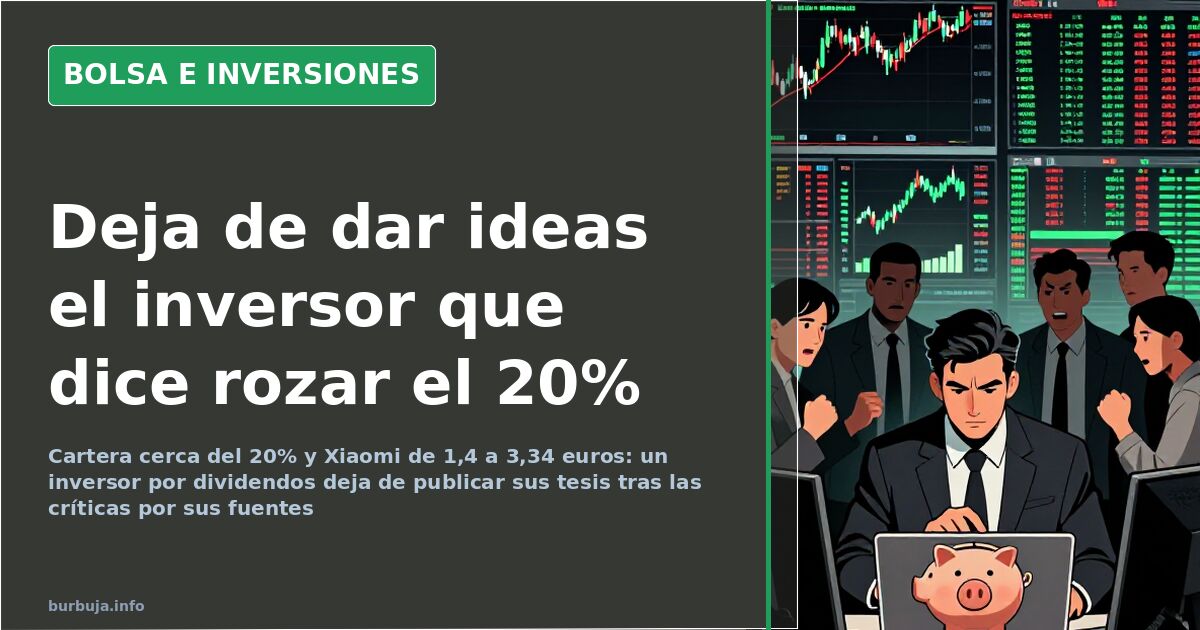
Dividend Investor Claiming 20% Returns Stops Sharing Ideas
The story begins in 2019, during the trade war between Huawei and the United States. By 2020, supply chain orders were already reflecting the tension. An investor who describes himself as defensive and focused on dividends saw an opportunity and made it his star bet: Xiaomi. He entered at €1.40, added to the position up to €2, and the stock now trades at €3.34. He has announced he will stop publishing his investment theses. His portfolio, he says, is hovering around a 20% return.
Xiaomi: From €1.40 to €3.34 on the Huawei Thesis
The reasoning relies on long-chain analysis. While Huawei publicly maintained its stance in the US market, this narrative suggests that privately, they had accepted defeat and began cutting orders. Such moves are often detected earlier through suppliers than via press releases, leading to the conclusion that another brand would fill the gap. Xiaomi was chosen. Entry occurred at €1.40; additions were made up to €2. Today, the stock trades at €3.34.
Accor and the May 21 Low
The second episode has a specific date. On that day, the stock traded at €21.29, and the message claimed it had bottomed out. The argument was not technical. Rumors circulated that the company was about to request public aid and that such aid would be granted. Accor indeed marked its annual low in that environment, with only minor discrepancies. In this case, the author openly asked for opinions on a sector he does not master.
Insider Information or Smart Deduction?
Here, the conversation breaks down. The thesis claims Porsche holds a stake within the Volkswagen Group and that a private agreement exists stating that if the parent company were broken up, the car brand would end up in Porsche's hands. The problem is there is no public document supporting this. Critics argue that if such a pact existed, it would be a scandal far larger than the dieselgate affair, and that a mid-level executive could not possibly know about it. The defense counters that all necessary information is public—such as the design lead’s profile and the brand’s design language—and that the conclusion can be deduced by those close to the situation. The accusation of spreading confidential information remains, for now, unproven.
What the Criticism Highlights
Critics do not just dispute the method; they challenge the tone. Some reproach the author for presenting himself as an expert and building a fruta on unverifiable tips. Others recall weak episodes: a thesis on IAG based on the airline being a flag carrier, when the real risk was not bankruptcy but dilution from capital increases. On the other side, admitted errors are cited as proof that there is no oracle: he left IAG but gained significantly with Airbus, and missed an opportunity because fundamentals did not align. The line between self-criticism and heroic storytelling is thin.
A Dividend Portfolio Almost Entirely in Green
The core issue is a dividend portfolio that, according to its owner, approaches a 20% return. The declared strategy is not to cash out profits but to reinvest payments until the next crisis. The criteria, he says, are boring: study fundamentals, understand the business, and invest only where one understands something, whether in finance or production. Norsk Hydro serves as a textbook example. The problem with these narratives is that they are always told with the benefit of hindsight (toro pasado).
A Farewell with More Pleas Than Celebration
The announcement triggered a majority reaction against the withdrawal: requests to continue publishing, thanks for specific ideas, and repeated advice—to ignore annoying critics rather than disappear. Opposing this, another group maintains that the problem was never others' manners, but a mix of arrogance and weak data. The protagonist himself acknowledges seeing himself in the mirror of those who left before him, a warning he chose to ignore.
The underlying question remains unanswered quantitatively. How much of that 20% comes from seeing things before the market, and how much from pure method? No one has put numbers on the table to separate the two. And the issue of the private agreement between Porsche and Volkswagen stays where it was: without documents, without verification, and with two versions that will not meet.
The story begins in 2019, during the trade war between Huawei and the United States. By 2020, supply chain orders were already reflecting the tension. An investor who describes himself as defensive and focused on dividends saw an opportunity and made it his star bet: Xiaomi. He entered at €1.40, added to the position up to €2, and the stock now trades at €3.34. He has announced he will stop publishing his investment theses. His portfolio, he says, is hovering around a 20% return.
Xiaomi: From €1.40 to €3.34 on the Huawei Thesis
The reasoning relies on long-chain analysis. While Huawei publicly maintained its stance in the US market, this narrative suggests that privately, they had accepted defeat and began cutting orders. Such moves are often detected earlier through suppliers than via press releases, leading to the conclusion that another brand would fill the gap. Xiaomi was chosen. Entry occurred at €1.40; additions were made up to €2. Today, the stock trades at €3.34.
Accor and the May 21 Low
The second episode has a specific date. On that day, the stock traded at €21.29, and the message claimed it had bottomed out. The argument was not technical. Rumors circulated that the company was about to request public aid and that such aid would be granted. Accor indeed marked its annual low in that environment, with only minor discrepancies. In this case, the author openly asked for opinions on a sector he does not master.
Insider Information or Smart Deduction?
Here, the conversation breaks down. The thesis claims Porsche holds a stake within the Volkswagen Group and that a private agreement exists stating that if the parent company were broken up, the car brand would end up in Porsche's hands. The problem is there is no public document supporting this. Critics argue that if such a pact existed, it would be a scandal far larger than the dieselgate affair, and that a mid-level executive could not possibly know about it. The defense counters that all necessary information is public—such as the design lead’s profile and the brand’s design language—and that the conclusion can be deduced by those close to the situation. The accusation of spreading confidential information remains, for now, unproven.
What the Criticism Highlights
Critics do not just dispute the method; they challenge the tone. Some reproach the author for presenting himself as an expert and building a fruta on unverifiable tips. Others recall weak episodes: a thesis on IAG based on the airline being a flag carrier, when the real risk was not bankruptcy but dilution from capital increases. On the other side, admitted errors are cited as proof that there is no oracle: he left IAG but gained significantly with Airbus, and missed an opportunity because fundamentals did not align. The line between self-criticism and heroic storytelling is thin.
A Dividend Portfolio Almost Entirely in Green
The core issue is a dividend portfolio that, according to its owner, approaches a 20% return. The declared strategy is not to cash out profits but to reinvest payments until the next crisis. The criteria, he says, are boring: study fundamentals, understand the business, and invest only where one understands something, whether in finance or production. Norsk Hydro serves as a textbook example. The problem with these narratives is that they are always told with the benefit of hindsight (toro pasado).
A Farewell with More Pleas Than Celebration
The announcement triggered a majority reaction against the withdrawal: requests to continue publishing, thanks for specific ideas, and repeated advice—to ignore annoying critics rather than disappear. Opposing this, another group maintains that the problem was never others' manners, but a mix of arrogance and weak data. The protagonist himself acknowledges seeing himself in the mirror of those who left before him, a warning he chose to ignore.
The underlying question remains unanswered quantitatively. How much of that 20% comes from seeing things before the market, and how much from pure method? No one has put numbers on the table to separate the two. And the issue of the private agreement between Porsche and Volkswagen stays where it was: without documents, without verification, and with two versions that will not meet.
Summary of a discussion on Burbuja.info - Foro de economía, actualidad y política., translated from Spanish and reviewed before publication. Read the full discussion (154 replies).
More summaries
-
Dividend Yields 2022: Norsk Hydro Leads with 13.6% Net
Norsk Hydro paid out a net 13.6% in 2022, topping the dividend payers list. The new 10% PTP tax and dividend fiscal penalties marked...
-
Dividend Portfolio: How to Build One for a 4% Net Return
Aim for €150k-€250k invested for a 4% net annual dividend income. Discover the rules and tax implications.
-
Norsk Hydro vs Polish Coal: A €500 Investment Duel
Two investors compete with €500 per company, pitting Norsk Hydro against Polish coking coal, with Xiaomi and Huawei's gap as the next bet.
-
Invertir desde Cero course reviews: useful but basic
Students call the stock market course introductory, not advanced: one month of classes and a year of monthly sessions.
-
Banesto Plunges to €2.20 as Santander Holds Over 90% Stake
Spanish bank Banesto trades at €2.20, down from €19 in 2007, with Banco Santander controlling over 90% of its capital.
-
Forum user urges Tesla buy, predicts 100% rally
A forum post encourages buying Tesla stock amid a promised 100% rebound, while records show executives selling shares.