
Spanish Court Awards €79,200 to Ex-Wife for Household Contributions
A Spanish court orders a €79,200 lump sum and €1,200 monthly child support for a woman who managed the home and raised three children during the marriage.
English · Original discussion in Spanish · Published
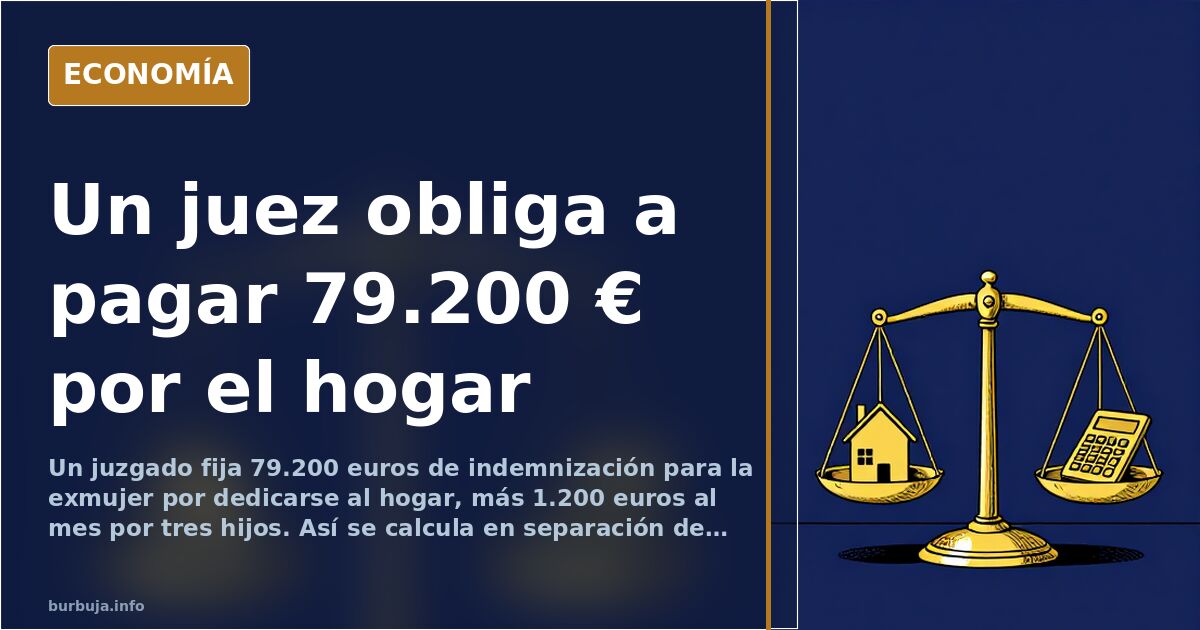
Court awards €79,200 to ex-vvife for household care
What is the value of managing a home and raising three children for fifteen years? A court has answered with a figure: €79,200. The ruling obliges the ex-husband, a businessman with significant assets, to compensate his ex-vvife for the period during which, according to the judgment, she did not work outside the home. This amount is supplemented by a child support payment of €1,200 per month, €400 for each of the three children, and the use of the penthouse that served as the family’s last residence. The woman had requested significantly more: €1,650 in child support and €1,500 for herself, totaling €3,150 per month.
The matter, widely reported by a provincial newspaper, comes with legal precedents. The judgment cites a similar ruling from the same court months prior and another case that forced a man to pay €200,000 to his ex-vvife for caring for her daughters. Compensation for family dedication has ceased to be a legal rarity, becoming a standard item in divorce settlements.
Cost of supporting three children per month
The most debated figure is not the lump-sum compensation, but the ongoing pension. The court ordered €1,200 monthly for three minors aged between 4 and 11. Some argue this amount hardly covers real upbringing costs, as the majority goes to school, extracurriculars, clothing, food, internet, and transportation. The counterargument relies on domestic arithmetic: if one adult contributes €500 per child, the other should contribute another €500, raising the question of whether three children need €3,000 per month just for food.
As a reference for domestic labor and childcare replaced by third parties, a range starting at €2,600 per month is cited if two full-time caregivers are hired. An even more uncomfortable calculation suggests that if the marriage had no savings, the share belonging to each spouse is zero. Splitting a zero balance yields zero. What was spent, was spent.
Impact of a separation of property regime
This is the detail many overlooked: the marriage was under a separation of property regime. There is no sharing everything. Each spouse retains their own assets, which is precisely why the legislator provided for compensation for the spouse who, with no own income, dedicated themselves to the home and family. This is a provision of the Civil Code activated upon divorce. In a case cited by a specialized firm, 184 months of marriage—15 years and 4 months—resulted in a compensation of €100,000.
The result is paradoxical. Under a joint property regime, dedication to the home is implicitly covered by half the assets. Under separation of property, it must be claimed separately. Those who sign without understanding this find out in court.
Must housing and food expenses be deducted?
The law does not mention such deductions, leading to the sharpest point of friction. One line of argument holds that the compensation should be reduced by the roof, food, clothing, leisure, and other expenses the ex-vvife enjoyed during the marriage, a form of payment in kind. With such deductions, the final figure would be significantly lower.
The immediate rebuttal is that these expenses also covered the husband and children, were not payments to third parties, and the enjoyment was shared. The closing counterargument is harsher: if caring for one’s own children is a compensable job, then parenting ceases to be a family duty and becomes billable.
Is compensation due if the vvife files for divorce?
This is the most repeated objection. Some compare it to any contract: the party who breaks the pact voluntarily leaves without compensation, farewell. Under this logic, paying the petitioner seems absurd.
The counterargument is that the dedication to the home occurred regardless of who takes the final step, and the compensation rewards past years, not an exit. Moreover, there is a recurring point: while one partner supported the house by working outside, the other missed out on raising their children. Who compensates for that?
The provider’s privilege and shared custody
Underlying these issues is an idea stated without euphemisms: the man enjoyed the privilege of being the provider for years and now pays for that privilege. It is the most uncomfortable version and the least discussed aloud.
Around this point, other issues unfold. That shared custody would reduce the financial burden and return time with the children to the father. That a home used by the mother and minors still belongs to the father. That real estate is what makes divorce most expensive, and those without property in their name fare better in a divorce than those who own assets.
One question remains open, and it should stay that way: if dedication to the home deserves compensation, why does the time the other parent spent outside working to support that same home not deserve it? No one has found the formula. The only contract in Spain that does not allow prior negotiation is, precisely, marriage.
Also available in: Deutsch
Summary of a discussion on Burbuja.info - Foro de economía, actualidad y política., translated from Spanish and reviewed before publication. Read the full discussion (276 replies).
More summaries
-
Shared custody: Two weeks a month to rebuild life
Esther Jaurrieta defends shared custody because it grants her two weeks free every month. The case reopens the debate on child support and children.
-
Spanish court orders Mexican surrogate to pay child support
A Spanish court has ordered a Mexican surrogate mother to pay child support for the child she carried for a Spanish father, highlighting legal contradictions.
-
Shared Custody Tops 50% in Spain: Co-Parenting or Illusion?
In 2025, shared custody exceeded 50% of divorces in Spain. Who really cares for the children? The role of grandmothers and the economic gap behind the milestone.
-
Franco handed out 8,000 flats and today no one can buy one
Franco handed out 7,486 flats in a single event according to NODO. Today, those flats rent for 1,200 euros: public housing, an uncomfortable memory
-
PSOE campaign in Spain echoes Cristina Fernández's 2011 playbook
The Spanish Socialist Party's campaign is being compared to Cristina Fernández de Kirchner's 2011 run: the staging, the Puerta del Sol encampment and the Iván Redondo factor.
-
Why hasn't Netflix made a miniseries about Spain's PSOE corruption scandals yet?
Could a series about political corruption in Spain ever be made? Forum users weigh up its feasibility, funding obstacles and the topic's narrative potential.