
Spanish Civil War: Why it hurts more than the 19th century
The Spanish Civil War killed fewer people than the Napoleonic invasion, yet still shapes politics. The narrative of the defeated and post-war repression explain why.
English · Original discussion in Spanish · Published
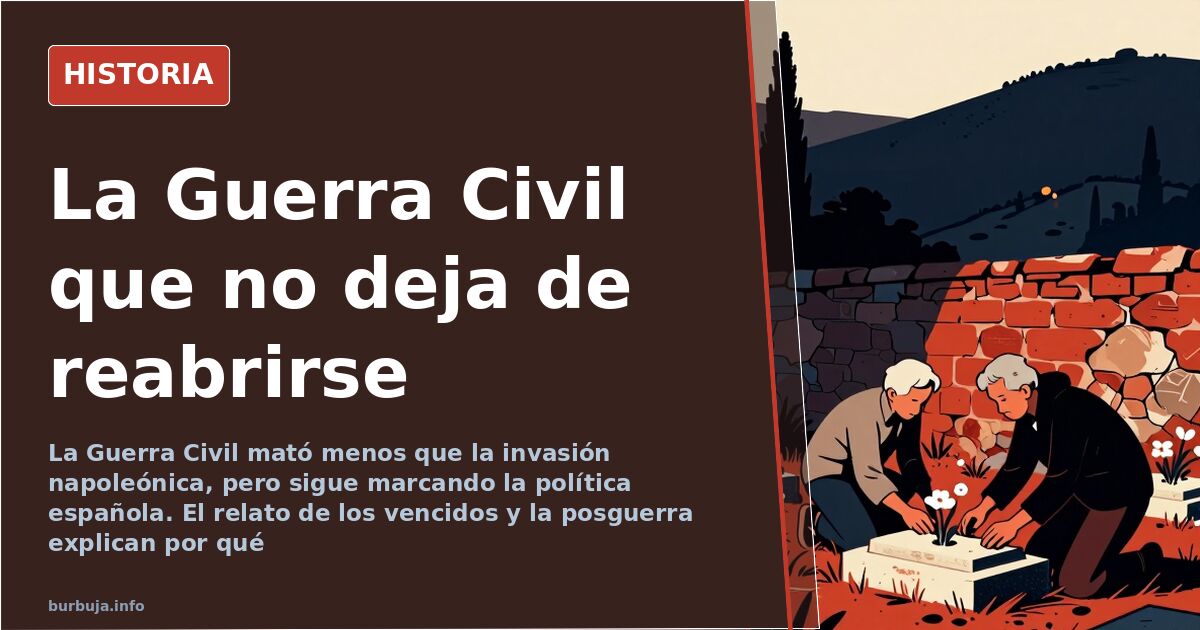
Why the Civil War weighs heavier than the entire 19th century
Why does a conflict with fewer casualties than the Peninsular War or the First Carlist War continue to define Spanish public life nearly a century later? The starting point is uncomfortable: the 19th century saw civil wars that were deadlier in relative terms. The Napoleonic invasion left around one million dead, half of them Spaniards, out of a population of about 11 million. Nearly 5% of the country. And in the First Carlist War, more soldiers died than in 1936, despite having half the inhabitants. On paper, the 19th century was bloodier. In memory, it was not.
The most common explanation points to a historical anomaly: the 1936 war would be one of the few where the losers wrote the narrative. The winning side allegedly ceded cultural primacy and control of the story to the defeated, which is historically unusual. Added to this is a generational factor: children and grandchildren inherited the trauma, while no one remains from the Carlist conflicts.
The thesis of political interest and the Historical Memory Law
One school of thought argues that the issue peine with the Historical Memory Law and that previously, during the Transition and the nineties, it was buried. The argument is that the governments of Felipe González and Aznar had no interest in stirring it up. The PSOE of that era focused on its present. It was only later that the topic returned to the center stage, with a transformed left and a different international context.
Opposing this view is another reading: it is not political interest, but rather that one of the sides is still active. Parties and unions that participated in the conflict remain within the system. The war did not close because there was no definitive defeat for anyone.
Post-war period as the true trauma
Here lies a nuance that shifts the axis. Several analyses agree that the trauma did not stem from the four years of war, but from the decades of repression, hunger, and rationing that trinc. When a civil war ends, the norm is to turn the page: pardons, reconciliation, reconstruction. This did not happen in Spain. Revenge against the defeated lasted decades.
The economic consequence was a secular delay that persisted far longer than necessary. That is the weighty fact: not the deaths of '36, but the subsequent years of misery.
The 19th century also had two Spains
The idea that there were no irreconcilable factions in the 19th century does not hold up. One need only read Blasco Ibáñez's La Araña zaina (The Black Spider) alongside Sardá y Salvany's El Liberalismo es Pecado (Liberalism is Sin). Clarín's novel *La Regenta* generated such hatred in Oviedo that when the war broke out, his bust was destroyed.
The difference is that liberals and Carlists no longer exist. Liberalism died in the twenties and Carlism faded after Vatican II. Without political heirs, there is no memory to monetize.
The Anglo-Saxon factor and the culture war
Another line highlights the influence of Anglo-Saxon historians on the Spanish narrative. It is argued that both left-leaning and conservative authors seek the approval of British Hispanists, some of whom act as propagandists for foreign interests.
To this is added criticism of Francoism for abandoning the culture war. The regime defeated Lenin but failed to anticipate Gramsci. The ideological vacuum of late Francoism was filled without resistance by the adversary's intellectual cadres. Cinema of the era, with exceptions, was characterized by *landismo* (a genre of soft-core comedy) and sensual openness (*destape*).
In the end, the fundamental question remains unanswered. The most traumatic war was not the deadliest. It was the one that left heirs with paychecks.
Why does a conflict with fewer casualties than the Peninsular War or the First Carlist War continue to define Spanish public life nearly a century later? The starting point is uncomfortable: the 19th century saw civil wars that were deadlier in relative terms. The Napoleonic invasion left around one million dead, half of them Spaniards, out of a population of about 11 million. Nearly 5% of the country. And in the First Carlist War, more soldiers died than in 1936, despite having half the inhabitants. On paper, the 19th century was bloodier. In memory, it was not.
The most common explanation points to a historical anomaly: the 1936 war would be one of the few where the losers wrote the narrative. The winning side allegedly ceded cultural primacy and control of the story to the defeated, which is historically unusual. Added to this is a generational factor: children and grandchildren inherited the trauma, while no one remains from the Carlist conflicts.
The thesis of political interest and the Historical Memory Law
One school of thought argues that the issue peine with the Historical Memory Law and that previously, during the Transition and the nineties, it was buried. The argument is that the governments of Felipe González and Aznar had no interest in stirring it up. The PSOE of that era focused on its present. It was only later that the topic returned to the center stage, with a transformed left and a different international context.
Opposing this view is another reading: it is not political interest, but rather that one of the sides is still active. Parties and unions that participated in the conflict remain within the system. The war did not close because there was no definitive defeat for anyone.
Post-war period as the true trauma
Here lies a nuance that shifts the axis. Several analyses agree that the trauma did not stem from the four years of war, but from the decades of repression, hunger, and rationing that trinc. When a civil war ends, the norm is to turn the page: pardons, reconciliation, reconstruction. This did not happen in Spain. Revenge against the defeated lasted decades.
The economic consequence was a secular delay that persisted far longer than necessary. That is the weighty fact: not the deaths of '36, but the subsequent years of misery.
The 19th century also had two Spains
The idea that there were no irreconcilable factions in the 19th century does not hold up. One need only read Blasco Ibáñez's La Araña zaina (The Black Spider) alongside Sardá y Salvany's El Liberalismo es Pecado (Liberalism is Sin). Clarín's novel *La Regenta* generated such hatred in Oviedo that when the war broke out, his bust was destroyed.
The difference is that liberals and Carlists no longer exist. Liberalism died in the twenties and Carlism faded after Vatican II. Without political heirs, there is no memory to monetize.
The Anglo-Saxon factor and the culture war
Another line highlights the influence of Anglo-Saxon historians on the Spanish narrative. It is argued that both left-leaning and conservative authors seek the approval of British Hispanists, some of whom act as propagandists for foreign interests.
To this is added criticism of Francoism for abandoning the culture war. The regime defeated Lenin but failed to anticipate Gramsci. The ideological vacuum of late Francoism was filled without resistance by the adversary's intellectual cadres. Cinema of the era, with exceptions, was characterized by *landismo* (a genre of soft-core comedy) and sensual openness (*destape*).
In the end, the fundamental question remains unanswered. The most traumatic war was not the deadliest. It was the one that left heirs with paychecks.
Also available in: Deutsch
Summary of a discussion on Burbuja.info - Foro de economía, actualidad y política., translated from Spanish and reviewed before publication. Read the full discussion (156 replies).
More summaries
-
New Book Reignites Debate on Spanish Civil War and the Republic
A recent book challenges the legitimacy of the 1931 elections, sparking renewed discussion about Spain's Second Republic and the Civil War.
-
Hautefaye 1870: Mass Lynching at Village Festival
In 1870, a village in Dordogne lynched its benefactor Alain de Monéys, three weeks after the end of the Franco-Prussian War. The Hautefaye case.
-
Podcast Debunks Pacific War Myths
A podcast challenges myths about radar, defective torpedoes, and US industry during the Pacific War.
-
Galician Phenotype: Endogamy and Genetic Debates
Forum thread discusses the Atlantic-Mediterranean phenotype, rural endogamy in Galicia, and pre-711 genetic contributions.
-
Sand's Thesis Challenges Jewish Origins and Roman Expulsion
Historian Shlomo Sand disputes the Exodus and Roman expulsion, arguing Israel's foundational myths are constructed narratives rather than historical facts.
-
Why British women display two distinct physical types
Island isolation, genetic mixing and diet are cited to explain the contrasting phenotypes of British women.