
Spanish chalet bought in 2008 for €230k now listed at €390k
A Spanish chalet bought for €230,000 in 2008: identical units sold for €160,000 in 2014, while one is currently listed at €390,000.
English · Original discussion in Spanish · Published
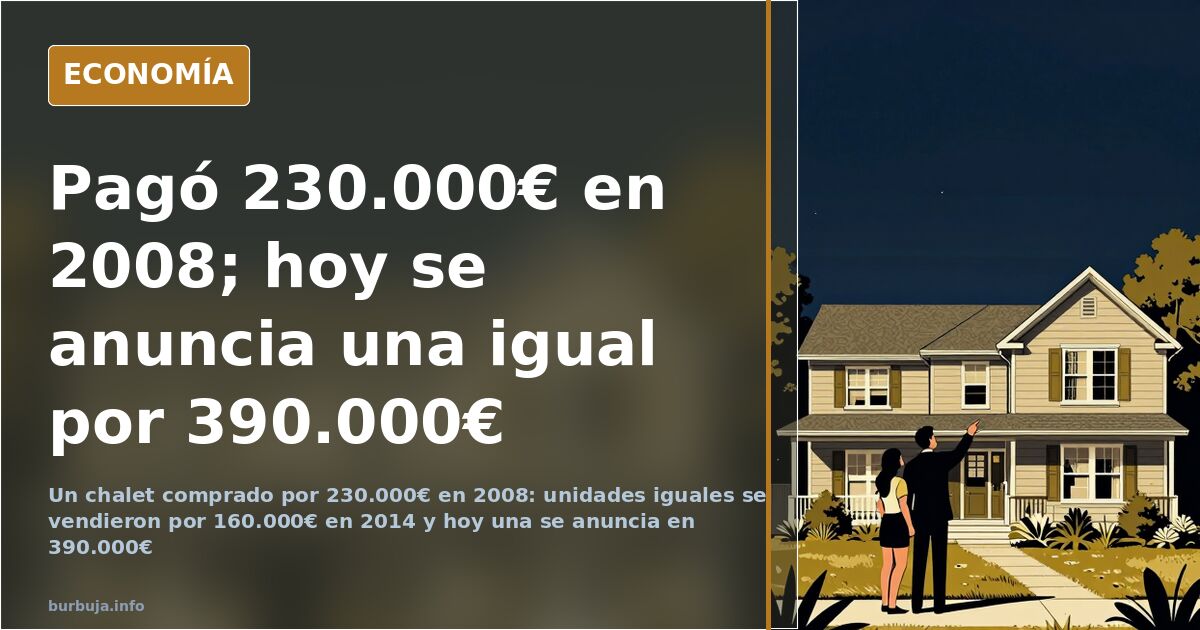
Bought in 2008, price fell 30%, now listed 70% higher
In 2008, amid the collapse of the Spanish property bubble, someone paid €230,000 cash for a detached chalet with 150 square meters built and a 380-square-meter plot, twelve minutes south of Granada. No mortgage, no landlord: own money and brand new, on a discount already applied from the 2007 price. Seventeen years later, the math is different. An identical home sold for €340,000 in December 2024, and another is now listed at €390,000. That is 70% above the purchase price. The detail that spoils the narrative is the middle stretch: units of this same type were sold for €160,000.
The decision had an uncomfortable logic. The buyer did not deny the bubble; rather, they assumed slow but prolonged declines and warned that, with 23 million homes in the stock, the result would be definitive and there would never be another real estate bubble. They bought out of personal need, without a mortgage, and made it clear they were not inviting anyone to imitate them. For those who preferred to wait, their advice was explicit: the longer you waited, the cheaper the purchase would be.
How much did that house's price fall?
By a third. Between 2008 and 2014, the market erased much of the value of homes bought during the euphoria, and this chalet was no exception: identical units were sold for €160,000, €70,000 less than the first cost. This makes the operation something other than a masterful buy. The balance sheet itself admits this without hiding it: on one hand, it acknowledges prices kept falling; on the other, it stresses there was no mortgage to pay, so the accounting hole didn't cost a single monthly installment.
Time then put everything in its place. Housing hit bottom in the mid-2010s and recovered. In December 2024, an identical unit sold for €340,000; today, the reference he has seen is €390,000. The 2008 entry price is now below market. Meanwhile, the buyer added other properties to their portfolio.
The rent that covered the hole
Because the alternative wasn't free either. The argument supporting the entire operation isn't capital gains, but the rent avoided. His reference is an equivalent rental averaging around €800 per month, which today sits near €1,500. During the same period, rents dropped to €600 before skyrocketing. The cash buyer never saw that bill, nor watched it rise.
This is where things get tangled. Those with cash to pay upfront had a real option; those needing financing played by different rules. For that second profile, some in the thread argue waiting was rational: prices fell and savings grew, the opposite direction of the bubble years when bricks rose faster than salaries could save. €230,000 in a single payment is beyond reach for almost everyone, disabling the example as a general recipe.
Hindsight calculations done after
Here comes the uncomfortable part. A house was never the best possible investment from 2008, only the most livable. According to a calculation circulating in the thread, €230,000 invested in gold would be worth around €1.4 million today; in index funds, close to €1.5 million. There is an even more absurd figure: according to the buyer himself, invested in bitcoin—the asset just born at €0.000494 per unit—the numbers break any scale, though he recalls the coin's supply is limited. The full breakdown, with its multiples, yields a dreamlike result best viewed with the same smile used to tell it.
What matters isn't the crypto-millionaire fantasy, but the common denominator extracted by several participants: almost any asset beat idle cash. The comparison serves little as reproach—in 2008 nobody knew—and much as a reminder. Housing doesn't compete with gold; it competes with rent, and there the result is less segarro and more real.
Can a bubble like 2007 repeat?
The forecast launched then still stands for those who hold it: the weight of property in Spanish households prevented a sharp crash and will also prevent history repeating with the same intensity. If the 1991 correction lasted seven years, the 2008 one could last ten or fifteen. What wasn't in the script was the subsequent rise, which some attribute to central banks and policymakers deciding not to let the market fall.
And the buyer summarizes it thus: those who bought didn't make the best possible deal, they made the one they wanted. They saw the house drop a third and decided not to sell; they saw it recover and still didn't sell. Now, with another unit listed at €390,000, paper vindicates them. Inflation eating away money over those seventeen years does the rest.
That housing rises unchecked is, at this point, the most comfortable and least reliable prediction. Anyone betting on it should first look at how long this house took to recover what it lost.
In 2008, amid the collapse of the Spanish property bubble, someone paid €230,000 cash for a detached chalet with 150 square meters built and a 380-square-meter plot, twelve minutes south of Granada. No mortgage, no landlord: own money and brand new, on a discount already applied from the 2007 price. Seventeen years later, the math is different. An identical home sold for €340,000 in December 2024, and another is now listed at €390,000. That is 70% above the purchase price. The detail that spoils the narrative is the middle stretch: units of this same type were sold for €160,000.
The decision had an uncomfortable logic. The buyer did not deny the bubble; rather, they assumed slow but prolonged declines and warned that, with 23 million homes in the stock, the result would be definitive and there would never be another real estate bubble. They bought out of personal need, without a mortgage, and made it clear they were not inviting anyone to imitate them. For those who preferred to wait, their advice was explicit: the longer you waited, the cheaper the purchase would be.
How much did that house's price fall?
By a third. Between 2008 and 2014, the market erased much of the value of homes bought during the euphoria, and this chalet was no exception: identical units were sold for €160,000, €70,000 less than the first cost. This makes the operation something other than a masterful buy. The balance sheet itself admits this without hiding it: on one hand, it acknowledges prices kept falling; on the other, it stresses there was no mortgage to pay, so the accounting hole didn't cost a single monthly installment.
Time then put everything in its place. Housing hit bottom in the mid-2010s and recovered. In December 2024, an identical unit sold for €340,000; today, the reference he has seen is €390,000. The 2008 entry price is now below market. Meanwhile, the buyer added other properties to their portfolio.
The rent that covered the hole
Because the alternative wasn't free either. The argument supporting the entire operation isn't capital gains, but the rent avoided. His reference is an equivalent rental averaging around €800 per month, which today sits near €1,500. During the same period, rents dropped to €600 before skyrocketing. The cash buyer never saw that bill, nor watched it rise.
This is where things get tangled. Those with cash to pay upfront had a real option; those needing financing played by different rules. For that second profile, some in the thread argue waiting was rational: prices fell and savings grew, the opposite direction of the bubble years when bricks rose faster than salaries could save. €230,000 in a single payment is beyond reach for almost everyone, disabling the example as a general recipe.
Hindsight calculations done after
Here comes the uncomfortable part. A house was never the best possible investment from 2008, only the most livable. According to a calculation circulating in the thread, €230,000 invested in gold would be worth around €1.4 million today; in index funds, close to €1.5 million. There is an even more absurd figure: according to the buyer himself, invested in bitcoin—the asset just born at €0.000494 per unit—the numbers break any scale, though he recalls the coin's supply is limited. The full breakdown, with its multiples, yields a dreamlike result best viewed with the same smile used to tell it.
What matters isn't the crypto-millionaire fantasy, but the common denominator extracted by several participants: almost any asset beat idle cash. The comparison serves little as reproach—in 2008 nobody knew—and much as a reminder. Housing doesn't compete with gold; it competes with rent, and there the result is less segarro and more real.
Can a bubble like 2007 repeat?
The forecast launched then still stands for those who hold it: the weight of property in Spanish households prevented a sharp crash and will also prevent history repeating with the same intensity. If the 1991 correction lasted seven years, the 2008 one could last ten or fifteen. What wasn't in the script was the subsequent rise, which some attribute to central banks and policymakers deciding not to let the market fall.
And the buyer summarizes it thus: those who bought didn't make the best possible deal, they made the one they wanted. They saw the house drop a third and decided not to sell; they saw it recover and still didn't sell. Now, with another unit listed at €390,000, paper vindicates them. Inflation eating away money over those seventeen years does the rest.
That housing rises unchecked is, at this point, the most comfortable and least reliable prediction. Anyone betting on it should first look at how long this house took to recover what it lost.
Also available in: Deutsch
Summary of a discussion on Burbuja.info - Foro de economía, actualidad y política., translated from Spanish and reviewed before publication. Read the full discussion (125 replies).
More summaries
-
Spanish housing shortage: why apartment prices keep rising
New building permits dropped from 885,000 in 2006 to 108,000 in 2023. This scarcity drives up housing prices with no sign of a market crash.
-
Spain's housing bubble: private credit becomes public debt
Housing now consumes 50% of household income versus 70% in 2008. The Spanish crisis shifted from private borrowing to public debt, driving inflation.
-
H&M and the dog clothing that reignites the birth rate debate
A video attributes to H&M a garment with a pocket for carrying the dog: AI doubts, XXXL size, and the pet-child business at the center of the debate.
-
University degrees no longer guarantee independence in Spain
Qualified workers struggle to live independently in Spain, facing €2,000 salaries against €1,200 rents and unbalanced responsibilities.
-
Spanish breakfast sparks online debate on sugar and health
A Spanish forum post about a protein-rich breakfast triggers heated arguments over added sugars, animal fats, and national identity.
-
Spanish Liberalism Defined by Imported Flags and Public Pay
Noelia Núñez’s unfinished degree highlights contradictions in Spanish liberalism, mixing imported symbols with state-funded careers.