
Spanish butcher highlights pension gap with social aid
A Spanish self-employed butcher with 32 years of work claims an €800 pension, while a newcomer receives €1,000 in aid. The video reignites debate on Spain's welfare system.
English · Original discussion in Spanish · Published
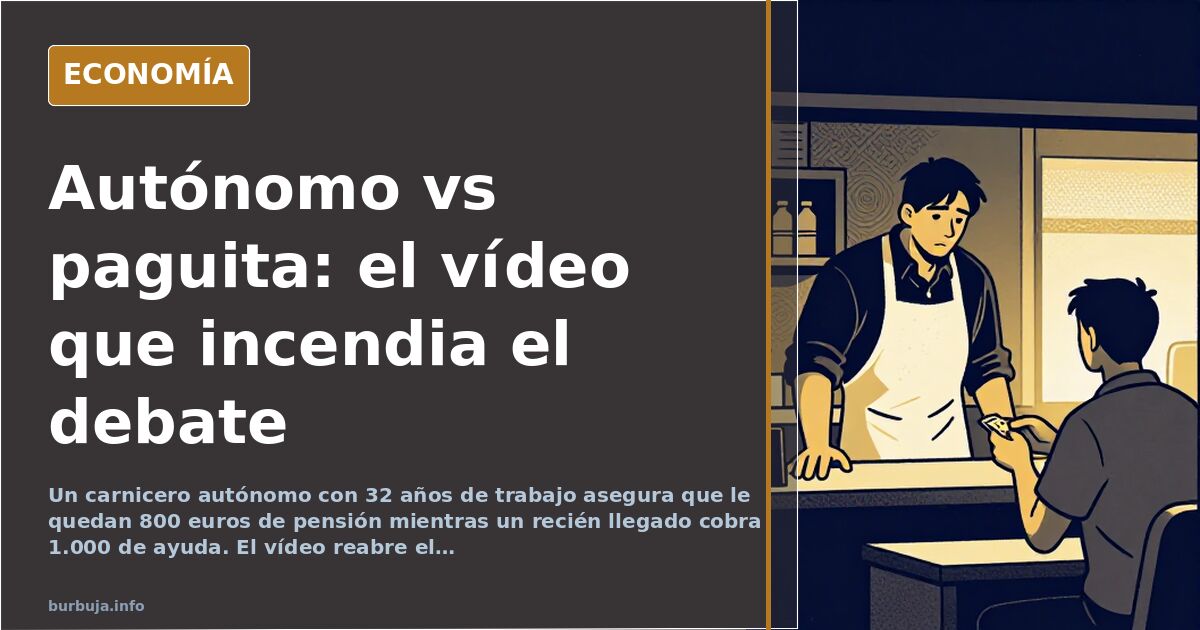
Spanish self-employed butcher compares his pension to social aid
A butcher who has worked for 32 years claims he receives only an €800 pension. According to his testimony, a recent arrival collects €1,000 in aid without having contributed a single day. The scene, filmed in his own shop and shared on social media, has peine the debate on the pension system and non-contributory benefits in Spain. For some participants, this is not an isolated case: it is a snapshot of a model that treats equally those who run the register and those who merely pass by.
What exactly does the butcher say and why did it strike a chord?
The protagonist is a self-employed individual running a butcher shop. His complaint is not against immigrants per se: it is against a system that, according to his experience, rewards those who do not contribute and punishes those who have paid for decades. 32 years of work and an €800 pension versus €1,000 in aid for someone who just arrived. The comparison is brutal, which is why it is circulating.
Some argue that the €800 figure is perfectly possible if a large part of those years was contributed at the minimum base or if there were periods without contributions. The pension calculation depends on the regulatory base, not on years of work in the abstract. Contributing for 40 years at the minimum yields a minimum pension, and seniority does not fix that.
The underlying problem is different: the system mixes two incompatible logics. Contributory pensions are financed by contributions. Non-contributory benefits are financed by taxes. When both amounts converge, the incentive breaks down. This is where the video stops being an anecdote.
The calculation no one makes: how much does a worker cost and what is left for them?
A breakdown circulating in the debate puts numbers to the issue. An unskilled worker earning the minimum wage costs the employer around €24,710 per year, approximately €2,059 per month prorated over twelve payments. From this amount, the worker receives significantly less after income tax (IRPF) and social security contributions. The difference between what is paid and what is received is not an accounting detail: it is the gap that explains why many self-employed individuals give up.
Added to this is consumption taxation. A worker earning €1,234 net pays VAT on everything they buy, property tax (IBI) if they own a home, vehicle circulation tax if they have a car, and special taxes on electricity, gas, fuel, alcohol, and tobacco, which in some cases exceed 50% of the final price. Calculating the real effective tax rate is almost impossible, but the direction is clear: lower income brackets bear an indirect burden that does not appear on the payslip.
Why self-employed workers say the system punishes them
The complaint is not just about the pension. It is about the whole package. A self-employed worker pays a fixed monthly fee regardless of their turnover. They have no unemployment insurance. No paid sick leave. No vacation. And when business is bad, they still pay. The flat-rate scheme for the first few years is a mirage: when it ends, a significant portion of self-employed workers deregister because the fee becomes unaffordable.
The contrast with the general regime is glaring from the perspective of those living it. An employee has unemployment benefits, subsidies, training, and aid. A self-employed worker who has been paying for twenty years has no safety net. This asymmetry is what turns a video from a butcher shop into a viral phenomenon.
The aid for those over 52 and the grievance pointed out by contributors
One of the most repeated points in the analysis is the subsidy for people over 52. Some argue that contributions for this benefit are calculated at 125% of the minimum wage, which in practice can generate a future pension higher than that of a self-employed worker who has contributed at the minimum for decades. The result, according to this reading, is a paradox: those who have been intermittently in the system may end up collecting more than those who have been in it all their lives.
To this is added the special agricultural regime, where for years it was not possible to contribute above the minimum base. Many rural workers have contributed at the floor throughout their lives and reached retirement with pensions that do not reach €900. This is not a flaw in the system: it is the system.
The debate on who contributes and who does not
The question hovering over the entire issue is whether it makes sense for the non-contributory pension to be so close to the minimum contributory pension. If someone who has never contributed can collect almost as much as someone who has contributed for fifteen years, the message sent by the system is perverse. Some defend that the non-contributory benefit is a survival net and must exist. Others respond that a survival net cannot compete in amount with the reward for contributing.
The discussion becomes complicated when the informal economy enters the picture. There are self-employed workers who contribute at the minimum and declare below what they actually earn. This reduces their future pension, but also their current tax burden. The result is a system where no one has incentives to declare the full truth, nor to contribute above the minimum if the return is so low.
What happens with integration and the discourse of working migrants?
The video has served for something more than talking about pensions. Part of the debate points out that migrants who have been working, contributing, and starting businesses for years are the first interested in ensuring the system does not degrade. Their complaint is not against immigration: it is against an aid model that, they argue, ultimately deteriorates the social perception of an entire group.
This argument has a more uncomfortable version. If the system distributes benefits without distinguishing between those who contribute and those who do not, the conflict is not between nationalities: it is between taxpayers and beneficiaries. In this line, the butcher in the video is not alone. He is accompanied, according to some participants, by a growing number of self-employed workers who see their effort diluted in a structure that does not recognize them.
The exact point where the analysis stalls is this: no one knows how many self-employed workers contribute at the minimum, how many declare below their actual income, and how many have abandoned the regime due to pure unviability. Without this data, the discussion remains an anecdote. With it, it would be a reform.
Also available in: Deutsch
Summary of a discussion on Burbuja.info - Foro de economía, actualidad y política., translated from Spanish and reviewed before publication. Read the full discussion (110 replies).
More summaries
-
Spain: 17 years of contributions grant a pension but low base
While 17 years of contributions entitle a person to a contributory pension in Spain, a long gap in payments can drastically reduce the final amount.
-
More and more workers in Spain are earning close to the minimum wage
Spain's minimum wage (SMI) has risen 47% since 2018, but wage compression is dragging engineers down to labourers' pay. An analysis of the tax trap and workplace absenteeism.
-
German vs. Spanish Minimum Pension After 15 Years on Minimum Wage
15 years on minimum wage doesn't yield €936 in Spain; that's a minimum top-up. Real calculation and German net pension explained.
-
46% of Spanish Voters Receive Public Funds, Analysis Finds
A journalistic analysis claims 46% of Spain's electoral census receives pensions, aid, or public employment. This figure constrains any potential reform.
-
War diary: seven days that changed the Middle East (February 28 - March 5, 2026)
Analysis of the war against Iran: official casualty figures don't add up with 2,000 drones and 500 missiles. Comparison with Venezuela and the cost of the bases.
-
Fire drill at Spain's Congress on the very day of the question time session
A fire drill at the Spanish Congress held during the government's question time session raises suspicions of a possible political distraction strategy.