
Spanish Business Circle Proposes Raising Retirement Age to 68-72
Spain's Círculo de Empresarios suggests delaying retirement to 68-72. Critics highlight hiring biases against workers over 50 and systemic flaws.
English · Original discussion in Spanish · Published
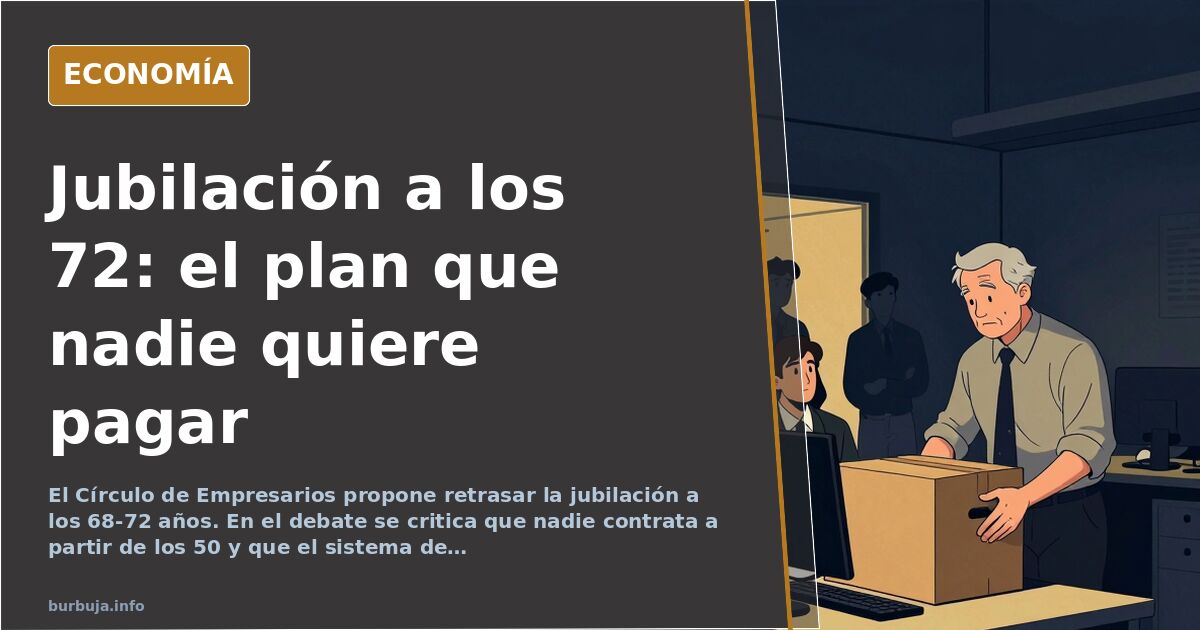
Círculo de Empresarios Proposes Delaying Retirement Until Age 72
The Círculo de Empresarios (a prominent Spanish business association) has proposed raising the retirement age to a range of 68 to 72 years. The proposal, reported by El Confidencial, has met with widespread rejection in public debate, where it is noted that the legal retirement age already approaches 67 and many workers reach 50 facing significant hiring barriers. This is not a new idea; it is yet another attempt to tighten a system that critics argue is failing on multiple fronts.
What Exactly Does the Círculo de Empresarios Propose?
The proposal does not call for direct cuts but rather for extending working lives to sustain the pay-as-you-go pension system. The argument is familiar: there are more pensioners and fewer contributors, and the demographic pyramid is unsustainable. The Círculo frames this as a mathematical necessity rather than an ideological choice. Supporters claim that without this adjustment, the system will collapse, leaving today's young people with no benefits.
Public reaction has been largely one of frontal rejection. Some point out that bank employees took early retirement at 50 with million-euro pensions, while now manual laborers and cleaners are asked to work until 72. The contradiction is hard to swallow: bailouts for the top, austerity for the bottom.
Who Hires Someone Aged 60?
The most repeated argument concerns the real labor market. Finding a job after 50 is often illusory. If you become unemployed at 55, you face more than fifteen years before retirement with little hope of being called back. The Círculo’s proposal ignores this reality: you cannot delay retirement when the system pushes older workers out much earlier.
Some suggest an intermediate solution: retirement based on years contributed, not age. Those who start at 14 and contribute for 40 years could retire at 54. Those starting at 30 would need to work until 70. However, nobody starts at 14 today. Labor market entry has shifted to the thirties, breaking any such calculation.
The Pay-As-You-Go System Under Fire
Part of the analysis argues that the pay-as-you-go system is a Ponzi scheme that only works while there are more contributors than pensioners. The proposed solution is privatization: individual accounts, similar to US 401k plans or the Chilean model. The argument is that individuals should manage their own money and the state should not promise what it cannot deliver.
The counterargument is immediate: Chile’s funds have failed, leaving many retirees without adequate pensions. Privatization guarantees nothing; it merely shifts risk to the individual. In a country with low wages and precarious employment, few can save enough.
Pensioners as Scapegoats
Another line of criticism targets high-income pensioners. Some complain that a retired couple can earn 5,000 euros a month from pensions and rents, while young people struggle with impossible mortgages. The uncomfortable conclusion is that not all pensioners are vulnerable, and some extract more than they contributed.
The rebuttal is that generalizing is unfair. Most pensioners receive between 800 and 1,500 euros, and many support children and grandchildren. Blaming an entire group for the crisis is a smokescreen that avoids discussing wages, housing, and productivity.
What Will Happen to Pensions?
The prevailing prediction is that nothing fundamental will change. The retirement age will be raised, contributions increased, and the system patched up, leaving the problem for the next generation. Unions will protest, businesses will insist, and the government in power will do the bare minimum to avoid losing votes. Meanwhile, those aged 40 today are contributing toward a retirement they may never fully collect.
The full calculation, including all demographic and economic variables, yields a result nobody wants to put in writing. But the conclusion is clear: either the model changes, or it collapses on its own. And nobody seems in a hurry to decide which happens first.
The Círculo de Empresarios (a prominent Spanish business association) has proposed raising the retirement age to a range of 68 to 72 years. The proposal, reported by El Confidencial, has met with widespread rejection in public debate, where it is noted that the legal retirement age already approaches 67 and many workers reach 50 facing significant hiring barriers. This is not a new idea; it is yet another attempt to tighten a system that critics argue is failing on multiple fronts.
What Exactly Does the Círculo de Empresarios Propose?
The proposal does not call for direct cuts but rather for extending working lives to sustain the pay-as-you-go pension system. The argument is familiar: there are more pensioners and fewer contributors, and the demographic pyramid is unsustainable. The Círculo frames this as a mathematical necessity rather than an ideological choice. Supporters claim that without this adjustment, the system will collapse, leaving today's young people with no benefits.
Public reaction has been largely one of frontal rejection. Some point out that bank employees took early retirement at 50 with million-euro pensions, while now manual laborers and cleaners are asked to work until 72. The contradiction is hard to swallow: bailouts for the top, austerity for the bottom.
Who Hires Someone Aged 60?
The most repeated argument concerns the real labor market. Finding a job after 50 is often illusory. If you become unemployed at 55, you face more than fifteen years before retirement with little hope of being called back. The Círculo’s proposal ignores this reality: you cannot delay retirement when the system pushes older workers out much earlier.
Some suggest an intermediate solution: retirement based on years contributed, not age. Those who start at 14 and contribute for 40 years could retire at 54. Those starting at 30 would need to work until 70. However, nobody starts at 14 today. Labor market entry has shifted to the thirties, breaking any such calculation.
The Pay-As-You-Go System Under Fire
Part of the analysis argues that the pay-as-you-go system is a Ponzi scheme that only works while there are more contributors than pensioners. The proposed solution is privatization: individual accounts, similar to US 401k plans or the Chilean model. The argument is that individuals should manage their own money and the state should not promise what it cannot deliver.
The counterargument is immediate: Chile’s funds have failed, leaving many retirees without adequate pensions. Privatization guarantees nothing; it merely shifts risk to the individual. In a country with low wages and precarious employment, few can save enough.
Pensioners as Scapegoats
Another line of criticism targets high-income pensioners. Some complain that a retired couple can earn 5,000 euros a month from pensions and rents, while young people struggle with impossible mortgages. The uncomfortable conclusion is that not all pensioners are vulnerable, and some extract more than they contributed.
The rebuttal is that generalizing is unfair. Most pensioners receive between 800 and 1,500 euros, and many support children and grandchildren. Blaming an entire group for the crisis is a smokescreen that avoids discussing wages, housing, and productivity.
What Will Happen to Pensions?
The prevailing prediction is that nothing fundamental will change. The retirement age will be raised, contributions increased, and the system patched up, leaving the problem for the next generation. Unions will protest, businesses will insist, and the government in power will do the bare minimum to avoid losing votes. Meanwhile, those aged 40 today are contributing toward a retirement they may never fully collect.
The full calculation, including all demographic and economic variables, yields a result nobody wants to put in writing. But the conclusion is clear: either the model changes, or it collapses on its own. And nobody seems in a hurry to decide which happens first.
Also available in: Deutsch
Summary of a discussion on Burbuja.info - Foro de economía, actualidad y política., translated from Spanish and reviewed before publication. Read the full discussion (133 replies).
More summaries
-
The Netherlands adopts individual pension accounts like Chile's model
The Netherlands implemented individual pension accounts in July 2023, with a five-year transition until 2028. The debate continues over who will pay for the change.
-
German advisory council suggests retiring at 73
A German advisory council to the Ministry of Economy proposes raising the retirement age to 73 to prevent pension collapse.
-
Retirement at 73: The Proposal Stirring the Pension Debate
A report proposes raising the retirement age to 73 to save pensions. Alternatives clash: immigration, spending cuts, or a model change…
-
Milan: The Mirror Spain Refuses to Look Into
After visiting Milan, a young woman says Spain has no idea what an invasion is. Data on Spain's minimum wage, regularizations, and the Italian mirror.
-
Sánchez escalates rhetoric against 'VoxPP' as PSOE fears July election defeat
Pedro Sánchez pushes the 'VoxPP' label citing child labor exploitation, while his party worries about a severe electoral backlash in July.
-
Iglesias Proposes Left-Wing Alliance with PSOE, Podemos and Sumar
Spain's Pablo Iglesias suggests a broad left-wing front led by Sánchez as Podemos loses seats in Madrid and Valencia.