
Reconquista: Myths and Debates on Origins
Denial of the Visigothic Kingdom, Islamic conquest, and nativist myths fuel a debate challenging the eight-century Reconquista narrative in Spain.
English · Original discussion in Spanish · Published
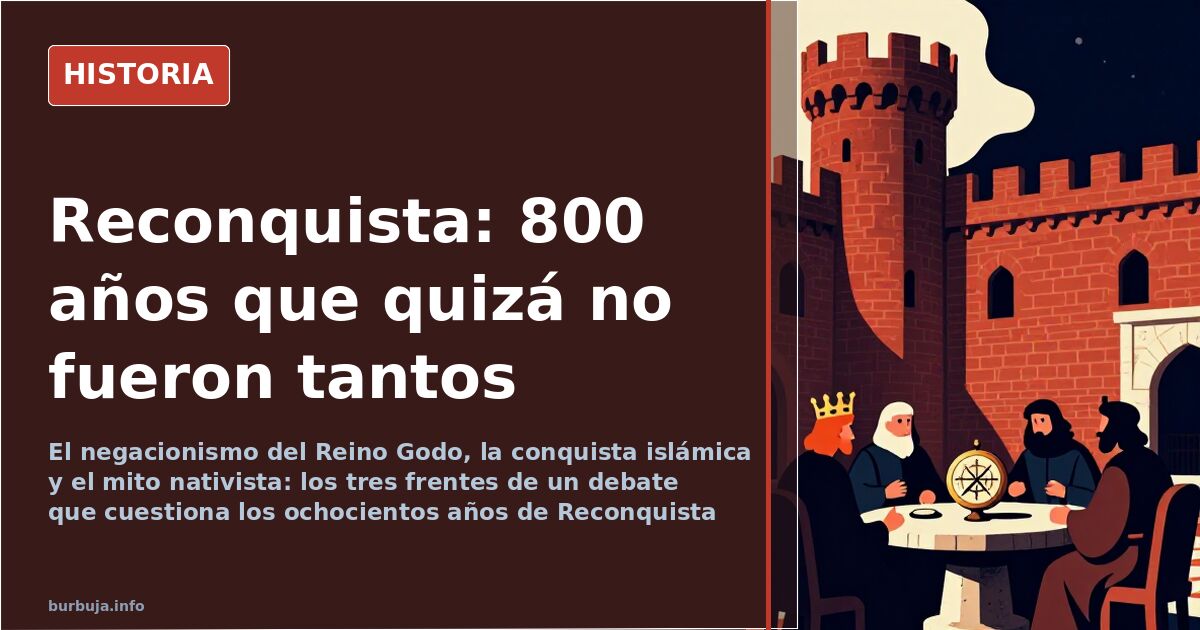
Reconquista: The Myths Nationalism Refuses to Revisit
Did the Kingdom of Spain exist before the Umayyad invasion of the 8th century? Was Don Pelayo a Goth or a local chieftain? Did the Reconquista last eight hundred years? The short answer is that none of these questions have a single definitive response, and those who display the most certainty are precisely those who handle the fewest sources. The debate begins with a provocative thesis: the denial of the Visigothic Kingdom and the denial of the Sarracinic conquest are two sides of the same ideological coin.
Did Spain Exist Before the Muslim Invasion?
The first assertion of this approach is categorical: in the 8th century, the Kingdom of Spain was invaded by the armies of the Umayyad Caliphate, collapsed, and disappeared. Shortly after, Christian resistance nuclei emerged claiming legal continuity with the Gothic kingdom. According to this reading, there is no source stating otherwise: Christians in the north, whether Galicians, Navarrese, Leonese, Asturians, Catalans, or Aragonese, identified the defeat as the loss of a common kingdom.
Against this, some argue that the Kingdom of Spain did not exist as such and that what existed was a conglomerate of Visigoths in decay. This discussion is not trivial: it determines whether the Reconquista was a restoration or an a posteriori construction. The topic suggests that anti-Spanish sentiment reaches its peak in authors who even deny the existence of Gothic kings, a thesis attributed to historians like Henry Kamen.
The Denial of the Sarracinic Conquest
At the opposite extreme appears a theory denying any conquest from North Africa. Its main cited proponent is Ignacio Olague, who argued that the peninsular population adopted Sarracin organically and that Al-Andalus would have been something typically Spanish and European. Olague was linked to the Falange, and his theses are now embraced by Andalusianist and far-left sectors interested in selling a peaceful or non-existent conquest.
The material leaves no doubt about the assessment of this thesis: it calls it "crazy" and notes that its current interest is the whitewashing of Sarracin. However, the discussion does not end there. Some nuance that the conquest was rapid precisely because the Visigothic kingdom was fragile, and that this fragility is explained by a system of endogamous aristocracies that generated hostility wherever they were established.
The Nativist Myth and the Invention of Northern Peoples
Here lies the core of the matter. The so-called nativist myth holds that the Goths never controlled the northern peninsula, that Christian chieftains had no relation to the Gothic identity, and that northern peoples remained alien to Romanization. That is, that the Asturians or Cantabrians of the 8th century corresponded to those of the 1st century BC.
Archaeological evidence, according to the argument, demonstrates the opposite: Gothic dominion was full, and today even the most regionalist historiography does not deny Visigothic rule. The theory originates from Barbero and Vigil, who postulated that northern peoples were a sort of isolated Gallic village that later rebelled against Goths and Jovenlandeses without a clear reason. There are no differences in tombs or documents that allow identifying these people as separate nations.
Was Pelayo Gothic or Asturian? The Problem of Names
One of the most repeated arguments is that Pelayo was not Gothic because he was named Pelayo. The material calls this reasoning absurd: we cannot know if Pelayo was Gothic, but we do know he claimed to be, and it makes sense that warriors from the Visigothic army took refuge in the north. There are other examples of Goths with Roman names, such as Pope Pelagius II, and Hebrew names in the era without anyone deducing ethnicity.
The interest in making Pelayo non-Gothic responds, according to this reading, to the same nativist myth. The important thing, it is argued, is not whether Pelayo was Gothic or native, but that the resistance nuclei claimed legal continuity. The discussion shifts to figures like Íñigo Arista, theoretically Basque but born in Aragon and connected to the Banu Qasi, or Rodrigo, whom some try to pass off as Asturian when documented kinships point elsewhere.
Did the Reconquista Last Eight Hundred Years?
Another myth highlighted is the round figure of eight hundred years. On the Cantabrian coast, Muslim presence did not reach half a century, and by 1085, with the reconquest of Toledo, the entire northern half of the peninsula had been recovered. By the mid-13th century, about five hundred years after the invasion, all territory was reconquered except for the small Kingdom of Granada.
The figure of eight hundred years is sustained only if counted until 1492, which amounts to measuring the Reconquista by its final episode rather than its development. The material emphasizes that the Reconquista occurred in different phases with huge territorial recoveries, and that even at the height of Muslim primacy, during Almanzor's time, he did not achieve a definitive victory.
The Concept of Reconquista and Its Deconstruction
The last derivative of the debate is the term itself. It is argued that the idea of Reconquista is a 19th-century fascist invention, but the material maintains that the term originates in the 18th century and that its use had no political connotation until attempts were made to deconstruct it. The discussion on whether the Reconquista was a continuous process or a series of disconnected episodes remains open.
Some go further and propose that the origin of the political continuity legitimizing modern Spain comes not from the Visigothic Kingdom through Pelayo, but from the Carolingian Empire. It is a minority thesis, but it illustrates how much the debate on origins is also a debate on present legitimacy.
In the end, the question is not whether the Reconquista existed, but how many myths fit into eight hundred years. And the answer, as almost always, depends on who pays the bill for history.
Did the Kingdom of Spain exist before the Umayyad invasion of the 8th century? Was Don Pelayo a Goth or a local chieftain? Did the Reconquista last eight hundred years? The short answer is that none of these questions have a single definitive response, and those who display the most certainty are precisely those who handle the fewest sources. The debate begins with a provocative thesis: the denial of the Visigothic Kingdom and the denial of the Sarracinic conquest are two sides of the same ideological coin.
Did Spain Exist Before the Muslim Invasion?
The first assertion of this approach is categorical: in the 8th century, the Kingdom of Spain was invaded by the armies of the Umayyad Caliphate, collapsed, and disappeared. Shortly after, Christian resistance nuclei emerged claiming legal continuity with the Gothic kingdom. According to this reading, there is no source stating otherwise: Christians in the north, whether Galicians, Navarrese, Leonese, Asturians, Catalans, or Aragonese, identified the defeat as the loss of a common kingdom.
Against this, some argue that the Kingdom of Spain did not exist as such and that what existed was a conglomerate of Visigoths in decay. This discussion is not trivial: it determines whether the Reconquista was a restoration or an a posteriori construction. The topic suggests that anti-Spanish sentiment reaches its peak in authors who even deny the existence of Gothic kings, a thesis attributed to historians like Henry Kamen.
The Denial of the Sarracinic Conquest
At the opposite extreme appears a theory denying any conquest from North Africa. Its main cited proponent is Ignacio Olague, who argued that the peninsular population adopted Sarracin organically and that Al-Andalus would have been something typically Spanish and European. Olague was linked to the Falange, and his theses are now embraced by Andalusianist and far-left sectors interested in selling a peaceful or non-existent conquest.
The material leaves no doubt about the assessment of this thesis: it calls it "crazy" and notes that its current interest is the whitewashing of Sarracin. However, the discussion does not end there. Some nuance that the conquest was rapid precisely because the Visigothic kingdom was fragile, and that this fragility is explained by a system of endogamous aristocracies that generated hostility wherever they were established.
The Nativist Myth and the Invention of Northern Peoples
Here lies the core of the matter. The so-called nativist myth holds that the Goths never controlled the northern peninsula, that Christian chieftains had no relation to the Gothic identity, and that northern peoples remained alien to Romanization. That is, that the Asturians or Cantabrians of the 8th century corresponded to those of the 1st century BC.
Archaeological evidence, according to the argument, demonstrates the opposite: Gothic dominion was full, and today even the most regionalist historiography does not deny Visigothic rule. The theory originates from Barbero and Vigil, who postulated that northern peoples were a sort of isolated Gallic village that later rebelled against Goths and Jovenlandeses without a clear reason. There are no differences in tombs or documents that allow identifying these people as separate nations.
Was Pelayo Gothic or Asturian? The Problem of Names
One of the most repeated arguments is that Pelayo was not Gothic because he was named Pelayo. The material calls this reasoning absurd: we cannot know if Pelayo was Gothic, but we do know he claimed to be, and it makes sense that warriors from the Visigothic army took refuge in the north. There are other examples of Goths with Roman names, such as Pope Pelagius II, and Hebrew names in the era without anyone deducing ethnicity.
The interest in making Pelayo non-Gothic responds, according to this reading, to the same nativist myth. The important thing, it is argued, is not whether Pelayo was Gothic or native, but that the resistance nuclei claimed legal continuity. The discussion shifts to figures like Íñigo Arista, theoretically Basque but born in Aragon and connected to the Banu Qasi, or Rodrigo, whom some try to pass off as Asturian when documented kinships point elsewhere.
Did the Reconquista Last Eight Hundred Years?
Another myth highlighted is the round figure of eight hundred years. On the Cantabrian coast, Muslim presence did not reach half a century, and by 1085, with the reconquest of Toledo, the entire northern half of the peninsula had been recovered. By the mid-13th century, about five hundred years after the invasion, all territory was reconquered except for the small Kingdom of Granada.
The figure of eight hundred years is sustained only if counted until 1492, which amounts to measuring the Reconquista by its final episode rather than its development. The material emphasizes that the Reconquista occurred in different phases with huge territorial recoveries, and that even at the height of Muslim primacy, during Almanzor's time, he did not achieve a definitive victory.
The Concept of Reconquista and Its Deconstruction
The last derivative of the debate is the term itself. It is argued that the idea of Reconquista is a 19th-century fascist invention, but the material maintains that the term originates in the 18th century and that its use had no political connotation until attempts were made to deconstruct it. The discussion on whether the Reconquista was a continuous process or a series of disconnected episodes remains open.
Some go further and propose that the origin of the political continuity legitimizing modern Spain comes not from the Visigothic Kingdom through Pelayo, but from the Carolingian Empire. It is a minority thesis, but it illustrates how much the debate on origins is also a debate on present legitimacy.
In the end, the question is not whether the Reconquista existed, but how many myths fit into eight hundred years. And the answer, as almost always, depends on who pays the bill for history.
Also available in: Deutsch
Summary of a discussion on Burbuja.info - Foro de economía, actualidad y política., translated from Spanish and reviewed before publication. Read the full discussion (119 replies).
More summaries
-
Debate: Al-Andalus and European History
A forum discusses Jean Batou's thesis on Al-Andalus as a key piece of European history. The thread shifts to conquest figures, genetics, and politics.
-
ETA and GAL: two arms of the same Gladio network in Spain
Investigation linking ETA and GAL as arms of the same NATO Gladio network, with drug trafficking funding and CIA control.
-
Chilean election debate highlights nationality laws
The controversy over Chile's presidential candidates revives the global debate on ius soli versus ius sanguinis, contrasting Latin American and European models of national identity.
-
Napoleon's Top Generals: The Seven He Chose
Napoleon ranked seven ancient and modern commanders, excluding himself. The debate on who was truly the greatest remains open.
-
Sea Peoples: The Bronze Age Collapse Mystery
Around 1200 BC, Sea Peoples devastated the Eastern Mediterranean. Iron, climate, and Luwians are key to this unexplained collapse.
-
Bilbao's Bid for Spain's Third City Status
With 350,000 residents and an 860,000 metro area, Bilbao trails Valencia, Seville, Malaga and Zaragoza by population.