
Spanish and Italian banks offer government bonds to retail clients
Major Spanish banks like La Caixa and Santander are selling Spanish and Italian debt funds with high subscription fees of up to 5%.
English · Original discussion in Spanish · Published
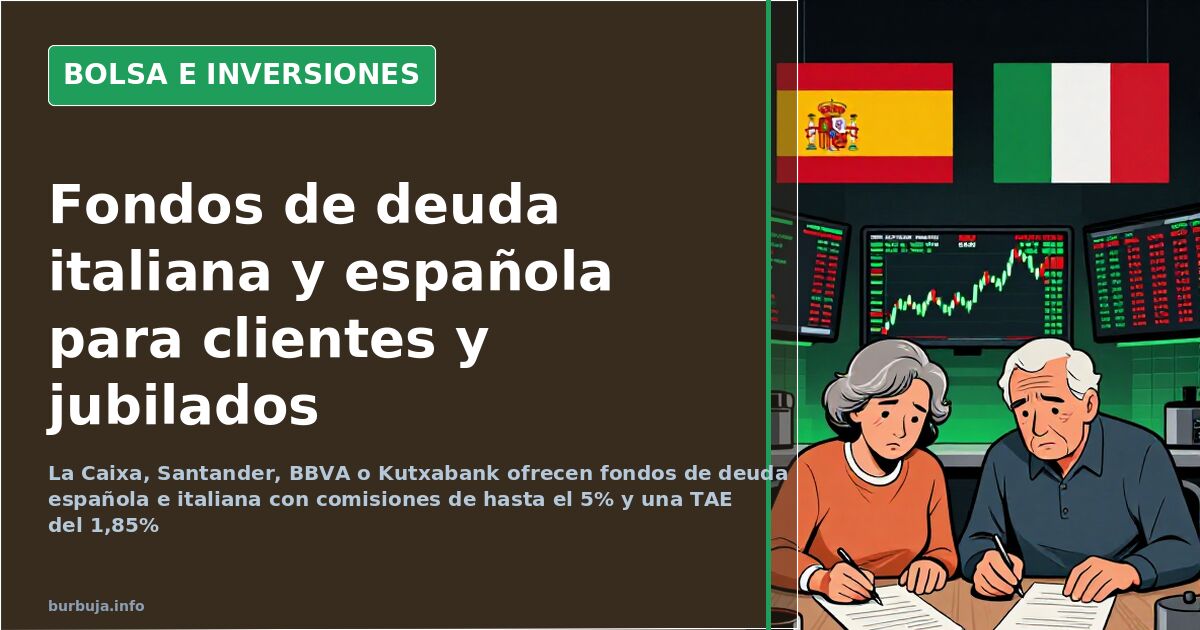
Banking and Italian bonds: a 5% commission for placing debt
[P]Spanish banks have found a goldmine in the sale of public debt. Entities such as La Caixa, Santander, BBVA, and Kutxabank are offering retail clients, including retirees, fixed-income funds loaded with Spanish and Italian bonds. The hook is the coupon; the fine print, the commission. And the question hovering over every operation is uncomfortable: why are they offloading this exposure precisely now?[/P]
[P]The calendar helps place the matter. The subscription period for one of these products began on December 21, 2022 and extends until July 30, 2024. In between, rushed salespeople: one even gave fourteen days of margin because "the offer was ending," according to the account of someone who left the branch with the brochure under their arm.[/P]
What 19-month fund is being offered and under what conditions
[P]The star product, as described by the published conditions, is a 19-month fund, non-guaranteed, with a TAE (Annual Equivalent Rate) of 1.85%, which is also not guaranteed, and 100% recovery of the investment provided it is held until maturity. Declared risk level: 1 out of 7. The underlying assets: debt issued by the Italian and Spanish States, autonomous communities, some liquidity, and a layer of private fixed income from OECD countries.[/P]
[P]The commissions are what should be read slowly. Management at 0.55% annually, deposit at 0.04% annually and, here is the trap, a 5% subscription fee for orders placed between December 21, 2022, and July 30, 2024. This instantly eats up more than two and a half years of the promised return. In another of the cited cases, the offer was 4% interest minus a 0.6% commission: a 3.4% net return.[/P]
Why are banks placing Spanish and Italian debt now?
[P]The most circulating hypothesis points to the balance sheet. With interest rates rising, old debt purchased at low coupons loses value in the secondary market: if the entity needs to sell it, it has to take a haircut. Placing it among retail clients until maturity avoids this loss and frees up space to buy new issuances, which pay more.[/P]
[P]Added to that is the commission. If the bank saw no risk in the product, it would keep it; if it places it, it is because there is margin for the bank and exposure for the client. The argument is repeated in every branch with different packaging: the profitability chart in the brochure appears in green, something that is scarce today, and selling in red is much more costly.[/P]
[P]The sales method also has its ritual. Suitability tests signed in one go, coffee for the elderly client, personalized treatment, and the feeling of being presented with an exclusive opportunity. The scene described—a salesperson calling them by name, asking about the family, and complaining about the lack of attention elderly people receive—is not a script exaggeration.[/P]
Is there a default risk on Spanish and Italian debt?
[P]This is where the disagreement begins. Spanish debt has an A rating according to S&P and, according to those who defend the product, that makes it a solid asset that forms part of pension plans, fixed-income funds, and index funds worldwide. Is a default imaginable? For that argument, the answer is no.[/P]
[P]The problem is not so much default as it is price. If the yields on that debt rise, the market value of bonds already purchased falls, and anyone needing to sell before maturity does so at a loss. The ECB activated the so-called anti-fragmentation mechanism to contain risk premiums, but, as pointed out in the debate, it is a tool with a political expiration date: it depends on whether the North is still willing to pay for the party.[/P]
[P]On the pessimistic extreme lies the Greek scenario. There were those who described the operation as a controlled bankruptcy in the style of 2011, with a 50% haircut for holders. And those who reminded that Spain is not on its way to reducing the deficit, but to increasing it.[/P]
2.7% deposits: the alternative that requires no signing
[P]Against the complex brochure, the most direct comparison is offered by the market itself. A two-year deposit yields 2.7%, without a subscription fee and without market risk if held. Margins narrow even further when considering that a two-year Spanish bond was offered over the phone at 2.5% annually, or 5% over the two years.[/P]
[P]For those not in a hurry, the dominant advice is to wait. With rates rising, bonds issued later will pay more, and buying today with a short maturity is equivalent to giving up that improvement. In parallel, the sector's prestige received another blow with the registration of the Deutsche Bank headquarters in Frankfurt within the investigation into the Cum-Ex tax fraud.[/P]
[P]With these numbers, the question that peine the matter remains without a closed answer: if the default risk is as remote as the rating suggests, why do so many entities prefer to collect a commission for intermediating instead of keeping the bonds? No one has yet provided a figure that fully solves this puzzle.[/P]
[P]Spanish banks have found a goldmine in the sale of public debt. Entities such as La Caixa, Santander, BBVA, and Kutxabank are offering retail clients, including retirees, fixed-income funds loaded with Spanish and Italian bonds. The hook is the coupon; the fine print, the commission. And the question hovering over every operation is uncomfortable: why are they offloading this exposure precisely now?[/P]
[P]The calendar helps place the matter. The subscription period for one of these products began on December 21, 2022 and extends until July 30, 2024. In between, rushed salespeople: one even gave fourteen days of margin because "the offer was ending," according to the account of someone who left the branch with the brochure under their arm.[/P]
What 19-month fund is being offered and under what conditions
[P]The star product, as described by the published conditions, is a 19-month fund, non-guaranteed, with a TAE (Annual Equivalent Rate) of 1.85%, which is also not guaranteed, and 100% recovery of the investment provided it is held until maturity. Declared risk level: 1 out of 7. The underlying assets: debt issued by the Italian and Spanish States, autonomous communities, some liquidity, and a layer of private fixed income from OECD countries.[/P]
[P]The commissions are what should be read slowly. Management at 0.55% annually, deposit at 0.04% annually and, here is the trap, a 5% subscription fee for orders placed between December 21, 2022, and July 30, 2024. This instantly eats up more than two and a half years of the promised return. In another of the cited cases, the offer was 4% interest minus a 0.6% commission: a 3.4% net return.[/P]
Why are banks placing Spanish and Italian debt now?
[P]The most circulating hypothesis points to the balance sheet. With interest rates rising, old debt purchased at low coupons loses value in the secondary market: if the entity needs to sell it, it has to take a haircut. Placing it among retail clients until maturity avoids this loss and frees up space to buy new issuances, which pay more.[/P]
[P]Added to that is the commission. If the bank saw no risk in the product, it would keep it; if it places it, it is because there is margin for the bank and exposure for the client. The argument is repeated in every branch with different packaging: the profitability chart in the brochure appears in green, something that is scarce today, and selling in red is much more costly.[/P]
[P]The sales method also has its ritual. Suitability tests signed in one go, coffee for the elderly client, personalized treatment, and the feeling of being presented with an exclusive opportunity. The scene described—a salesperson calling them by name, asking about the family, and complaining about the lack of attention elderly people receive—is not a script exaggeration.[/P]
Is there a default risk on Spanish and Italian debt?
[P]This is where the disagreement begins. Spanish debt has an A rating according to S&P and, according to those who defend the product, that makes it a solid asset that forms part of pension plans, fixed-income funds, and index funds worldwide. Is a default imaginable? For that argument, the answer is no.[/P]
[P]The problem is not so much default as it is price. If the yields on that debt rise, the market value of bonds already purchased falls, and anyone needing to sell before maturity does so at a loss. The ECB activated the so-called anti-fragmentation mechanism to contain risk premiums, but, as pointed out in the debate, it is a tool with a political expiration date: it depends on whether the North is still willing to pay for the party.[/P]
[P]On the pessimistic extreme lies the Greek scenario. There were those who described the operation as a controlled bankruptcy in the style of 2011, with a 50% haircut for holders. And those who reminded that Spain is not on its way to reducing the deficit, but to increasing it.[/P]
2.7% deposits: the alternative that requires no signing
[P]Against the complex brochure, the most direct comparison is offered by the market itself. A two-year deposit yields 2.7%, without a subscription fee and without market risk if held. Margins narrow even further when considering that a two-year Spanish bond was offered over the phone at 2.5% annually, or 5% over the two years.[/P]
[P]For those not in a hurry, the dominant advice is to wait. With rates rising, bonds issued later will pay more, and buying today with a short maturity is equivalent to giving up that improvement. In parallel, the sector's prestige received another blow with the registration of the Deutsche Bank headquarters in Frankfurt within the investigation into the Cum-Ex tax fraud.[/P]
[P]With these numbers, the question that peine the matter remains without a closed answer: if the default risk is as remote as the rating suggests, why do so many entities prefer to collect a commission for intermediating instead of keeping the bonds? No one has yet provided a figure that fully solves this puzzle.[/P]
Also available in: Deutsch
Summary of a discussion on Burbuja.info - Foro de economía, actualidad y política., translated from Spanish and reviewed before publication. Read the full discussion (102 replies).
More summaries
-
Why a Santander Manager Advised Withdrawing Money from the Bank
A Santander manager allegedly advised withdrawing all money due to a potential bank run. What happens to 10,000 euros and savings over 100,000?
-
Opening a Bank Account in France: €20,000 Annual Cash Limit and the La Caixa-SG Route
French banks cap annual cash withdrawals at €20,000 and transactions at €1,500. Open an account via the La Caixa-Société Générale partnership without residing in France.
-
Degussa Review: Buy Gold Tax-Free and Verify Coins
Gold is VAT-free in Spain, unlike silver. Degussa is generally pricey but offers the best deal for Mexican 50 Peso coins. Verifying coins is easier than bullion bars.
-
Universal Basic Income: The Debate Dividing Workers
The debate over Universal Basic Income intensifies as critics warn of labor disincentives and fiscal pressure, citing implementation failures in Catalonia, Spain.
-
Gold prices have increased tenfold since 2000
Gold prices have surged tenfold since 2000, with the ounce rising from 250 to 2,515 euros. The debate focuses on what benchmark to use.
-
Victoria PLC: High-risk potential 4x play amid debt restructuring
With £1bn in revenue and an £83m market cap, Victoria PLC faces a massive turnaround after refinancing debt with Koch Industries.