
Spain's 'Worse is Better' Myth and the True Cost of Civil War
The 'worse is better' narrative faces its real bill: who dies in a civil war, and why most advocates exclude themselves from that list.
English · Original discussion in Spanish · Published
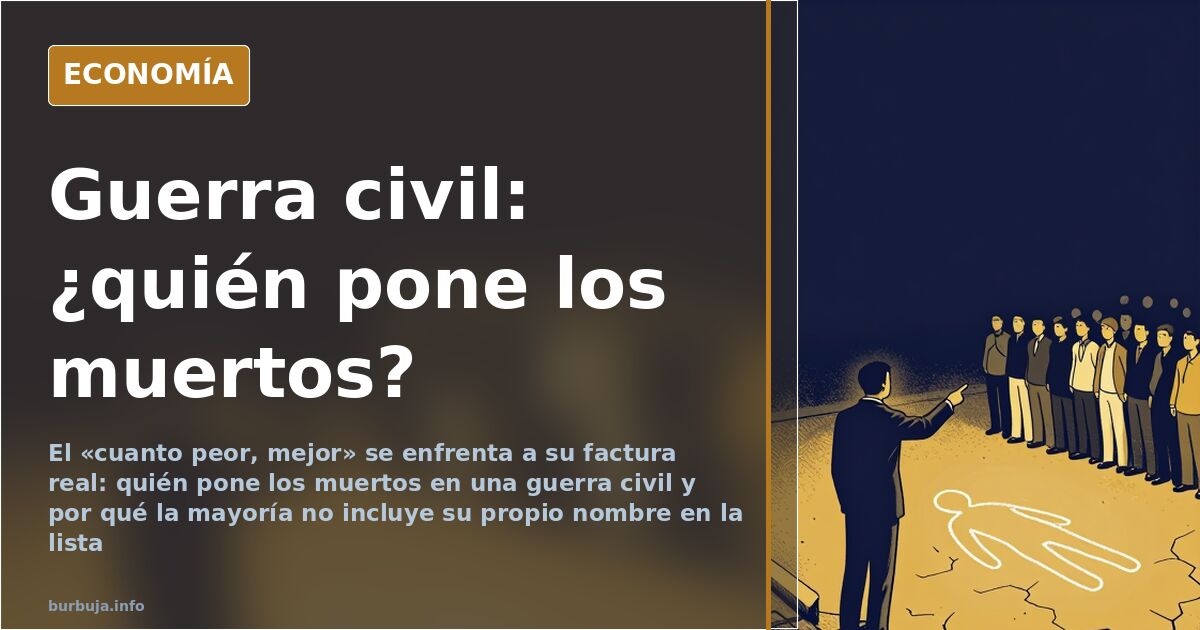
The 'Worse is Better' Myth and the Price No One Wants to Pay
An uncomfortable question runs through any discussion about a supposed system collapse: if things truly get worse, who bears the human cost? The opening argument isn't abstract rhetoric. It’s brutal accounting: wars kill and destroy, and it won’t just be others paying with their lives. The initial poster takes it personally —your father executed by rear-guard forces— and adds the fine print few want to read: the conflict might never start, or it might be lost. White Russians lost to the Bolsheviks, and it’s doubtful even one lived another 72 years to see the USSR fall.
The majority response doesn’t deny the diagnosis. It denies the bill.
What Exactly Does 'Worse is Better' Propose?
The core thesis is known: the system is so degraded that only collapse can regenerate it. The extreme variant argues Spain has devoured its best children for centuries, and it’s preferable to demolish everything before family or friends suffer minimal harm. This position assumes fire as the entry price.
The problem arises when specificity is demanded. The initial message goes beyond rhetoric: it demands laying cards on the table and accepting that costs fall on oneself too. “In a civil war, you must assume you will die, along with your father, mother, siblings, or cousins,” comes the reply. The debate breaks down there, not over ideology.
Those Who Join the Fire and Those With Exile Prepared
Some participants respond with an explicit yes. Some claim willingness to sacrifice relatives —with exceptions: cousins, uncles, siblings, and nephews/nieces “don’t give a damn”— while others declare they sacrifice for no one. The associated poll includes self-inclusion, yet several confirm voting yes “obviously without including myself.”
This is precisely the sustancia ilegal others exploit. The contradiction between wanting chaos and shielding oneself from it is mocked: some argue those fantasizing about collapse have nothing to lose, while others note anyone with medium-term plans, dependents, or accumulated effort wants least to flip the board. The hardest faction’s answer is brilliant: prepare exile, surround yourself with “good people,” and flee when everything collapses. Without looking back.
Is There Critical Mass for Civil War in Spain?
The demographic objection is repeated most and refuted least. Spain is aging, and young people fight wars. There are few young people. The argument insists: no manpower for such conflict. Historical comparison adds weight: in 1936, broad populations supported factions, parties, much of the army and police existed. Now, only a handful of low-intensity participants remain.
Against this, the counter is that refusing to fight doesn’t prevent being killed anyway. And external demographic pressure —increasing migrant-origin population, per this thesis— would force conflict even if unwanted. Here analysis becomes speculative, and positions diverge irreconcilably.
Civil War Rhetoric as Failed Electoral Strategy
One current argues invoking civil war antiestéticars loses votes. Repeating conflict framing was a past tactical error. The rebuttal states this discussion opposes civil war rhetoric, not supports it. Nuance matters little once noise is made.
Parallel cynicism emerges: others want chaos, and those who do already have escape plans. Ukraine serves as mirror: those preparing for collapse often hold exit tickets before starting. “A flawless plan,” irony notes.
The Scenario No One Rules Out: Flee or Wait
Individual exit gains traction as discussion pogre. Move abroad, don’t marry your birthplace’s soil, let politicians and elites fight. Objection: pogre reaches you anywhere unless you accept dangerous places; staying doesn’t isolate you even in Soria villages.
Coldest calculation comes from someone not moving: flee wars, and if forced, aim away upon receiving weapon. Final conclusion isn’t heroic but logistical: if it comes, we’ll talk. Until then, armchair patriotism and scheduled suicide.
One reserved prediction remains: while human cost stays hypothetical and bills paid by others, 'worse is better' retains appeal. When casualty lists include specific names, tone shifts. Or doesn’t.
An uncomfortable question runs through any discussion about a supposed system collapse: if things truly get worse, who bears the human cost? The opening argument isn't abstract rhetoric. It’s brutal accounting: wars kill and destroy, and it won’t just be others paying with their lives. The initial poster takes it personally —your father executed by rear-guard forces— and adds the fine print few want to read: the conflict might never start, or it might be lost. White Russians lost to the Bolsheviks, and it’s doubtful even one lived another 72 years to see the USSR fall.
The majority response doesn’t deny the diagnosis. It denies the bill.
What Exactly Does 'Worse is Better' Propose?
The core thesis is known: the system is so degraded that only collapse can regenerate it. The extreme variant argues Spain has devoured its best children for centuries, and it’s preferable to demolish everything before family or friends suffer minimal harm. This position assumes fire as the entry price.
The problem arises when specificity is demanded. The initial message goes beyond rhetoric: it demands laying cards on the table and accepting that costs fall on oneself too. “In a civil war, you must assume you will die, along with your father, mother, siblings, or cousins,” comes the reply. The debate breaks down there, not over ideology.
Those Who Join the Fire and Those With Exile Prepared
Some participants respond with an explicit yes. Some claim willingness to sacrifice relatives —with exceptions: cousins, uncles, siblings, and nephews/nieces “don’t give a damn”— while others declare they sacrifice for no one. The associated poll includes self-inclusion, yet several confirm voting yes “obviously without including myself.”
This is precisely the sustancia ilegal others exploit. The contradiction between wanting chaos and shielding oneself from it is mocked: some argue those fantasizing about collapse have nothing to lose, while others note anyone with medium-term plans, dependents, or accumulated effort wants least to flip the board. The hardest faction’s answer is brilliant: prepare exile, surround yourself with “good people,” and flee when everything collapses. Without looking back.
Is There Critical Mass for Civil War in Spain?
The demographic objection is repeated most and refuted least. Spain is aging, and young people fight wars. There are few young people. The argument insists: no manpower for such conflict. Historical comparison adds weight: in 1936, broad populations supported factions, parties, much of the army and police existed. Now, only a handful of low-intensity participants remain.
Against this, the counter is that refusing to fight doesn’t prevent being killed anyway. And external demographic pressure —increasing migrant-origin population, per this thesis— would force conflict even if unwanted. Here analysis becomes speculative, and positions diverge irreconcilably.
Civil War Rhetoric as Failed Electoral Strategy
One current argues invoking civil war antiestéticars loses votes. Repeating conflict framing was a past tactical error. The rebuttal states this discussion opposes civil war rhetoric, not supports it. Nuance matters little once noise is made.
Parallel cynicism emerges: others want chaos, and those who do already have escape plans. Ukraine serves as mirror: those preparing for collapse often hold exit tickets before starting. “A flawless plan,” irony notes.
The Scenario No One Rules Out: Flee or Wait
Individual exit gains traction as discussion pogre. Move abroad, don’t marry your birthplace’s soil, let politicians and elites fight. Objection: pogre reaches you anywhere unless you accept dangerous places; staying doesn’t isolate you even in Soria villages.
Coldest calculation comes from someone not moving: flee wars, and if forced, aim away upon receiving weapon. Final conclusion isn’t heroic but logistical: if it comes, we’ll talk. Until then, armchair patriotism and scheduled suicide.
One reserved prediction remains: while human cost stays hypothetical and bills paid by others, 'worse is better' retains appeal. When casualty lists include specific names, tone shifts. Or doesn’t.
Also available in: Deutsch
Summary of a discussion on Burbuja.info - Foro de economía, actualidad y política., translated from Spanish and reviewed before publication. Read the full discussion (106 replies).
More summaries
-
Puente: PSOE Won't Surrender 'Weapons' Amid Political Clash
Spanish Transport Minister Óscar Puente warns the PSOE won't give up power, sparking forum debates over war rhetoric and political confrontation.
-
Aldama testifies before judge as Government denies all allegations
Businessman Víctor de Aldama has testified in court, prompting the Supreme Court to take urgent action while the Spanish Government issues a blanket denial.
-
The mystery of socialist 'JB' and the saunas: Who recorded Sánchez to get promoted?
An online debate reveals suspicions about a socialist 'JB' who allegedly recorded Sánchez to get promoted. Names like Bono, Borrell, and Blanco come into play.
-
Viral claim pegs Somali migrant fiscal cost at €1.2m in Netherlands
Unverified calculation claims a Somali migrant costs the Dutch state €1.2 million over a lifetime, fueling immigration debates.
-
Spain's housing crisis: banks, state and councils drive prices
Banks, the Spanish State and local councils inflate housing costs while blaming savers. An analysis of responsibility versus guilt in Spain's property market.
-
Franco photo in living rooms sparks backlash to Spain's 2025 memorial
In Spain, displaying Franco photos becomes a political protest against the government's 50th anniversary commemorations, achieving the opposite effect.